


If you’ve been searching for a straight answer to this, here it is: yes, foreigners can register a company in Ireland.
You don’t need to be an EU citizen, you don’t need a visa, and you don’t even need to have set foot in the country. Thousands of non-resident founders from Bangalore to Lagos to São Paulo do exactly this every year.
But “yes” is where most articles stop, and it’s exactly where the real questions start. Can you actually be a director without living there?
Do you need a visa at some point? And what changed in 2026 that older guides won’t tell you about? Let’s go through it properly.
Can Foreigners Register a Company in Ireland? (Quick Answer)
There’s no citizenship or residency requirement to own or register an Irish company — anyone, from anywhere, can be a shareholder.
The part that trips people up is directorship: Irish law wants at least one director connected to the EEA, and if you don’t have that, you’ll need a workaround (more on this shortly).
Here’s the distinction that resolves most of the confusion: registering and owning a company is not the same as living or working in Ireland.
You can set up an Irish LTD from your laptop in Mumbai and never need a visa for it. You’d only need one if you decided to actually move there and work day-to-day in the business.
Who Counts as a "Foreigner" for Irish Company Registration?
Not all foreigners are treated equally here, and this matters more than most guides let on.
If you’re an EU or EEA national, you’re in the easy lane. You can be a director with zero extra paperwork, no bond, no visa conversation.
If you’re a non-EEA national which covers most Indian, US, UK (post-Brexit), Middle Eastern, and Asian founders you’re in a different bucket.
You’ll either need an EEA-resident director on your team or a specific bond to cover the gap, which we’ll unpack shortly.
One thing that surprises people: this is about where you live, not what passport you hold. An Irish citizen who’s spent the last five years in Dubai is legally “non-EEA resident” here.
EEA residency means spending 183+ days a year physically inside an EEA country citizenship doesn’t override that.
Do You Need to Live in Ireland to Register a Company?
No. This is genuinely one of the more founder-friendly systems in Europe. You don’t need to visit Ireland, rent an office, or hire local staff to get a company on the books.
What you do need is a registered office address in the country, a real physical address, not a P.O. box where official correspondence can legally be sent.
Most non-resident founders use a company secretarial or virtual office provider to handle this.
The distinction worth holding onto: registering remotely is straightforward. Operating remotely hiring, invoicing, and dealing with tax still requires you to plug into the local system properly, even if you’re never physically there.
It’s less “I moved to Ireland” and more “I now have a compliance calendar to keep up with.”
Director Residency Requirements for Non-EEA Founders
Irish company law requires at least one director to be resident in the EEA. If none of your directors qualify, you have two realistic options:
Option 1: Appoint an EEA-resident director. This could be a co-founder, a trusted contact, or a professional nominee director service.
The trade-off is that you’re adding a person with legal responsibilities to your board worth thinking through carefully, especially with a nominee.
Option 2: Take out a Section 137 bond. This is the more common route for solo non-EEA founders, and it’s also the most misunderstood part of the entire process.
The bond provides a fixed amount of coverage in case your company gets hit with fines for things like late filings — but here’s the part that trips people up: the coverage figure is not what it costs you.
The actual premium is a small fraction of that amount, valid for a two-year term.
A practical example: say you’re a founder in Chennai setting up an Irish LTD to sell software into the EU, and none of your co-founders live in Europe.
You’d take out the bond before incorporation. It needs to be in place from day one, not added after and once it’s issued, you’re compliant for two years.
After that, you renew it, bring on an EEA-resident director, or apply for a “real and continuous link” exemption if your company has built up genuine employment and presence in Ireland by then.
Skipping the bond isn’t really an option if you don’t have an EEA director the CRO will reject your filing without it.
Not sure if you need an EEA director or a bond?
Talk to a Vorx specialist and we’ll tell you which route fits your situation in one call — no obligation.
Contact Vorx Consultancy →
Requirements to Register a Company in Ireland as a Foreigner
Once the director question is sorted, the rest of the requirements are refreshingly standard:
- At least one director (any nationality, subject to the EEA rule above)
- A company secretary — can be the same person as your director if you have two or more directors, but a sole director must appoint someone else
- At least one shareholder — no nationality or residency restriction
- A registered office address in Ireland
- A company name cleared through the Companies Registration Office (CRO)
None require you to be Irish, EU-based, or physically present; the paperwork is the same whether you’re incorporating from Dublin or Dubai. It’s only the director residency piece that changes your path.
Read this blog: Ireland Company Formation Requirements: What Do You Need to Start a Company? (2026)
Choosing a Business Structure as a Foreign Founder
For most foreign founders, the answer is a Private Company Limited by Shares (LTD) — the default structure in Ireland, with limited liability, straightforward setup, and it’s what banks and investors expect to see.
There’s also a Designated Activity Company (DAC), generally used for regulated activities, but unless you’ve been specifically advised otherwise, LTD is the right call.
If you’re expanding an existing foreign company rather than starting fresh, consider registering a branch (an “external company”) instead of a new subsidiary.
A branch isn’t a separate legal entity, it’s an extension of your existing company so your parent company carries full legal responsibility for everything the branch does.
Most first-time founders are better off with a straightforward LTD subsidiary; branches suit established companies testing the Irish market first.
Read This Blog: Ireland LTD vs Sole Trader: Which Business Structure Is Best for Foreign Entrepreneurs?
Documents Required for Non-Resident Company Registration
You’ll need the basics: passports or ID for all directors and shareholders, proof of address, and confirmation of your registered office.
If you’re going the bond route, you’ll also need your Section 137 documentation sorted before filing.
The part that’s changed recently is identity verification with the CRO itself. If you have a PPS number (unlikely for most non-residents) or an RBO number, you use that.
If you have neither, you’ll need an Identified Person Number (IPN), applied for through a Verification of Identity Form (VIF).
As of 30 April 2026, the CRO tightened how this form gets witnessed. Previously, some remote witnessing was accepted; now, the VIF must be witnessed in person, with the witness and the person signing physically in the same room, over concerns about the integrity of online witnessing.
If you’re a non-resident founder without a PPS number, plan around this; it usually means booking time with a notary or solicitor rather than handling it entirely online.
Most formation agents can coordinate this for you, but it’s no longer a same-day digital step.
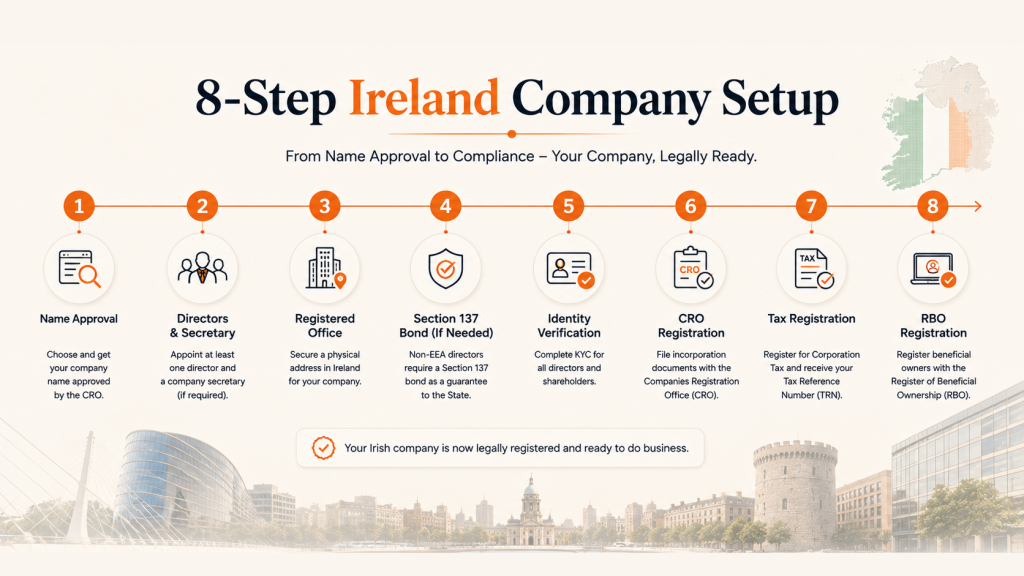
Step-by-Step Registration Process for Foreigners
- Choose your company type and name, then run a name check with the CRO
- Appoint your director(s), secretary, and shareholders
- Arrange your registered office address in Ireland
- Secure a Section 137 bond, if you don’t have an EEA-resident director
- Complete identity verification — PPS number, RBO number, or IPN via VIF
- File your incorporation documents (Form A1) with the CRO through Core.ie
- Register for tax with Revenue — corporation tax at minimum, plus VAT and employer registration if hiring
- File your RBO return within five months of incorporation — a separate filing from incorporation itself, and missing it carries real consequences
Most non-resident registrations, once documents are in order, take roughly 5–10 working days for CRO processing. Identity verification is usually what adds time if it’s not sorted in advance.
Read this Guide: How to Register a Company in Ireland: Complete 2026 Guide
Tax Implications for Non-Resident Company Owners
Ireland’s 12.5% corporate tax rate on trading income is one of the country’s biggest draws, and it applies regardless of where the owners live.
If you’re a non-resident director, though, there’s a wrinkle: Ireland taxes directors’ fees at source, no matter where you live or work from, often missed until Revenue flags it.
If your country has a double taxation treaty with Ireland and India included, that can reduce what you owe at home, but you’ll want proper documentation rather than assuming it applies automatically. Treat this as the headline version; it deserves its own dedicated read.
Opening a Business Bank Account as a Non-Resident
This is often the more practical sticking point, more than the legal registration itself.
Traditional Irish banks can be slow for non-residents and sometimes still expect an in-person visit for identity checks, which isn’t ideal if you’re not planning to travel.
Electronic Money Institutions like Wise Business or Revolut Business have become the realistic default for most non-resident founders, faster onboarding, entirely remote, and generally accepted by clients and suppliers without issue.
Have your incorporation documents, proof of address, and director ID ready in digital form, since that’s what most providers ask for upfront.
Moving to Ireland to Run Your Company (Visa Options)
Worth repeating: none of the above requires a visa. This section only applies if you want to physically relocate and run the business from Ireland yourself.
The main route for founders is the Start-up Entrepreneur Programme (STEP), aimed at people launching innovative, scalable businesses in Ireland.
It’s a separate application from company registration, with its own eligibility criteria around funding and business viability.
If you’re looking to work in Ireland more generally rather than found a qualifying startup, that’s a standard employment permit conversation instead of a different process entirely.
Common Mistakes Foreign Founders Make When Registering in Ireland
A few patterns show up again and again:
Assuming the bond costs as much as its coverage value. The coverage amount and the actual premium are two different things.
Missing the RBO filing deadline. It’s separate from incorporation, and the five-month window catches people off guard.
Treating the registered office as a mailbox with nothing behind it. You need an actual service that forwards and manages correspondence.
Not planning for the 2026 in-person VIF requirement. Without a PPS number, budget time for this — it’s no longer a same-day online step.
Forgetting that owning ≠ living there. Founders sometimes delay registration waiting on visa plans that were never actually required.
How Vorx Consultancy Can Help
Reading through all of this is one thing: actually getting a Section 137 bond issued, an IPN verified, and a Form A1 filed correctly on the first try is another.
This is where most non-resident founders lose time, not because the rules are unclear, but because a small mismatch (a name that doesn’t match your passport exactly, a bond arranged too late, a VIF witnessed the wrong way) sends the whole filing back to the start.
At Vorx Consultancy, we handle non-resident company registration in Ireland end-to-end: name clearance, Section 137 bond arrangement, registered office and company secretary services, identity verification (including the 2026 in-person VIF process), CRO filing, RBO registration, and post-incorporation tax setup.
If you’re an Indian entrepreneur, NRI, or non-EU founder registering an Irish company remotely, we manage the pieces that are easiest to get wrong so your filing goes through clean the first time.
Conclusion
So, can foreigners register a company in Ireland?
Yes, without needing EU citizenship, a visa, or a single trip to the country.
What actually decides how smooth the process is comes down to a handful of specifics: whether you have an EEA-resident director or need a Section 137 bond, whether your identity verification is sorted before you file, and whether you understand what registering a company does (and doesn’t) commit you to.
None of it is complicated once you know the sequence. It’s mostly a matter of getting the order right, bond before incorporation, identity verification before filing, RBO within five months after and not assuming a rule from an older guide still applies in 2026.
If you’d rather have someone handle that sequencing for you, Vorx Consultancy can take it from name check to fully registered company, wherever in the world you’re starting from.
Still comparing options?
Get a free, no-obligation breakdown of exactly what your Irish company registration will involve based on your residency status.
Contact Vorx Consultancy →
