

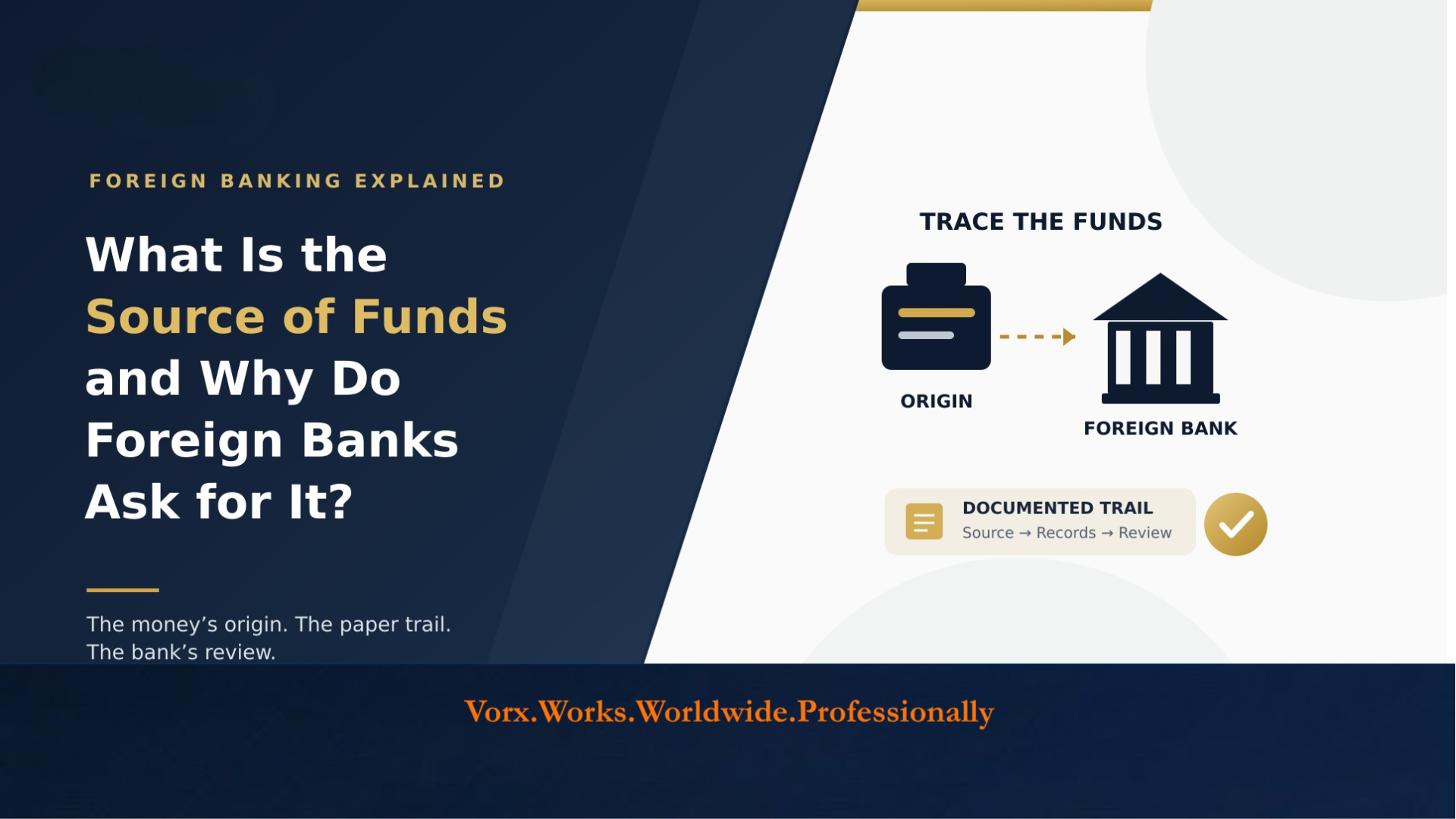
You have registered a company abroad and are ready to deposit money into its bank account. Then the bank asks for proof of your source of funds. You know the money is yours, so why does it need more information?
For a business owner, the frustrating part is often that the money is already visible in a bank statement. But the statement may show only where a transfer came from, not how the money was originally earned. Foreign banks need to connect those two parts of the story. This guide explains what they look for, which documents can help and how to respond when the trail is less straightforward.
What Is the Source of Funds?
Source of funds is the origin of the particular money involved in a transaction. It might be income from clients, savings from employment, proceeds from selling property or a documented business loan.
Saying “the money came from my Indian bank account” describes the transfer route. It does not necessarily explain how you obtained it. If the amount came from years of business earnings, the bank may need records connecting those earnings to the funds you are transferring. This differs from the source of wealth, which describes how a person accumulated their overall assets.
Planning to do business abroad? Talk to Vorx: www.vorxcon.com
Why Do Banks Ask for a Source of Funds?
Foreign banks need to understand their customers and the transactions moving through their accounts. Source of funds checks form part of customer due diligence and help banks assess whether a payment is consistent with what they know about a person or business.
For example, regular payments from named clients may fit a consultancy’s stated activity. A substantial payment from an unrelated third party may need a closer explanation. Being asked for evidence is a normal part of banking; the request alone does not imply that you have done anything wrong.
Recommended Reading:
If you receive customer payments online, it also helps to understand the different roles of a merchant account and a business bank account when tracing how funds reach your business.
When Does a Bank Request the Source of Funds?
You may receive a request:
- While opening an account, when the bank asks how you will fund it and what payments you expect.
- Before or after a transfer, particularly if the amount or sender needs clarification.
- When activity changes, such as receiving payments from a new country or a party the bank did not expect.
- During an account review, when the bank updates its information about your business.
There is no universal amount above which every foreign bank asks the same questions. The level of review depends on the customer, transaction and bank’s risk assessment.
Planning to do business abroad? Talk to Vorx: www.vorxcon.com
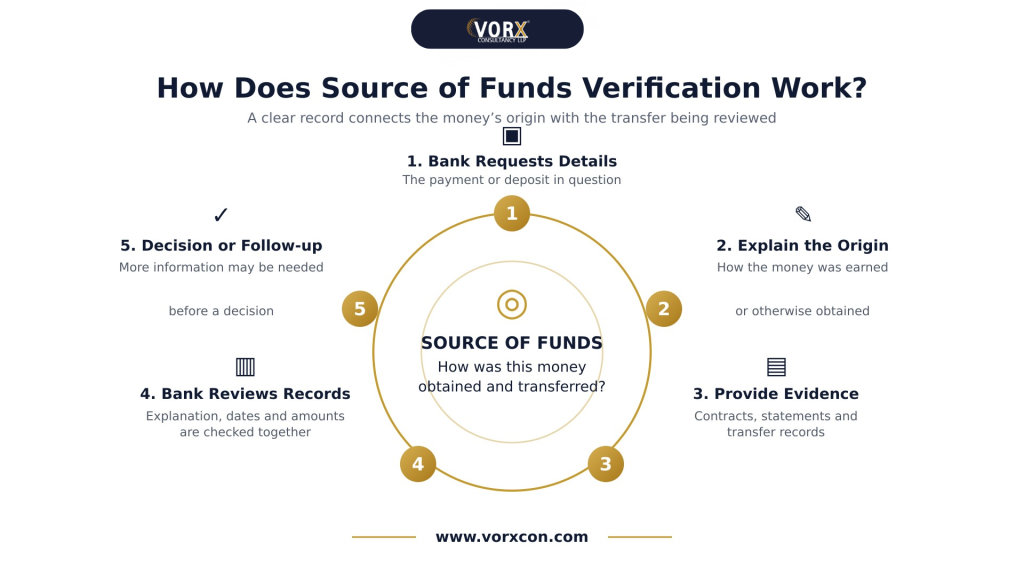
How Should You Respond to a Bank’s Request?
First, check which payment or balance the bank wants explained. A broad collection of documents can be less useful than a focused response that answers its question.
Then prepare a short explanation covering:
- The underlying source: Was the money earned from clients, saved from salary, borrowed or received from selling an asset?
- The people or businesses involved: Who paid whom, and why?
- The payment trail: Which accounts did the money pass through before reaching the foreign bank?
- The evidence: Which document supports each part of your explanation?
Make sure dates, names and amounts are consistent. If the bank’s request is vague, ask what it needs clarified before submitting further records.
Which Documents Can Show Source of Funds?
The documents depend on whose money is being checked and how that money was obtained. A foreign bank may ask for records showing both the original source and the transfer into the account.
Whose funds? | Source of funds | Documents that may support it |
Individual or company owner | Salary savings | Payslips or employment records, plus bank statements showing salary credits |
Individual or company owner | Property sale, investments, gift or inheritance | Relevant sale, investment, gift or estate records, plus statements showing receipt |
Founder funding a company | Personal savings or a business loan | Evidence of the original savings or a signed loan agreement, plus statements showing the transfer to the company |
Self-employed person | Client income | Business registration, client contracts or invoices, tax returns and bank statements |
Company | Client or business income | Contracts, invoices, records of completed work where applicable, and company bank statements |
Challenges Businesses Face When Verifying Source of Funds
For a business, money may pass through several accounts before it reaches a foreign bank. That can make a genuine transaction difficult to explain, especially when records are held by different people.
Common challenges include:
- Mixed personal and business funds: The owner funds the company, but records do not clearly explain the owner’s original source.
- Multiple client payments: The business cannot easily connect a transferred balance to its invoices and receipts.
- Related-company transfers: Money moves between group companies without clear agreements or supporting records.
- Incomplete records: A statement shows the latest transfer but leaves earlier steps unexplained.
The issue is often the missing link between how the money was generated and how it reached the account.
Planning to do business abroad? Talk to Vorx: www.vorxcon.com
What Happens If the Bank Cannot Verify the Funds?
The bank may ask more questions, delay or decline a payment, restrict account activity, or decide it cannot open or continue the banking relationship. The outcome depends on the facts and applicable requirements; an incomplete first response does not automatically lead to account closure.
If you cannot provide a requested document, explain why and ask whether another record would address the same point. Do not change your explanation simply to make it fit the paperwork.
Recommended Reading:
Choosing a provider for international payments? Our guide to digital banks and neobanks for international business payments can help you compare your options alongside their documentation requirements.
How Can You Minimize Bank Requests in the Future?
You cannot eliminate routine bank reviews, but you can make your transactions easier to understand:
- Keep contracts, invoices and corresponding payment records together.
- Document loans and transfers between owners and companies when they occur.
- Give the bank an accurate description of your business and expected payments.
- Update your account information when your activities change significantly.
Good recordkeeping will not prevent every question. It will help you answer one without having to reconstruct years of transactions.
How Vorx Can Help With Your Source of Funds?
A source of funds request often involves more than finding one document. An Indian founder funding an overseas company, for example, may need to connect personal income or business earnings to a transfer made through several accounts. A company receiving foreign client payments may need to match contracts and invoices with the amounts credited.
Vorx Consultancy helps business owners review that trail, identify missing records and put together a clear explanation for the bank’s questions. We can help you prepare for the review; the bank decides what evidence it will accept and whether to approve the account or transaction.
Make your foreign banking documents easier to prepare. Speak with Vorx Consultancy.
Book a Strategy Call: (Calendly Link)
Visit: www.vorxcon.com
Email: support@vorxcon.com
Final Thought
When a bank asks where your money came from, “my existing bank account” may be only the beginning of the answer. The useful question is: Could someone unfamiliar with your business follow the money from the activity that generated it to the payment under review?
If the answer is yes—and the documents support each step—you are in a stronger position to respond clearly. If there are gaps, find them before the bank has to ask.