

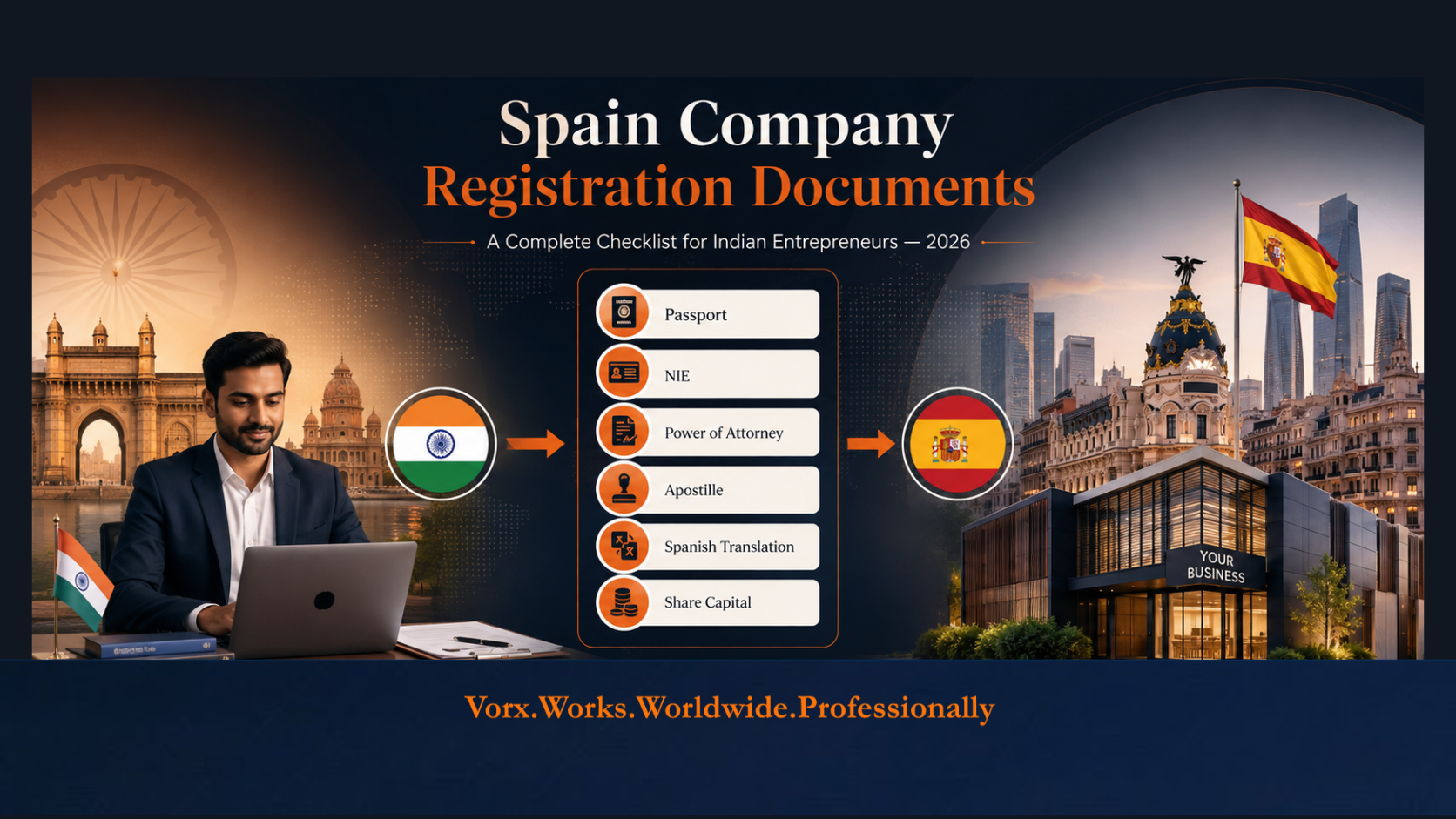
Spain has quietly become one of the more practical entry points into the European market for Indian founders EU market access, a well-defined company formation framework, and growing interest from Indian IT, consulting, trading, and F&B businesses looking to build a genuine European base rather than simply export to it.
But before any of that happens, there’s paperwork, and for an Indian entrepreneur, it carries a few extra layers. A Spanish or EU founder never has to think about authentication, translation, and identity documents that don’t exist back home in the same form.
This is why understanding Spain company registration documents for Indian entrepreneurs matters before anything else, not after you’ve already committed to a timeline.
This guide walks through exactly which documents you need for Spain company registration from India, why each one matters, and where Indian founders typically get stuck.
At Vorx Consultancy, we work with founders through this process regularly, and most of the delays we see aren’t caused by Spanish bureaucracy, they’re caused by documents prepared in the wrong order.
Why Document Preparation Matters More for Indian Founders
Every company registration process runs on documents, and Spain’s is well defined once the paperwork is in order.
The friction for Indian founders comes from one simple fact: Indian identity and corporate documents aren’t automatically recognised by Spanish authorities. They need to be authenticated and translated before they carry any legal weight in Spain.
This means an Indian entrepreneur should treat the documentation stage as its own project, separate from the actual registration steps. Getting it right upfront tends to save weeks later.
Overview: The Three Categories of Spain Company Formation Documents
It helps to think of the documents in three groups rather than one long list, because each group follows a different preparation path.
Category | Examples | Where the friction usually is |
Personal identity documents | NIE, passport, power of attorney | Getting an NIE from outside Spain |
Corporate formation documents | Name certificate, Articles of Association, bylaws | Drafting and notarising correctly |
Financial documents | Share capital certificate, bank confirmation | Opening an account as a non-resident |
Understanding which bucket a document falls into makes it easier to plan realistically, since personal identity documents almost always take the longest for someone applying from India.
Essential Documents Required for Company Registration
Here’s what actually goes into a Spanish company file, and why each piece matters for an Indian applicant specifically.
Company Name Certificate (Certificación Negativa de Denominación) Issued by the Registro Mercantil Central, this confirms your proposed company name isn’t already taken.
You provide a list of names ranked according to preference and the registry accepts the first one which is available.
Articles and Memorandum of Association set out the objectives of the firm, capital structure, and governance within the company. These documents are completed before the notary process starts.
Bylaws of Company (Estatutos Sociales) are quite similar to Articles and explain the working mechanism of the company.
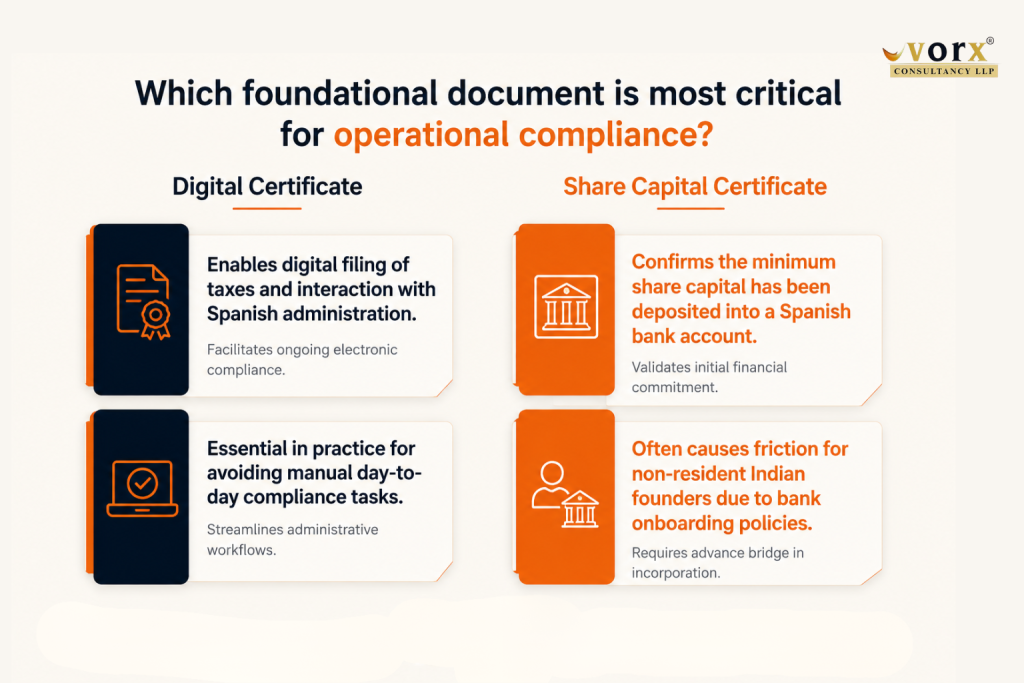
Share Capital Bank Certificate Confirms the minimum share capital has been deposited into a Spanish bank account before incorporation. This is one area where non-resident Indian founders often hit friction, since not every bank is equally comfortable onboarding a non-resident applicant at this early stage.
Shareholder and Director Identification A common misconception: an Indian PAN card or Aadhaar number has no legal standing in Spain.
What Spanish authorities actually require is an NIE (explained next) for every shareholder and director involved.
Tax Activity Declaration (Modelo 036) Registers the company’s economic activity with the Spanish tax authorities shortly after incorporation.
Digital Certificate (Certificado Digital) Rarely appears in generic checklists, but it’s essential in practice; it’s what allows the company to file taxes and interact with Spanish administration online. Without it, day-to-day compliance becomes far more manual.
UBO Declaration Spain, like most EU jurisdictions, requires disclosure of the Ultimate Beneficial Owner, the individual who ultimately controls or benefits from the company, distinct from the listed shareholders on paper.
What Is an NIE, and Why Does It Matter So Much?
The NIE (Número de Identificación de Extranjero) is a foreigner identification number, and it’s arguably the single most important document in this process for an Indian founder more important, in practical terms, than any corporate document.
Every shareholder and director needs one before the company can be formally incorporated. There are two ways to get it: applying in person in Spain, or through the Spanish consulate in India before you travel.
The consulate route tends to take considerably longer, so it’s worth starting well before you begin drafting corporate documents, not after.
It’s also worth distinguishing between the NIE (a personal identification number) and the NIF (the company’s own tax identification number, generated after incorporation).
Founders sometimes assume these are the same, they’re related, but not interchangeable.
Vorx Consultancy Insight: We generally advise clients to treat the NIE application as the starting gun for the entire process, not a parallel task. Everything else can move forward once it’s in motion, but very little can be finalised without it.
If you’re planning to set up a company in Spain from India, it also helps to understand the complete incorporation process.
Read our guide: Spain Company Formation Requirements 2026: A Complete Guide for Indian Entrepreneurs
Power of Attorney: Registering Without Travelling to Spain
Not every founder wants to fly to Spain to sit in front of a notary. A Power of Attorney (POA) allows a lawyer or authorised representative to sign incorporation documents on your behalf.
For this to hold up legally, the POA has to go through the same authentication chain as any other foreign document notarised in India, apostilled, and translated by a certified translator into Spanish.
Done correctly, it’s often the more efficient route for founders who want to keep the process moving without blocking out travel dates around a notary appointment.
The Apostille and Sworn Translation Process, Explained Properly
This is where most delays actually happen, and it deserves more attention than it usually gets.
India is a member of the Hague Apostille Convention, which means Indian public documents can be authenticated for use in Spain through an apostille rather than a longer consular legalisation process.
Once apostilled, most documents also need a sworn translation into Spanish, done by a translator officially authorised for the purpose.
A few details matter more than founders expect:
Sequence matters. The apostille has to be obtained first, and the translation done afterward not the other way around. Translating before apostilling is one of the most common mistakes we see.
Copies matter. The apostille needs to sit on the original document or a properly certified copy, never a plain photocopy.
Validity windows matter. Certain documents, such as police clearance certificates, are only valid for a limited period after issue.
If the apostille and translation process takes a few weeks, that validity window needs to be accounted for when planning your submission date.
None of this is complicated once you know it, but it’s rarely explained clearly, and it’s the reason a document set that looks complete on paper can still get rejected.
Step-by-Step: How the Process Comes Together
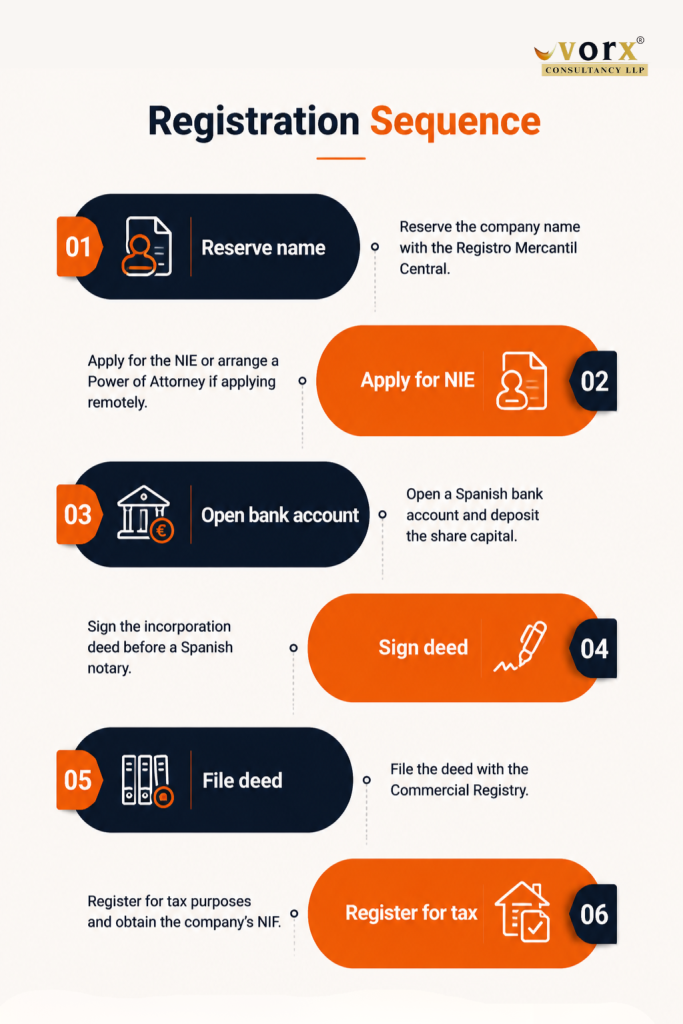
Once the individual documents are ready, the registration sequence generally looks like this:
- Reserve the company name with the Registro Mercantil Central
- Apply for the NIE (or arrange a Power of Attorney if applying remotely)
- Open a Spanish bank account and deposit the share capital
- Sign the incorporation deed before a Spanish notary
- File the deed with the Commercial Registry
- Register for tax purposes and obtain the company’s NIF
Each step depends on the one before it, which is why document preparation needs to happen well ahead of the notary appointment rather than alongside it.
Need Help With Spain Company Registration?
Preparing NIE, apostille, translations, incorporation documents, and registration paperwork can be challenging when you’re starting from India.
Planning to register a company in Spain? Contact Vorx Consultancy to get guidance on your company formation and documentation requirements.
Notarization Requirements
The Spanish notary (notario) plays a central role in authenticating Spanish company incorporation documents verifying the founders’ identity, confirming the accuracy of the incorporation deed, and formally recording the company’s creation.
Some documents can be notarised in India and then apostilled for use in Spain, while the final incorporation deed itself must be signed before a Spanish notary, either in person or through your representative under a Power of Attorney.
Timeline: What to Realistically Expect
Timelines vary depending on individual circumstances, document readiness, and current processing volumes, so treat any timeline as a general guide rather than a fixed promise.
Once documents are fully prepared, the core incorporation steps tend to move fairly efficiently.
The stage that most often extends the overall timeline is the NIE application, particularly when processed through a consulate rather than in person in Spain.
Tax Considerations Tied to Your Documents: The India-Spain DTAA
The Tax Activity Declaration you file isn’t just a formality; it connects directly to how your Spanish company will be taxed, including income flowing back to India.
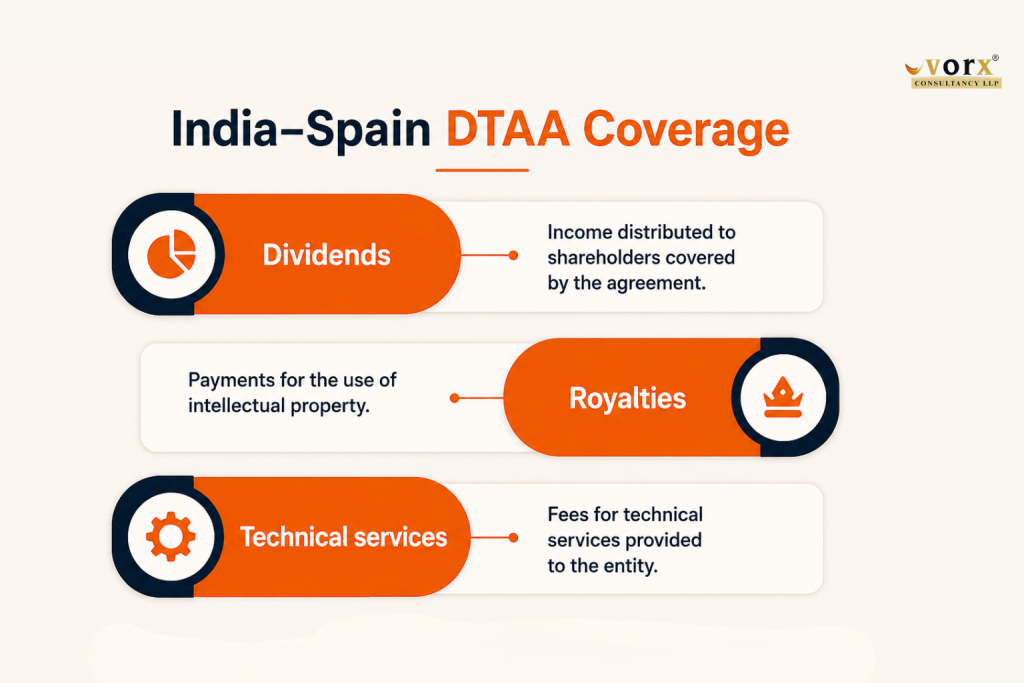
The India-Spain Double Taxation Avoidance Agreement exists to prevent the same income being taxed twice across both jurisdictions, covering areas like dividends, royalties, and fees for technical services.
This becomes particularly relevant if your Indian parent company plans to license intellectual property or provide technical services to the new Spanish entity, since treaty provisions can affect applicable rates.
That said, treaty benefits aren’t automatic, and the agreement includes limitation-of-benefits conditions that need proper assessment of a conversation worth having with a qualified tax advisor before the company structure is finalised, not after.
Spain Company Formation Requirements Specific to Indian Entrepreneurs
A few friction points come up consistently for Indian founders working through Spain company formation requirements:
Name formatting mismatches. Indian documents sometimes format names or titles differently than Spanish registries expect, causing avoidable back-and-forth.
Banking friction. Not all Spanish banks are equally set up to onboard non-resident applicants quickly, and some request extra documentation around source of funds.
Assuming Indian ID is sufficient. PAN, Aadhaar, and Indian passports establish identity in India; they don’t substitute for an NIE in Spain.
Common Documentation Mistakes to Avoid
- Translating a document before it’s apostilled
- Submitting a photocopy instead of a certified original for apostille
- Letting a time-sensitive document (like a police clearance certificate) expire before submission
- Underestimating how long a consular NIE application can take
- Forgetting the digital certificate and UBO declaration, since they’re rarely framed as “registration documents”
Ready to Start Your Spain Company Setup?
Get your documentation in the right order before moving ahead with incorporation.
Speak with Vorx Consultancy about your Spain company registration requirements.
Additional Licenses and Permits
Depending on your business activity, core Spain business registration documents alone may not be enough to start operating.
Sectors like food and beverage, import-export, financial services, and healthcare often require sector-specific licenses on top of the core incorporation paperwork worth identifying early, since some take longer to secure than the registration itself.
Final Thoughts
Registering a company in Spain isn’t especially complicated once you understand the sequence but for Indian entrepreneurs, the real work happens before the notary appointment, in getting documents authenticated, translated, and properly ordered.
Founders who move through this smoothly are usually the ones who treat the NIE and apostille process as the first milestone, not an afterthought.
At Vorx Consultancy, we help Indian founders map out this document sequence early, so registration becomes the straightforward part rather than the stressful one.
If Spain is part of a broader European expansion plan, it’s worth having that conversation before drafting any paperwork at all.
Planning to register a company in Spain from India?
Let Vorx Consultancy help you navigate the documentation, NIE, apostille, and incorporation process.