
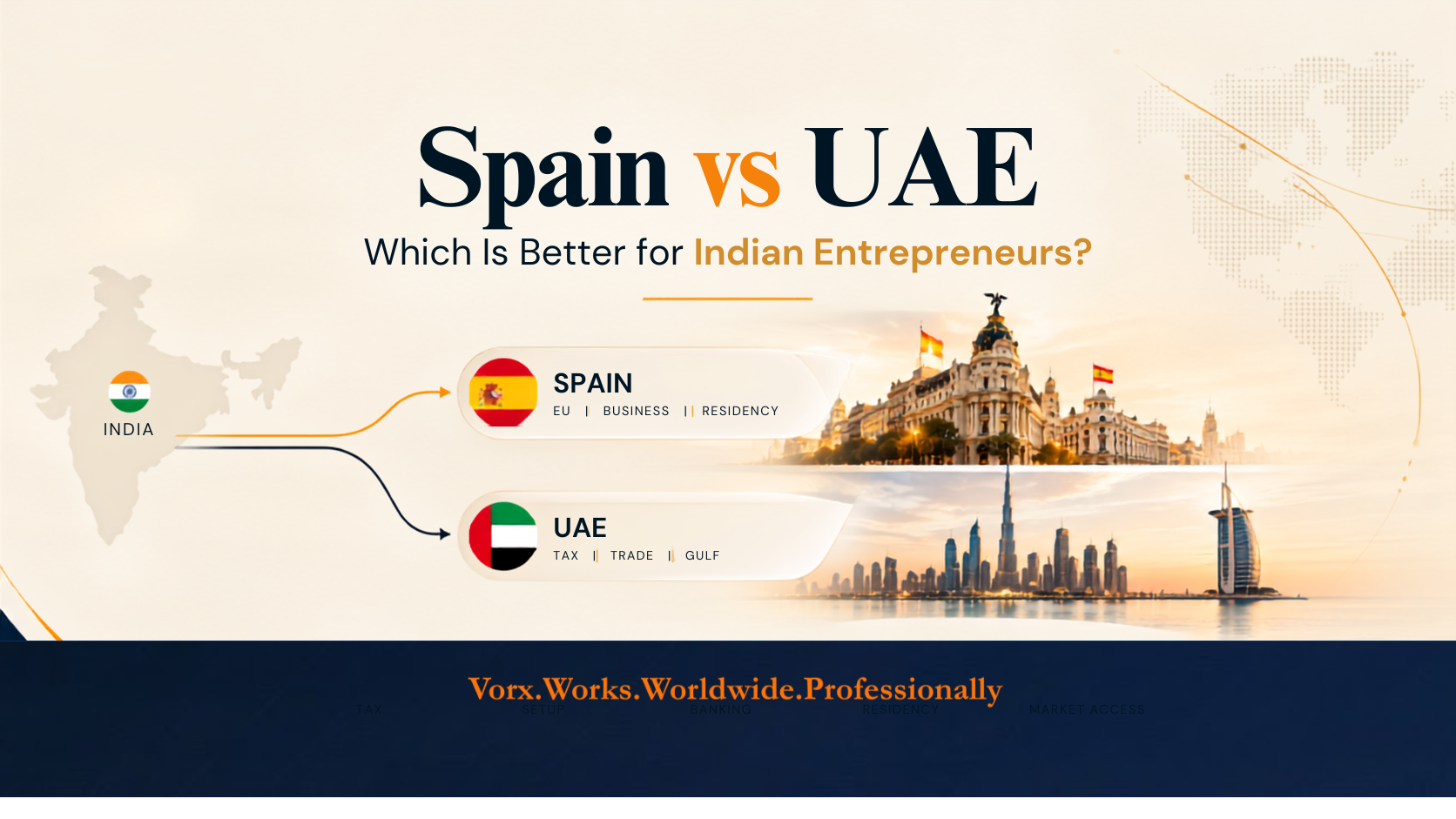
For Indian entrepreneurs looking beyond domestic markets, Spain and the UAE tend to come up early in the conversation, and for good reason. One opens the door to the European Union.
The other offers a low-tax, high-speed base with easy access to the Gulf, Africa, and South Asia. Both are genuinely attractive. Neither is automatically “better.”
The right answer depends on what you’re actually optimizing for: market access, tax efficiency, speed of setup, or a long-term residency pathway.
This guide walks through the practical differences that matter to Indian founders specifically, including a few compliance details most comparisons skip entirely.
Spain vs UAE: Quick Comparison
Factor | Spain | UAE |
Company Type | Sociedad Limitada (SL) | Mainland LLC / Free Zone |
Corporate Tax | Around 25% | 9% above AED 375,000 |
Personal Tax | Progressive | No personal income tax |
VAT | 21% | 5% |
Setup Time | 3–6 weeks | 3–10 working days |
Ownership | 100% in most sectors | 100% in most sectors |
Market Access | EU Market | GCC & MENA |
Residency | Selected visa routes | Investor & Golden Visa routes |
These figures move with policy changes in both jurisdictions, so treat them as a starting point for comparison rather than a final number to plan around.
How Does Company Formation Compare Between Spain and UAE?
Spain’s process runs through formal channels a tax ID, a notary, and the Mercantile Registry so Indian founders often find the paperwork slower than expected, especially with translation and apostille steps involved.
UAE’s process leans toward speed, with many free zones allowing the entire application to be handled remotely.
Neither process is inherently harder. Spain simply involves more institutional steps, while the UAE trades some of that structure for speed.
If your business needs a European legal identity for contracts, clients, or credibility, that extra process in Spain is often the point, not a drawback.
Formation Step | Spain | UAE |
ID Required | NIE | Establishment Card |
Key Documents | Passport, Deed & Apostilled Docs | Passport, Application & Business Plan |
Authority | Mercantile Registry | DED / Free Zone Authority |
Remote Setup | Limited | Often Available |
Timeline | 3–6 Weeks | 3–10 Working Days |
Read this guide: Spain Company Formation Requirements 2026.
Which Jurisdiction Offers Better Tax Treatment for Indian Founders?
Most comparisons stop at the headline rate, and that’s exactly where they fall short. The number that actually matters is what happens after profits are repatriated to India under the relevant DTAA, with Foreign Tax Credit relief available under Section 90 depending on the treaty terms and your residency status.
Here’s a simplified illustration. Suppose a founder, we’ll call her Priya, earns ₹1 crore in profit through a UAE free zone company taxed at 0% on qualifying income.
Once she repatriates that money to India as a resident Indian, it’s assessed under India’s rules on foreign income, and Schedule FA reporting applies regardless of how little tax was paid abroad.
A Spain-based SL, by contrast, pays corporate tax upfront but may see reduced withholding on dividends under treaty terms. The “cheaper” jurisdiction on paper isn’t always the one with more money landing in the founder’s account.
Vorx Consultancy Insight: Tax comparisons that stop at the corporate rate miss the part that actually affects an Indian founder’s net return. The repatriation and reporting layer deserves as much attention as the headline number.
Tax Factor | Spain | UAE |
Corporate Tax | Standard corporate tax applies | Corporate tax applies above the applicable threshold |
Personal Tax | Progressive | No personal income tax |
VAT | 21% | 5% |
DTAA with India | India-Spain DTAA | India-UAE DTAA |
India Tax Relief | Foreign Tax Credit | Foreign Tax Credit |
India Reporting | Schedule FA | Schedule FA |
Read this guide: Spain Corporate Tax Guide 2026.
What Should Indian Founders Know About RBI and FEMA Rules?
This part applies no matter which country you choose, and it’s often the piece founders discover too late.
Individuals typically remit under the RBI’s Liberalised Remittance Scheme, while companies generally use the Overseas Direct Investment route instead.
These requirements exist independently of Spain or UAE’s own rules, and missing the ongoing filings tends to create more friction than any foreign compliance requirement does.
Requirement | Individual (LRS) | Indian Company (ODI) |
Annual Limit | Applicable LRS limit | Applicable ODI limit |
TCS | As per applicable rules | Not under LRS |
Key Form | Form A2 | Form ODI |
Ongoing Filing | Tax Return Disclosure | Annual Performance Report |
Beyond Limit | Not Permitted | RBI Approval Required |
How Do Business Banking and Compliance Requirements Differ?
Opening a corporate account in Spain as a non-resident founder tends to take longer, while UAE banking has generally moved faster though scrutiny has tightened for entities without a clear physical operation.
A company that exists only on paper, without staff, an office, or real activity, may face more questions than one with visible substance.
Compliance-wise, neither system is lighter across the board. They’re just structured differently.
Aspect | Spain | UAE |
Bank Account | Often slower | Generally faster |
Annual Filing | Accounts & Tax Return | VAT & Bookkeeping |
Audit | Based on Company Size | Required for Many Entities |
Substance | EU Requirements | Relevant Activity Rules |
Ownership | Registry Disclosure | UBO Filing |
Read this guide: Spain Company Compliance Requirements in 2026
What Are the Residency Options for Indian Entrepreneurs?
Company ownership in either jurisdiction does not automatically grant residency.
It can, however, support an application under specific visa categories, and the pathways differ meaningfully Spain’s routes lean on income, savings, or an approved business plan, while UAE’s lean more directly on investment or ownership value.
One detail that rarely gets mentioned: your residency status changes how India taxes you. An NRI is not bound by the LRS limits that apply to resident Indians, and foreign income is treated differently once that status is established.
If residency is part of your long-term plan, it’s worth mapping out alongside the tax questions above rather than treating them separately.
Visa / Program | Country | Based On | Key Note |
Non-Lucrative Visa | Spain | Income / Savings | No Active Business |
Entrepreneur Visa | Spain | Business Project | Business Plan Required |
Digital Nomad Visa | Spain | Remote Income | Not Company-Based |
Investor Visa | UAE | Investment / Business | Category-Based |
Golden Visa | UAE | Investment / Eligibility | Long-Term Residency |
Which Market Gives You Better Business Access Europe or the Gulf?
Spain’s real advantage is the European Union itself, while UAE’s strength lies in its position as a trade and logistics hub connecting the Gulf, Africa, and South Asia.
For trading, re-export, and logistics-driven businesses, that geographic positioning is difficult to replicate elsewhere.
Neither market access advantage is universal. It depends entirely on where your customers, suppliers, or investors actually are.
Aspect | Spain | UAE |
Main Market | EU Market | GCC & MENA |
India Trade Link | EU-India Relations | India-UAE CEPA |
Best Sectors | E-commerce, SaaS, Consulting | Trading, Logistics, Re-export |
Key Advantage | EU Compliance Recognition | Sector-Based Free Zone Benefits |
So, Which Is Better: Spain or UAE?
Spain tends to suit founders building toward long-term EU presence or residency, even at a higher tax cost.
UAE tends to suit founders prioritizing speed, lower tax exposure, and Gulf-region access. The scorecard below breaks this down by priority.
Priority | Better Fit |
EU market credibility | Spain |
Lowest possible corporate tax | UAE |
Fastest incorporation | UAE |
Long-term EU residency goal | Spain |
Trading/re-export business model | UAE |
Regulatory recognition in Europe | Spain |
Zero personal income tax | UAE |
Spain or UAE? Choose Based on Your Business Goals
Before deciding on a jurisdiction, compare your market, tax structure, compliance needs, banking requirements, and residency plans. Vorx Consultancy can help you assess which option aligns better with your expansion strategy.
How Vorx Consultancy Helps Indian Entrepreneurs Choose the Right Jurisdiction
At Vorx Consultancy, we work with Indian founders who are weighing exactly this decision, and the honest answer is usually more nuanced than “Spain” or “UAE.”
It depends on where your revenue will actually come from, how you plan to move funds under RBI’s ODI and LRS rules, and whether residency is a genuine goal or a secondary benefit.
For Indian entrepreneurs, the key consideration isn’t just where incorporation is cheaper or faster.
It’s how the company structure, tax treatment, banking access, and residency pathway work together over the next several years, not just at the point of setup. We help founders map that full picture before committing to either jurisdiction.
Conclusion:
There’s no universal winner between Spain and UAE. Spain suits founders building a long-term European presence and willing to navigate more structure to get there.
UAE suits founders prioritizing speed, lower tax exposure, and Gulf-region access. The better question isn’t which country ranks higher on a comparison table, but which one matches your business model, your timeline, and how you plan to bring profits back to India.
If you’re still weighing the decision, it’s worth speaking with someone who can look at your specific situation, your target market, your capital, and your residency goals, rather than relying on a generic comparison alone.
Choosing the right jurisdiction starts with the right strategy.
Get expert guidance from Vorx Consultancy on company setup, tax considerations, banking, and residency pathways in Spain and the UAE.