
Incorporating a company is not a point where its responsibilities end, but rather the beginning. Once a company starts operating, it must deal with tax obligations, corporate filings, maintaining licence, meeting employee requirements and other responsibilities. Failing to meet even a routine obligation may result in unneeded expenses and complications.
Depending on a country, company type and industry, there are different sets of rules that a company must follow. However, in most cases they concern the same general set of rules. Understanding what responsibilities a company has allows it to develop a practical approach to compliance rather than simply reacting to each deadline and obligation as it appears.
What Does Business Compliance Mean?
Business compliance, in general, is a set of obligations imposed on a company by law and the system of controls designed to ensure a company meets all of its statutory obligations. Not only does it concern itself with the regular filings and payments, but also the internal controls and documentation needed for a company to operate lawfully.
For multinational or large-scale businesses that have to operate under the rules of several countries the problem may be significantly more complex, requiring careful analysis to ensure that all requirements are followed. It is crucial for such companies to understand what requirements they have, rather than trying to follow a generic set of rules.
Planning your next business move? Connect with Vorx Consultancy for expert guidance. Contact us
Recommended Reading:
For a practical overview of key compliance areas to consider before and after incorporation, read our compliance checklist for registering a company abroad.”
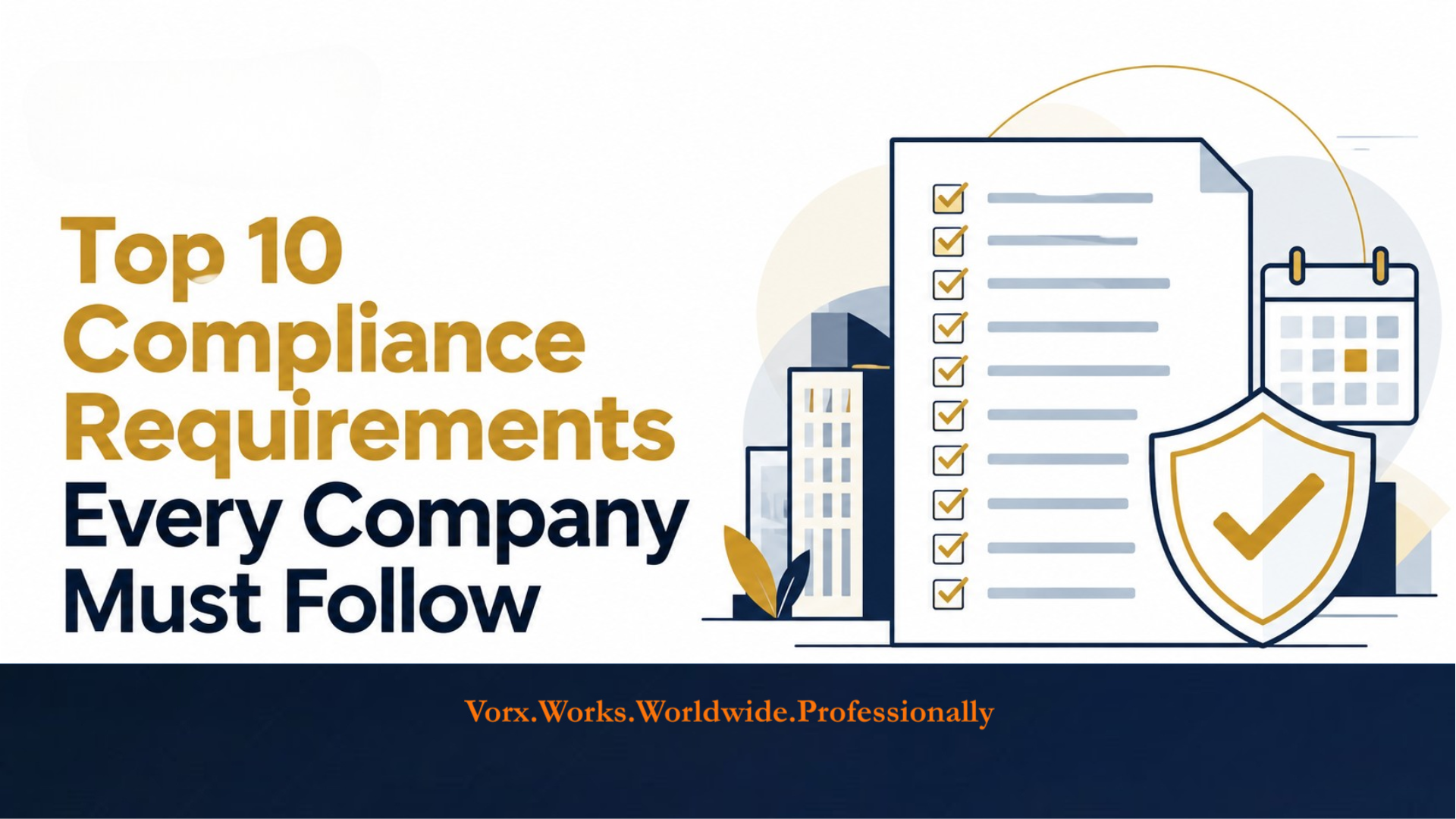
Top 10 Compliance Requirements Every Company Must Follow
1. Corporate & Statutory Filings
Once a company has been incorporated it must adhere to the filing requirements in the jurisdiction where it is established, for example its annual return, financial statements and any other information on its corporate structure.
Why It Matters
Statutory filings allow a business to remain in good standing and ensure its records are correctly filed. They are often reviewed as part of an audit, banking arrangement, investment and/or corporate due diligence.
Key Obligation
The company must maintain a record of filing deadlines and complete all returns and relevant supporting documentation by the due date. Changes to the composition of the board of directors, shareholders, registered office or similar should be filed with the appropriate authority if required.
2. Tax Registration & Returns
Tax obligations begin with identifying which taxes apply to the company and when registration becomes necessary. Depending on the jurisdiction and business activity, this may involve corporate tax, VAT or GST, withholding tax and other applicable taxes.
Why It Matters
Tax compliance directly affects the company’s financial position. Incorrect returns, missed registrations or late payments can result in penalties and may create problems during tax reviews or cross-border transactions.
Key Obligation
Keep tax registrations, calculations, supporting records and filing deadlines under regular review. Tax returns should reflect the company’s actual financial activity, with appropriate documentation retained to support reported figures.
3. Accounting & Financial Records
A company must maintain its accounting and financial records to support its tax position, decision-making process and statutory filing requirements. It must show clearly its income and expenditure, and details of its balance sheet items (assets, liabilities and finance transactions).
Why It Matters
Poor record-keeping can hinder its ability to provide information during an audit or due diligence, and could lead to errors in its tax and statutory reporting.
Key Obligation
It must maintain proper records (e.g. books of account, invoices, banking information, expense records) that are consistent with the accounting records for the period required by law. These should be reflective of the company’s actual transactions.
4. Business Licences & Permits
A company may need more than its basic incorporation or business registration to operate legally. Specific activities, locations and industries can require additional licences, permits or regulatory approvals.
Why It Matters
A business can be properly incorporated and still operate outside the scope of its authorised activities. An expired or unsuitable licence can interrupt operations and may expose the company to regulatory action.
Key Obligation
Review whether the company’s current licences cover its actual activities and monitor renewal dates. Any expansion into a new activity or market should trigger a check for additional approvals.
5. Employment & Labour Compliance
A company must meet its legal obligations when it hires employees including, potentially, employment contracts, payroll, terms and conditions of employment, statutory benefits, leave entitlements and employee records (depending on the applicable local labour laws).
Why It Matters
Non-compliance with employment regulations can be costly (e.g. incorrect payroll or benefits) and effective documentation helps to resolve disputes about employment matters.
Key Obligation
The company should keep employee contracts and payroll information accurate and up to date, and review its employment practices if there are changes to labour laws.
6. Data Protection & Privacy
A business typically collects personal information from various stakeholders (e.g. customers, employees, suppliers). Depending on the jurisdictions in which it operates and where individuals are based, differing levels of compliance with data protection laws may be required.
Why It Matters
Data protection is not simply about having a privacy policy on a company’s website, but understanding what information it collects, why it collects it, who has access to it, and how it is stored and retained.
Key Obligation
Where required, appropriate controls should be in place to govern collection, access, storage and deletion of personal data. If applicable, companies should also retain records of data processing activity and consent.
7. Industry-Specific Regulations
Depending on the nature of a company’s business it may be subject to additional regulations specific to the products or services it sells or uses. Regulated sectors include, among others, financial services, healthcare, food, pharmaceuticals and certain technology activities.
Why It Matters
Compliance with broader company laws does not automatically mean that a firm is compliant with industry-specific regulations. Regulatory gaps in such areas could affect a company’s ability to operate in a particular sector or provide certain services.
Key Obligation
The company must identify the relevant regulating bodies and their requirements in relation to its industry. Prior to offering specific products, services and/or regulated activities, a firm should ensure that any additional approvals, reporting requirements or controls are in place.
8. Intellectual Property Compliance
A company must manage its own and its stakeholders’ intellectual property rights (IPR) and ensure that appropriate protection is in place for its own IPR (e.g. trademarks, patents) and that it does not infringe any third parties’ IPR.
Why It Matters
IPR can provide significant commercial value and it is crucial to ensure that a company’s ownership of IPR is protected. A lack of clarity on ownership or unregistered IPR can prevent future commercial exploitation and raise disputes.
Key Obligation
Ownership records and registrations must be well maintained and documented, particularly in relation to trademarks, patents and other protectable assets. Where relevant, employee, development and vendor contracts should clearly identify ownership of materials and work provided.
9. Cybersecurity & Information Controls
As businesses rely on technology and digital solutions for more parts of their operations, the safeguarding of business information becomes part of compliant management practices. This includes customer, financial, employee and other confidential information.
Why It Matters
A cybersecurity incident could lead to disclosure of sensitive information and business interruption. This risk can be heightened if a company shares access to systems, data or information with third-parties such as vendors, suppliers or employees.
Key Obligation
Appropriate access controls, authentication procedures, back-ups and other security measures should be in place according to the type of information a company stores and processes. Physical and digital access to systems and information should be monitored, particularly when departing employees or external service providers have access.
10. Ongoing Compliance Monitoring
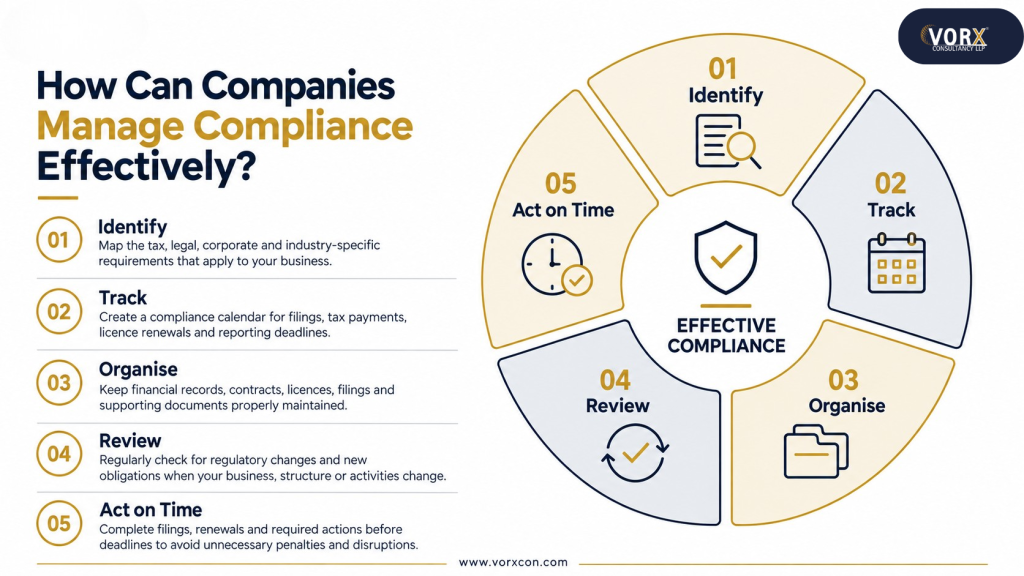
A company must not only complete the compliance obligations applicable at a point in time, but must also monitor new requirements, deadlines and obligations arising from changes in its business activity.
Why It Matters
A company can easily become non-compliant if it fails to update its practices in line with a change in requirements or its own business needs. Monitoring allows a firm to identify upcoming requirements ahead of time.
Key Obligation
A centralised compliance monitoring calendar should be maintained to ensure that all filing, tax, licensing and other requirements are completed on time. Responsibility for each task should be assigned and a company should regularly verify that its compliance programme reflects its current requirements.
Recommended Reading:
Businesses operating across borders can also explore our International Tax Planning Guide for a broader view of tax compliance and planning.
What Happens When a Company Misses a Compliance Requirement?
The consequences depend on the nature of the obligation and the jurisdiction involved. Depending on the situation, a company may face:
- Late filing fees or financial penalties
- Interest on outstanding tax or statutory payments
- Licence or registration complications
- Regulatory investigations or enforcement action
- Delays during banking, investment or due diligence processes
Not every compliance error carries the same consequence, which is why businesses should address missed obligations promptly rather than allowing them to accumulate.
Planning your next business move? Connect with Vorx Consultancy for expert guidance. Contact us
How Vorx Can Help With Corporate Compliance?
It becomes much easier to ensure a company has compliance with filings, tax and regulatory requirements if a systematic approach is taken to address them all. Vorx Consultancy helps businesses by managing their ongoing compliance requirements in different jurisdictions effectively.
- Tax & Accounting Compliance: Tax registration, tax filings, accounting support and annual reporting requirements.
- Licence & Regulatory Compliance: Business licence renewals, regulatory requirements and jurisdiction-specific compliance support.
- International Compliance Support: Cross-border corporate compliance, reporting requirements and ongoing obligations for international businesses.
- Corporate & Statutory Compliance: Annual filings, corporate records, regulatory submissions and ongoing company maintenance.
Stay compliant. Stay focused on your business. Connect with Vorx Consultancy for professional corporate compliance support.
Book a Strategy Call: (Calendly Link)
Visit: www.vorxcon.com
Email: support@vorxcon.com
Final Thoughts
Organizations should incorporate compliance within their processes and strategy, not as an administrative function for which they have to scramble to find answers when a deadline approaches. Corporate, tax accounting, licensing, employment, and industry-specific regulations are areas where companies have to deal with compliance matters on a daily basis.
Therefore, the best approach would be to know what needs to be complied with, who is responsible for it, and incorporate it into the regular processes by having a review of deadlines and records. By having the right compliance management process in place, companies can avoid regulatory pitfalls and operate free from disruptions.