


There are many options available across Europe to obtain a long term future in another country. Depending on the country, foreign nationals will be able to obtain a national permanent residence or EU Long Term Residency if they meet the requirements after meeting the required period of lawful residence.
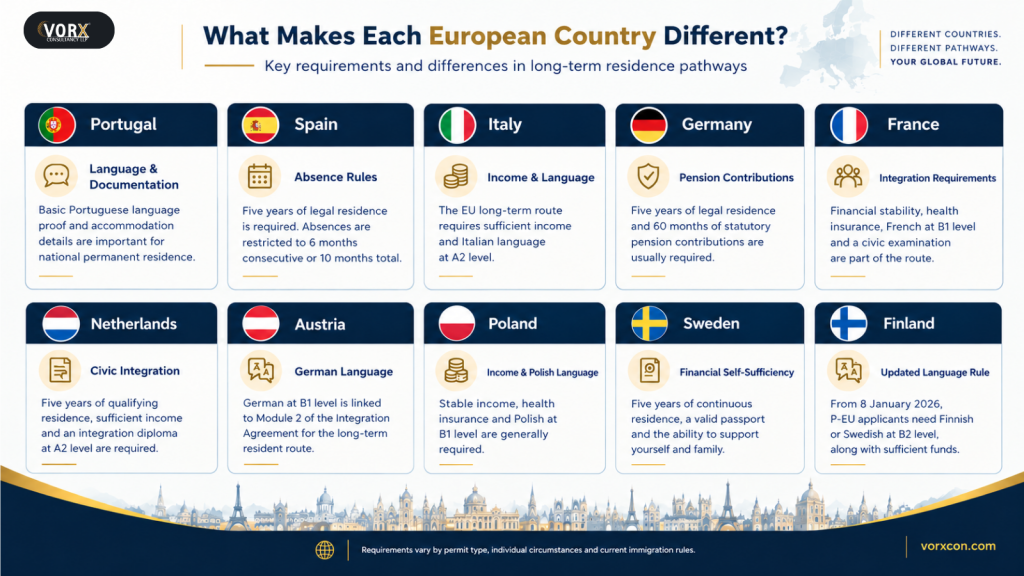
Many EU countries require applicants to have lived in the country for five years to obtain EU Long Term Residency. They will also need to meet the requirements related to financial situation, healthcare, language and integration. There are also some countries which offer national permanent residence. Here are 10 European countries with established residence pathways and their main eligibility requirements.
For assistance with international residency options, contact Vorx Consultancy.
1. Portugal
Portugal offers a national permanent residence authorization for foreign nationals who have established legal residence in the country. This route can suit people who have lived in Portugal for several years and want to continue living there without a time limit on their residence status.
Main requirements:
- Hold a temporary residence permit for at least five years.
- Provide proof of sufficient means of subsistence, accommodation and compliance with tax and Social Security obligations.
- Demonstrate basic Portuguese language knowledge, generally through an accepted A2-level certificate.
2. Spain
Spain offers national long-term residence authorization, allowing eligible foreign nationals to live and work in the country indefinitely under the same conditions as Spanish citizens. The standard route is based on qualifying legal residence in Spain.
Main requirements:
- Generally, five years of legal and continuous residence in Spain.
- Meet the applicable criminal-record and public-order conditions.
- Keep absences within the permitted limits. Generally, absences must not exceed six consecutive months or ten months in total during the five-year period. Different limits may apply to qualifying work-related absences.
Recommended Reading:
Remote workers and eligible professionals considering Spain can explore the Spain Digital Nomad Visa requirements, application process and renewal options before planning their long-term stay.”
3. Italy
Italy provides an EU residence permit for long-term residents to eligible non-EU nationals. Applicants need to establish their legal residence history and meet the relevant financial and language conditions.
Main requirements:
- Meet the five-year qualifying residence requirement and hold an eligible residence permit.
- Demonstrate sufficient annual income, assessed against the applicable Italian social allowance threshold.
- Meet the Italian-language requirement, generally through an accepted A2-level qualification or test, subject to exemptions.
For assistance with international residency options, contact Vorx Consultancy.
4. Germany
There are two key options in Germany, the national settlement permit and permanent EU residence permit. Requirements will vary depending on what category you fall under, what job you have had and your personal circumstances. Skilled workers may be eligible for a national settlement permit quicker than 5 years.
Main requirements for the EU long-term residence route:
- At least five years of qualifying legal residence in Germany.
- Sufficient German-language ability, basic knowledge of the country’s legal and social system, and adequate living space for the applicant and family.
- Sufficient financial resources, health insurance and the required pension insurance contributions, subject to applicable exceptions.
5. France
France offers an EU long-term resident card to eligible non-EU nationals who meet the residence, financial and integration requirements. The card is generally valid for ten years and can be renewed.
Main requirements:
- Generally, five years of legal and continuous residence under qualifying permits.
- Stable, sufficient and regular resources, assessed against the applicable income threshold.
- Health insurance and compliance with the applicable French-language and civic-integration requirements. The precise conditions depend on the application and any relevant exemptions.
For assistance with international residency options, contact Vorx Consultancy.
6. Netherlands
The Netherlands offers national permanent residence and EU long-term resident permits. Applicants must establish a qualifying residence history and satisfy the relevant income and integration conditions.
Main requirements:
- Generally, at least five consecutive years with a valid Dutch residence permit, with the Netherlands as the main place of residence.
- A valid permit for a non-temporary purpose and continued compliance with residence conditions.
- Sufficient income and an integration diploma, generally at A2 level, unless exempt.
7. Austria
Austria offers a residency title known as Long-term Resident – EU. This gives eligible third country nationals a long term residency status and allows them to work in the Austrian labour market.
Main requirements:
- Resided in Austria for 5 years continuously.
- Completed Module 2 of the Integration Agreement (German B1 and understanding of basic Austrian legal and social values).
- Met general residency requirements (secure finances, adequate housing and Health Insurance).
For assistance with international residency options, contact Vorx Consultancy.
8. Poland
Poland offers an EU long-term resident permit to eligible foreign nationals. The status is granted indefinitely, although the residence card itself must be renewed periodically.
Main requirements:
- Generally, five years of uninterrupted qualifying legal residence. Not every residence category counts in full.
- Stable, regular and sufficient legal income, assessed over the applicable period.
- Health insurance, a legal title to accommodation and proof of Polish at B1 level, subject to applicable exemptions.
Recommended Reading:
After identifying a suitable residence route, applicants should check the required documents, financial evidence and application conditions carefully. Read about the common mistakes to avoid before submitting a residence permit application.
9. Sweden
Sweden offers EU long-term resident status to eligible non-EU/EEA nationals. This is different from the Swedish national permanent residence permit and has its own eligibility conditions.
Main requirements:
- Five years of continuous qualifying legal residence in Sweden. Certain temporary permits, including permits for studies below doctoral level, generally do not count.
- A valid passport or other accepted travel document.
- Evidence that the applicant can support themselves and their family through employment, business activity or sufficient financial resources.
10. Finland
Finland offers a long-term resident’s EU residence permit, known as the P-EU permit. This is separate from Finland’s national permanent residence permit, whose eligibility rules changed on 8 January 2026.
Main requirements:
- Five years of qualifying legal residence under an eligible status, such as a continuous residence permit or certain other qualifying residence statuses.
- Continued lawful residence and a valid eligible status when applying.
- Compliance with the specific rules governing the current residence permit and qualifying residence history. Some study-based residence periods may be treated differently.
Which Residence Route Should You Explore?
Your Purpose | Residence Route to Explore | What to Check |
Work abroad | Work Permit / EU Blue Card | Job offer, qualifications and salary |
Start a business | Business / Self-Employment Permit | Business eligibility and financial resources |
Join family | Family Reunification | Relationship proof and sponsor requirements |
Study or research | Student / Researcher Permit | Admission, funding and whether residence counts towards long-term status |
How Vorx Consultancy Can Help with your Foreign Residency?
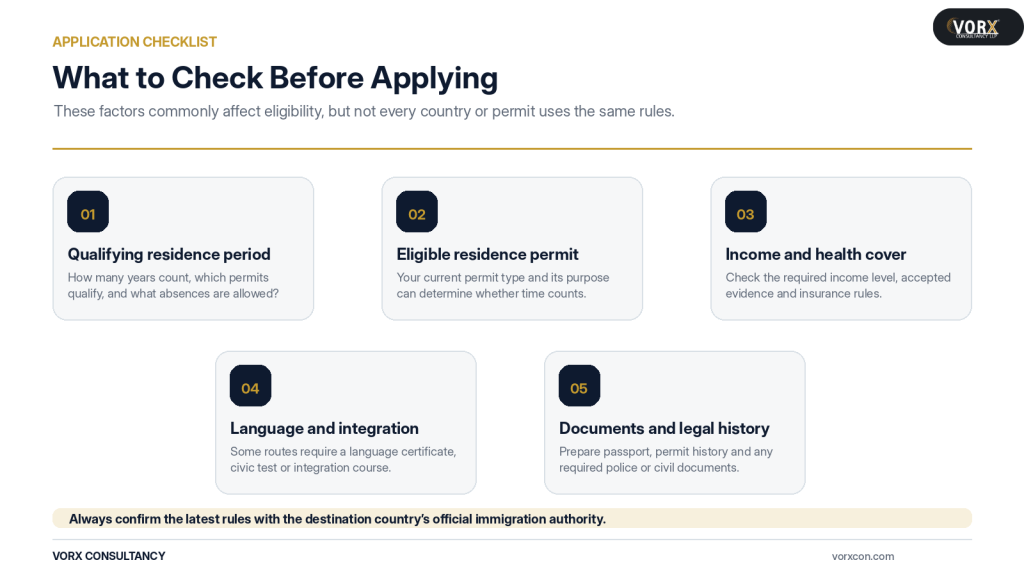
It is important to know what country is best for you to live in as there are many factors to consider. This could include the original visa/permit, what are acceptable income sources, language requirements, what documents you will need and rules around absence.
Vorx Consultancy can help with immigration and residency. We can advise on which residence route is best for you, what documents you will need and help with applications. The correct route will depend on your situation and current regulations in the country you are applying to.
Planning to settle in Europe for the long term? Connect with Vorx Consultancy to explore suitable residence pathways.
Book a Strategy Call: (Calendly Link)
Visit: www.vorxcon.com
Email: support@vorxcon.com
Final Thought
There are many long term residency options available across Europe. As there is no one route that is suitable for everyone it is important to check what permit you will receive, how long you will need to reside there, financial requirements, language requirements and any restrictions on how long you can be away. Knowing this will enable you to determine which route will be best for your long term goals.