

In terms of becoming a base to create a location-independent career, Spain has become one of the best options for Indian entrepreneurs, remote workers, and freelancers.
The climate here is not the only reason for such popularity – it is easy to get a chance to live in Spain and work abroad due to a specific document that gives one an opportunity to do it. This document is called Spain Digital Nomad Visa.
If you consider applying for it, this article will provide you with information regarding its main features, target audience, and mistakes people make when applying for this visa.
Working with founders and professionals from different countries and helping them with obtaining various visas, we noticed that good preparation can help with the Digital Nomad Visa too.
What Is the Spain Digital Nomad Visa?
The Digital Nomad Visa was introduced under Spain’s Startup Act (Ley de Startups) to attract remote professionals, freelancers, and entrepreneurs whose income comes from outside the country.
It’s a residence authorization, not a work-search visa; the assumption is that you already have income secured before you apply, whether through an employer, international clients, or your own foreign-registered business.
There are two routes into the visa. You can apply through a Spanish consulate in India before you travel, or apply from within Spain if you’re already there legally on another status (though, as we’ll cover later, not every prior status qualifies for this switch).
Each route has a different initial validity period, and the visa can be renewed over time, potentially building toward long-term residency eligibility.
Vorx Consultancy Insight: A lot of applicants treat this as a one-time application.
In practice, it’s better to think of it as the start of a multi-year relationship with Spanish immigration and tax authorities, one where consistency in your documentation matters as much at renewal as it did on day one.
Who Should Apply — and Who It's Not For
The visa serves a broader group than most people assume, but the right approach depends heavily on which category you fall into.
Applicant Type | How They Typically Qualify |
Remote/salaried employees | Employer letter confirming remote work is permitted, employment contract, salary proof |
Freelancers and self-employed | Client contracts, invoicing history, proof of an ongoing client relationship |
Entrepreneurs/business owners | Usually stronger applying as a remote consultant or contractor to their own foreign entity, rather than as “Owner” or “Director” |
Digital nomads with mixed income | Combination of contracts, invoices, and bank statements showing consistent foreign-sourced income |
That entrepreneur nuance is worth pausing on. Business owners who apply while listing themselves as “Owner” or “Director” of the foreign company sometimes run into complications, since Spanish authorities may look more closely at whether the applicant is genuinely working remotely versus managing a business that could trigger separate registration obligations in Spain.
A cleaner approach for many founders is to frame the application around the remote services they personally provide to their company, supported by an appropriate agreement.
It’s also worth being clear on who this visa is not for. If you’re hoping to find local employment in Spain, this isn’t the right route.
Spanish immigration authorities have been explicit that the visa is meant for people whose income originates outside the country.
And if you’re already in Spain on a tourist entry or a Non-Lucrative Visa, converting to Digital Nomad status from inside the country is generally not available; this is a common misconception that trips up a surprising number of applicants.
Spain Digital Nomad Visa Eligibility Requirements
The eligibility criteria are reasonably straightforward once you break them down, though the exact income figure changes each year, so treat any number you see online including ours as something to verify at the time you apply, not something to bank on months in advance.
Remote work eligibility: The majority of your income needs to come from outside Spain.
If you plan to take on Spanish clients or work, there’s typically a cap on how much of your income can come from domestic sources without affecting your eligibility.
Work history requirement: Authorities generally want to see that you’ve worked with your current employer or client for a reasonable stretch of time already, and that the foreign company you work with or for has been operational for a meaningful period; this isn’t a visa for brand-new working relationships.
Proof the role is genuinely remote: A letter from your employer or client confirming that remote work is authorized carries real weight here.
Income requirement: Spain calculates this as a percentage of its national minimum wage (SMI), which is revised annually.
Because of that link, the required monthly income shifts most years sometimes only slightly, sometimes more. If you’re applying with a spouse or children, the required income increases per dependent.
Health insurance: You’ll need private health insurance that covers you (and any family members joining you) for the full duration of your stay, without co-pays or major coverage gaps.
Clean criminal record: A background check is required from Spain and from any country where you’ve lived for an extended period in recent years, properly apostilled and translated.
Registered address in Spain:You’ll need to show where you plan to live, even if this is arranged shortly before or after arrival depending on your application route.
Read this guide: Spain Company Formation Requirements 2026
Documents Required for the Spain Digital Nomad Visa
Documentation is where most delays happen not because the requirements are unclear, but because apostille and translation timelines are longer than people expect, especially from India.
Category | Typical Documents |
Personal | Valid passport, passport photos, proof of address, apostilled police clearance certificate with certified translation |
Employment/Business | Signed employment or client contracts, letter authorizing remote work, proof the foreign company is actively operating |
Financial | Payslips, invoices, or bank statements showing consistent income over recent months |
Insurance | Private health insurance policy valid for the full intended stay |
A practical tip we give clients: start the apostille process for your police clearance certificate as early as possible.
It’s routinely the slowest-moving piece of the entire application, and delays here can push your whole timeline back by weeks.
Read this guide: Spain Company Registration Documents: A Complete Checklist for Indian Entrepreneurs (2026)
How to Apply for the Spain Digital Nomad Visa from India
Application from India requires applying through the Spanish consulate serving the state or region in which you reside. Be sure you have the correct consulate before booking an appointment.
Here are the basic steps:
- Verify your eligibility and get your documents sorted out beforehand because translating and getting the documents apostilled can take time.
- Book your appointment at the consulate and apply, along with submitting your biometrics.
- Once your application is approved, visit Spain within the stipulated period of time.
- Empadron yourself upon reaching Spain.
- Get your TIE (residence card).
If you’re already in Spain legally on a status that permits switching, the process runs through Spanish immigration authorities directly rather than a consulate but remember, this route isn’t open to everyone, particularly those on a Non-Lucrative Visa or tourist entry.
Ready to Explore Your Spain Digital Nomad Visa?
Get professional guidance on eligibility, documentation, apostille, and the application process.
Vorx Consultancy Insight: Processing timelines vary more than people expect, largely because of factors outside the applicant’s control apostille turnaround for criminal record certificates being the most common bottleneck. Building in buffer time rather than planning around a best-case scenario tends to save a lot of stress.
Spain Digital Nomad Visa for Family Members
One of the more appealing aspects of this visa is that it isn’t designed only for solo applicants. Spouses, registered partners, and dependent children can typically be included, and in some cases dependent parents may qualify as well, depending on individual circumstances.
Each family member requires their own supporting documents, marriage or birth certificates, apostilled and translated and the overall income requirement increases with each dependent added to the application.
Families can often apply together in a single process, though timing can vary if a spouse or children plan to join later rather than travel together.
If you’re relocating with school-age children, it’s worth researching Spain’s international and local schooling options early, since enrollment timelines don’t always align neatly with visa processing.
Can You Work for Spanish Companies or Take Local Clients?
This is one of the most common questions we get from freelancers, and the honest answer is: it depends on scale.
The visa is built around foreign-sourced income, and while a limited amount of Spanish-sourced income is generally tolerated, exceeding that threshold can create complications both for your current status and for renewal.
Spanish authorities have increased scrutiny in recent years around applicants who technically hold a Digital Nomad Visa but are functionally working like local freelancers.
If you find your Spanish client base growing over time, it’s worth having a conversation about whether a different registration status makes more sense for where your business is actually heading, rather than trying to stretch the Digital Nomad framework further than it’s designed for.
Tax Considerations for Digital Nomad Visa Holders
Spain offers a special tax regime, commonly referred to as the Beckham Law, that can apply to eligible employees relocating under this visa.
Broadly, it allows a flat rate of taxation on Spanish-sourced income for a defined number of years, rather than the standard progressive tax bands.
A few things worth flagging clearly: this regime is generally available to employees, and self-employed or freelance applicants often don’t qualify in the same way.
There’s also a filing window after you register in Spain, and foreign-sourced income that’s already taxed in its country of origin is commonly treated differently from Spanish-sourced income.
Tax rules like this are highly dependent on individual circumstances, and getting this wrong can be costly in ways that go beyond the visa itself.
This is genuinely an area where speaking to a Spain-based tax advisor before you relocate is worth the time.
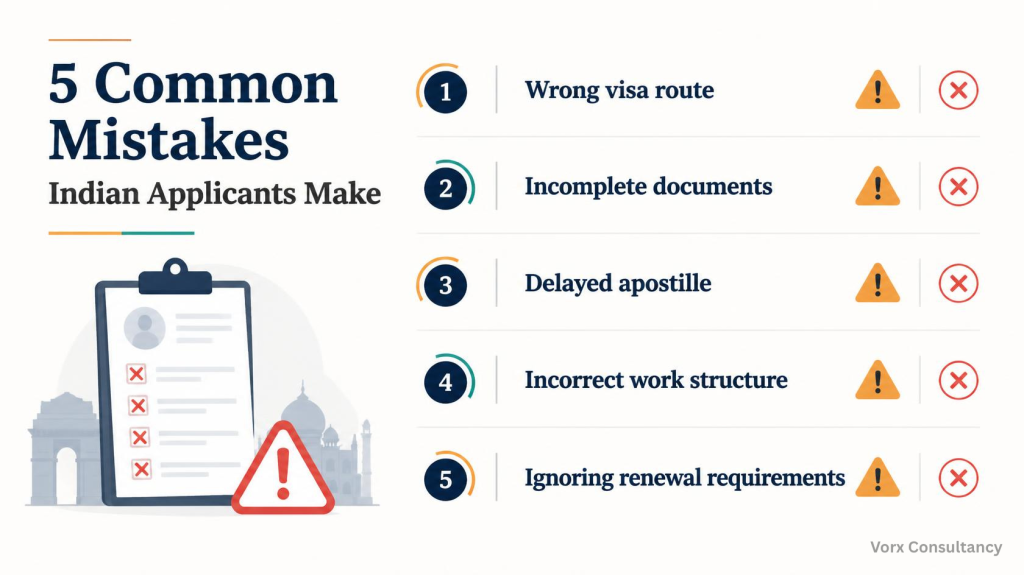
Common Mistakes Indian Applicants Make
A few patterns show up again and again:
Assuming a status switch is possible: Believing you can convert from a tourist visa or Non-Lucrative Visa to Digital Nomad status once you’re already in Spain.
Applying as “Owner” instead of structuring the application around remote services. This often creates unnecessary complications for entrepreneurs.
Underestimating document timelines: Especially apostille processing for police clearance certificates, which routinely takes longer than applicants expect.
Submitting generic or templated documentation: Immigration authorities have grown more attentive to applications that look copy-pasted rather than individually prepared.
Skipping Social Security registration once in Spain : This can create friction later, particularly at renewal.
Treating approval as the finish line: The visa needs to be renewed, and renewal is assessed against current requirements, not the ones in place when you first applied.
Planning to Apply for Spain’s Digital Nomad Visa?
Not sure if your income, work structure, or documents meet Spain’s requirements? Vorx Consultancy can help you assess your eligibility and prepare your application with greater clarity.
Renewing Your Spain Digital Nomad Visa
Renewal doesn’t get nearly as much attention as the initial application, but it deserves it.
When your renewal comes up, your eligibility is reassessed against whatever the current requirements are at that time, not the figures or rules that applied when you were first approved.
If Spain’s minimum wage has shifted upward, your income requirement will likely have shifted with it.
You’ll typically need to resubmit updated income proof, confirm your health insurance is still valid, and show a clean compliance history with Spanish Social Security if applicable.
Given the increased scrutiny authorities have applied to renewals recently, keeping organized records throughout your stay, not just scrambling to assemble them before your renewal window puts you in a much stronger position.
Successful renewals over time can also move you closer to long-term residency eligibility, which is worth keeping in mind if Spain is a long-term plan rather than a short-term relocation.
How Vorx Consultancy Can Help with Your Spain Digital Nomad Visa
Vorx Consultancy provides assistance to individuals who are entrepreneurs, telecommuters, and freelancers to understand if they meet the requirements for such visas and what are their options.
In case they qualify, we provide help in terms of gathering documents, apostille, translation, (empadronamiento), and TIE application after arrival.
As the requirements for the verification and renewal of documents are becoming more rigorous, it is good to have an experienced second eye that can prevent unnecessary mistakes from happening.
Conclusion
The Spain Digital Nomad Visa remains one of the more accessible ways for Indian entrepreneurs, remote employees, and freelancers to build a long-term base in Europe — but it rewards applicants who treat it as an ongoing commitment rather than a single form to fill out.
Eligibility rules and income thresholds shift annually, so always confirm current figures before you apply rather than relying on last year’s numbers.
And with Spanish authorities paying closer attention to documentation quality and renewal compliance in recent years, a well-prepared, individually tailored application matters more than it used to.
If you’re still working through the details of tax treatment, document apostilles, or how family relocation fits into your timeline it’s worth exploring those topics in depth before you start the formal process.
And if you’d like a second opinion on where your specific situation stands, Vorx Consultancy is here to help you think it through.
Take the Next Step with Confidence
If you’re considering Spain as your next base, Vorx Consultancy can help you assess your Digital Nomad Visa eligibility and navigate the documentation and application process.
Discuss Your Case with Vorx Consultancy
