

There might come a point for any company, when despite being perfectly legally registered, having an official website and providing goods or services to clients worldwide, it is being asked a series of questions pertaining to their details prior to opening a company bank account or entering a business partnership. This way of operating, when institutions are required to make sure that they are going to deal with the right persons, who own the business and whose activities are legitimate, is known as Corporate KYC.
This aspect of customer due diligence ensures the verifying organisation understands the client’s nature and ownership whilst assessing the potential risks this business could pose. Corporate KYC, is one very important element companies must understand prior to establishing any overseas banks accounts, partnerships or new business opportunities.
Planning to establish or expand your business internationally? Contact Vorx Consultancy for support with company formation, banking assistance and compliance planning.
What Is Corporate KYC?
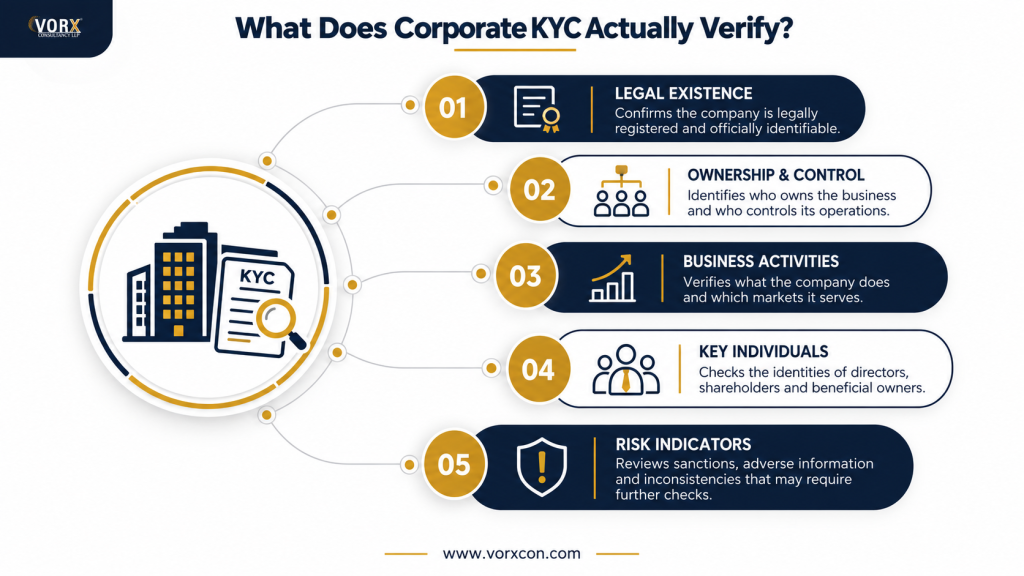
Corporate KYC, otherwise known as ‘Know Your Company’ refers to the range of processes an institution can undertake in order to verify the details of a business prior to any sort of relationship being established. Corporate KYC is not carried out exclusively by banks, rather payment institutions and others, who are required to know their customers and therefore identify elements such as owners, directors and beneficiaries and ultimately understand if the company is legitimate.
Corporate KYC is closely related to Know Your Business (KYB). Although the terms are sometimes used interchangeably, KYB generally refers more broadly to verifying business entities and their ownership, while KYC is the wider customer due diligence concept.
Recommended Reading:
Understand why foreign banks verify the origin of business funds and which documents can help meet their due diligence requirements.
Why Is Corporate KYC Important for Businesses?
Corporate KYC is more than an administrative requirement. It helps institutions make informed decisions about the companies they work with and supports more transparent business relationships.
Building trust with banks and business partners
Beyond a regulatory requirement, corporate KYC enables organisations to have a good understanding of who they are dealing with prior to doing any business, which ultimately results in a successful relationship.
Establishing trust with banks and business partners
Having all the relevant documents, consistent and trustworthy information about a business can result in banks and institutions better understanding how a company operates as well as helping in establishing partnerships or even suppliers. Whilst it does not guarantee a bank or financial institution will accept the documentation, it makes sure that all information has been presented in an orderly and trustworthy manner.
Avoiding fraud and financial risk
Companies that operate fraudulently can submit fabricated documentation or incorrect, misleading information about themselves. This is why institutions carry out KYC checks to verify that the information provided regarding a company is consistent with its actual nature and not misleading or false in any way.
Ensuring regulatory compliance
Depending on the institution, its specific regulations as well the location within which the business operates, there are certain aspects of customer due diligence a company will be required to undertake, as a result of anti-money laundering legislation and guidelines. The completion of the appropriate corporate KYC checks will ensure that the right steps are taken to meet the legal requirements imposed or to identify any issues that need addressing.
Facilitating business expansion in a more structured manner
When dealing with a completely new market, unfamiliar documentation and requirements can be confusing and challenging to deal with amidst a lot of other formalities related to entering a foreign market. Having all the relevant information documented and easily accessible for institutions to review, is bound to create a smoother and more structured process for all parties.
Planning to establish or expand your business internationally? Contact Vorx Consultancy for support with company formation, banking assistance and compliance planning.
When Might a Company Need to Complete Corporate KYC?
Whilst corporate KYC relates a business entity in the context of banking, there are a number of points in a company’s journey that may require some sort of verification:
Opening a bank account: A bank may require the company to undergo some customer due diligence prior to the bank account being opened.
Applying for payment services: A payment institution may need to review the company’s structure, prior to a merchant account being opened.
Establishing relationships with new suppliers or partners: Businesses can carry out due diligence on new partners or suppliers.
Expanding internationally: An overseas institution may want to carry this step further, by undertaking its own verification.
Recommended Reading:
Learn how incomplete company records, unclear ownership details and other compliance issues can affect foreign business bank account applications.
How Does the Corporate KYC Process Work?
Despite the range of variations in the requirements of different institutions and companies, there are generally four aspects in the due diligence process undertaken by banks and other organisations:
Company information provided: The company submits all documents necessary in verifying its details.
Verification of documents: Institution verifies information provided to ensure accuracy.
Risk assessment: The business type, its ownership structure and relationship with the potential institution are reviewed in terms of certain risks.
Decision: The organisation decides whether to proceed with the company.
Verification of documents may continue past the on-boarding or set up of the initial relationship, as institutions are permitted to review information pertaining to their customers, depending on their own risk profile.
Planning to establish or expand your business internationally? Contact Vorx Consultancy for support with company formation, banking assistance and compliance planning.
Which Documents May Be Required for Corporate KYC?
Documents requested for KYC checks on companies, will depend on a range of aspects including the company itself, location, institution and so on. Some general examples of documents and information that may be required in due diligence checks are:
- Certificate of incorporation or similar documents proving the incorporation of the company.
- Registered or business address.
- Details of directors, stakeholders, beneficial owners.
- Identification and address of individuals.
- A description of the nature of business along with relevant commercial documentation.
- Financial information or source of funds, should they be required.
Supplying every piece of information required, whilst possibly being a safe option, is by no means a recommended strategy.
Why Can Corporate KYC Become More Complex During International Expansion?
When dealing with international business there are other documents, which may be required by banks overseas, which are different to the documents required within local jurisdiction. The system and regulation around the disclosure of company ownership differ from one country to another. Also documents issued abroad may require additional verification, translation or certification. The requirements of banks abroad or potential partners may question the nature of international transactions, source of funds, nature of relationship. These are not always red flags, but potentially part of a process they need to undertake independently in order to decide on the potential relationship. Businesses can prepare for this process by familiarising themselves with documentation, understanding requirements depending on the country or keeping track of documentation, which will help them present a clear picture of their business to the banks.
Planning to establish or expand your business internationally? Contact Vorx Consultancy for support with company formation, banking assistance and compliance planning.
How Vorx Consultancy Can Support Your Business Setup?
Preparing for international expansion involves more than registering a company. Business owners may also need to organise corporate documentation, understand local compliance obligations and prepare for banking requirements in the chosen jurisdiction.
Vorx Consultancy assists businesses with:
- International company formation and registration.
- Corporate banking application support.
- Company documentation and ownership information guidance.
- Tax and ongoing compliance assistance.
- International business expansion planning.
With the right preparation, businesses can approach these requirements with a clearer understanding of what may be needed. Final KYC decisions, however, remain with the relevant bank or institution.
Simplify Corporate KYC and cross-border compliance with Vorx Consultancy. Get in Touch
Book a Strategy Call: (Calendly Link)
Visit: www.vorxcon.com
Email: support@vorxcon.com
Final Thought
Companies need to understand the importance of Corporate KYC, as the verification process is instrumental in building trust between organisations and their respective institutions. Being aware of the necessary documentation as well as understanding the requirements ahead of opening a bank account of entering business relations or international partnerships can ensure a smoother process overall. It is essential to prepare accordingly and have all necessary and relevant documents ready to submit, without overwhelming potential partners, banks or suppliers with information, which could potentially confuse them.