


Expanding from India into an international market can open the door to new customers, investors and revenue opportunities. But incorporating a company overseas is only one part of the process. The tax implications can extend across both the country where the business operates and India.
For Indian businesses, the real challenge is often not the foreign tax rate itself. It is understanding where the business is considered to operate, how money moves between entities, which tax treaty applies and what needs to be reported in India.
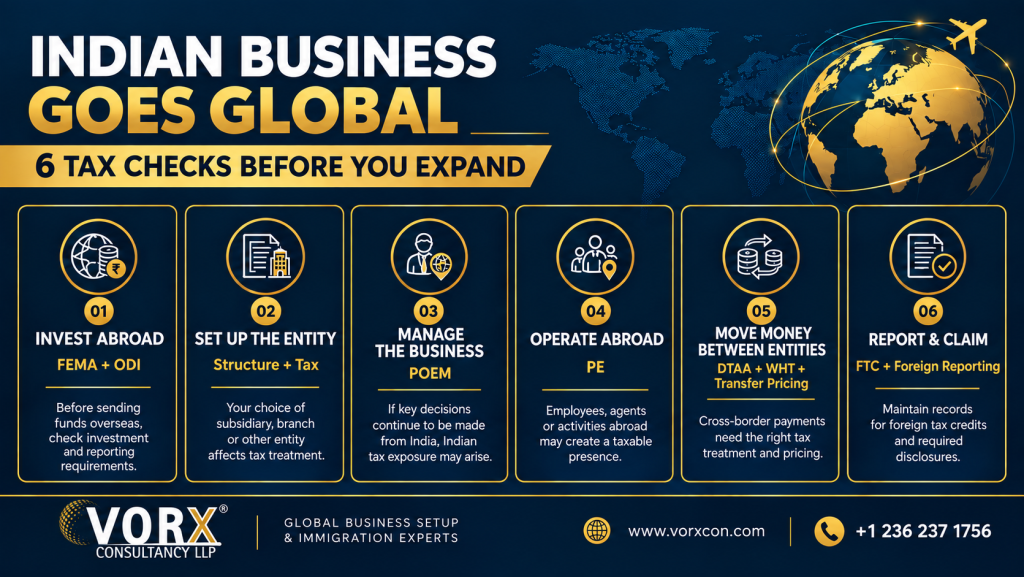
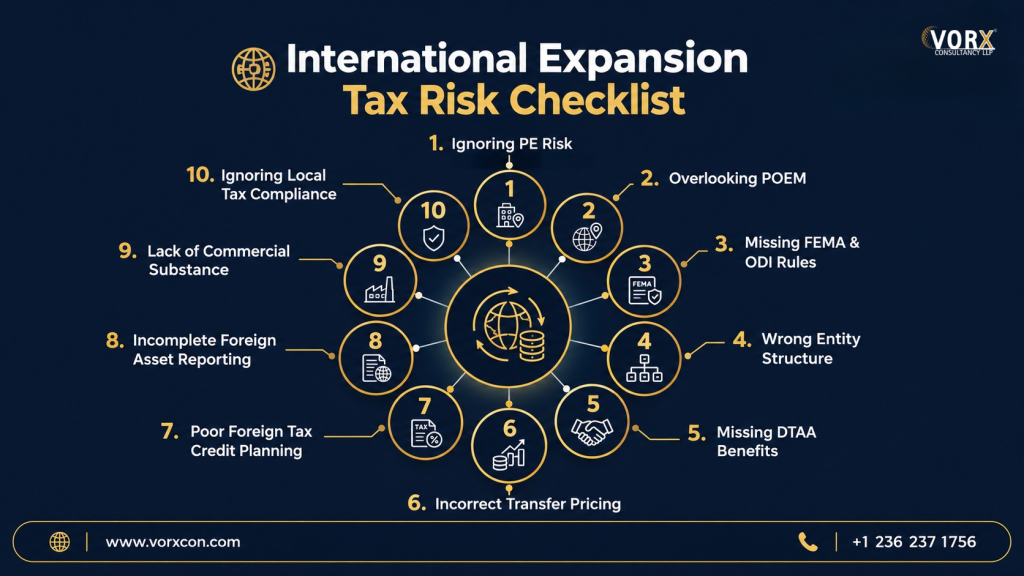
Here are 10 tax mistakes Indian businesses should avoid when expanding abroad.
1. Ignoring Permanent Establishment (PE) Risk
One of the most common international tax mistakes is assuming that a business needs a physical office before it can create a taxable presence. In reality, activities performed through employees, agents or business representatives in another country can potentially create a Permanent Establishment (PE) depending on the applicable domestic law and tax treaty.
For example, an Indian company may have a sales team or representative regularly negotiating contracts in another country. Simply calling that person an “agent” does not necessarily remove the tax risk.
Before starting operations, businesses should assess whether their people, contracts and activities could create a taxable presence abroad.
2. Assuming an Overseas Company Is Automatically Taxed Only Abroad
Registering a company in Dubai, Singapore, the UK or another jurisdiction does not automatically separate it from Indian tax considerations. Indian businesses and founders need to consider Place of Effective Management (POEM) and where key management and commercial decisions are actually being made.
If important decisions relating to strategy, contracts, pricing and operations continue to be made from India, the overseas structure may face additional Indian tax considerations.
The important question is not simply, “Where is the company registered?” It is also, “Where is the company actually being managed?”
3. Ignoring FEMA and ODI Compliance
International expansion also involves India’s foreign exchange regulations. When an Indian company invests in or establishes an overseas business, FEMA and Overseas Direct Investment (ODI) requirements can become relevant. Reporting, documentation, valuation and other regulatory requirements need to be considered alongside the tax structure.
A business may have a perfectly valid commercial reason for expanding overseas but still face problems if the investment and reporting process is not handled correctly.
This is why FEMA compliance for overseas investment should be considered at the planning stage, not after the money has already moved.
Recommended Reading:
If you are comparing jurisdictions based on corporate tax rates, explore our guide to Top 10 Countries Offering the Lowest Corporate Tax Rates in 2026.
4. Choosing the Overseas Entity Structure Without Tax Planning
An LLC, private limited company, branch, subsidiary or partnership can have very different tax and compliance consequences. Choosing a structure simply because it is cheap or quick to incorporate can create problems later with profit repatriation, investor funding, inter-company transactions and exit planning.
The right question is not just “Which country has the lowest corporate tax?” It is “Which structure fits the business model, ownership, funding and long-term expansion strategy?”
5. Missing DTAA and Withholding Tax Benefits
Cross-border payments such as interest, royalties, technical service fees and other payments may be subject to withholding tax. Indian businesses sometimes pay tax at the domestic rate without checking whether a Double Taxation Avoidance Agreement (DTAA) provides a different treatment.
However, treaty benefits usually depend on meeting applicable conditions and maintaining appropriate documentation, which may include tax residency documentation.
Ignoring DTAA provisions can result in unnecessary tax costs or difficulty claiming treaty benefits.
Recommended Reading:
To understand how treaty provisions can affect cross-border income and withholding tax, explore our guide to Top 10 Countries with DTAA Agreements with India.
6. Getting Transfer Pricing Wrong
Once an Indian company and its overseas subsidiary start transacting with each other, transfer pricing becomes an important consideration. Management fees, technology charges, shared services, loans, royalties and other inter-company transactions should be structured and documented appropriately. Using arbitrary pricing simply to move profits between jurisdictions can attract scrutiny.
A proper transfer pricing strategy should consider the functions performed, assets used, risks assumed and the commercial basis of the transaction.
Need Strategic Guidance?
Book a Strategy Call: (Calendly Link)
Visit: www.vorxcon.com
Email: support@vorxcon.com
7. Failing to Claim or Document Foreign Tax Credits
Paying tax in another country does not necessarily mean the business has to bear the same tax again in India. Depending on the circumstances, Foreign Tax Credit (FTC) may be available. But claiming credit generally requires appropriate documentation and timely reporting.
Businesses should therefore maintain foreign tax payment records, tax statements and supporting documents rather than trying to reconstruct the information when the Indian tax return is being prepared.
8. Poor Reporting of Foreign Assets and Transactions
Another mistake is treating foreign reporting as an administrative formality. Overseas investments, foreign bank accounts, ownership interests and other relevant transactions may need to be appropriately disclosed under Indian tax and regulatory requirements.
Recent reporting has highlighted regulatory scrutiny around delayed or incomplete overseas investment reporting, beneficial ownership gaps and mismatches between remittances and tax disclosures.
9. Creating a Structure Without Real Commercial Substance
A company may be legally incorporated overseas, but tax authorities can look beyond incorporation documents. If an overseas entity has little genuine activity, no meaningful decision-making, limited commercial purpose or operations that remain almost entirely controlled from India, the structure can attract additional scrutiny.
International tax planning should therefore be based on commercial substance, not simply on obtaining a lower tax rate.
10. Treating Local Tax Compliance as an Afterthought
Every country has its own tax registrations, filing deadlines, accounting rules and reporting requirements. Corporate tax may only be one part of the picture. Depending on the business and jurisdiction, VAT or sales tax, payroll-related obligations, withholding requirements and annual corporate filings may also apply.
Waiting until the first notice arrives is an expensive way to discover these requirements. Businesses expanding abroad should build a compliance calendar covering both India and the overseas jurisdiction from the beginning.
How Vorx Consultancy Helps Indian Businesses Manage International Tax Risks?
For Indian businesses, international expansion requires careful coordination between business structuring, taxation, foreign exchange regulations and ongoing compliance. A structure that works commercially may still create unexpected tax exposure if its management, transactions or reporting obligations are not planned correctly.
Vorx Consultancy supports businesses through the key stages of international expansion, helping them evaluate the practical and regulatory considerations before establishing an overseas presence.
Vorx Consultancy Can Help With:
- International Company Formation
- Cross-Border Tax Planning
- FEMA & ODI Compliance
- DTAA & Withholding Tax Guidance
- Transfer Pricing Support
- International Banking Solutions
- Ongoing Compliance Support
With the right structure in place from the beginning, businesses can expand internationally with greater clarity and fewer avoidable tax and compliance risks.
Expanding abroad? Plan your international tax structure with Vorx.
Book a Strategy Call: (Calendly Link)
Visit: www.vorxcon.com
Email: support@vorxcon.com
Final Thoughts
International expansion can create significant opportunities for Indian businesses, but tax mistakes can quickly turn a successful expansion into an expensive compliance problem. The biggest lesson is simple: incorporation is only the beginning.
Before expanding, businesses should understand PE exposure, POEM, FEMA and ODI requirements, DTAA benefits, transfer pricing, foreign tax credits and local compliance obligations. A well-planned international tax structure can help reduce avoidable risks while giving the business a clearer path to scale globally.