

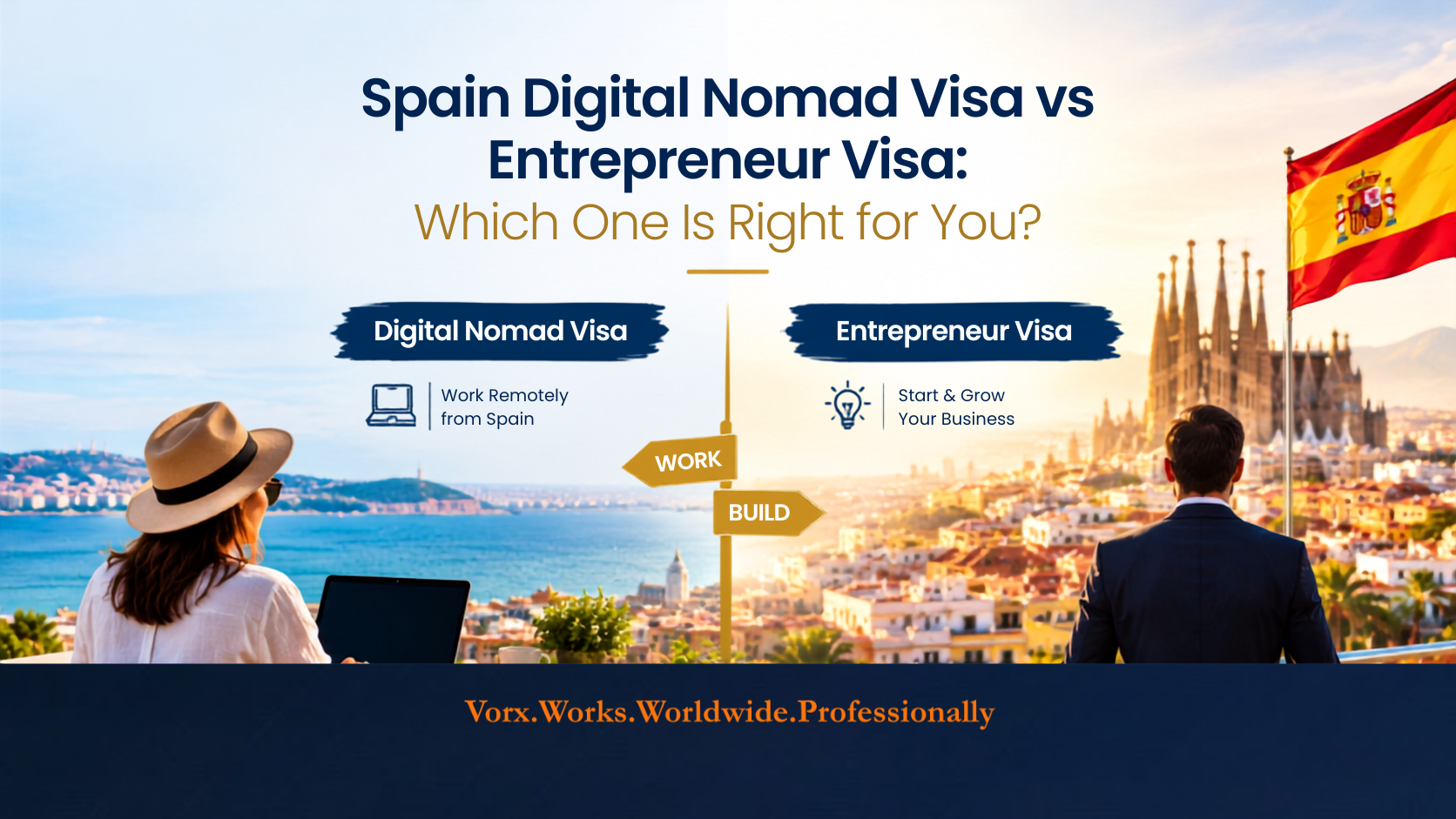
Spain has quietly become one of Europe’s more accessible entry points for founders, remote professionals, and business owners looking to expand their footprint internationally.
For Indian entrepreneurs and remote workers in particular, it offers something harder to find elsewhere in the EU: a legal, well-defined pathway to live and work in Europe without needing a European employer or an EU passport.
The trouble is that Spain actually offers two very different routes for this, and they get confused constantly.
The Digital Nomad Visa and the Entrepreneur Visa frequently go hand-in-hand, at times even after consulting with a lawyer beforehand; however, these visas serve different purposes.
Selecting the wrong one will not only cause delays; it may end up resulting in your application being refused, lost months, or a residency permit that restricts your company’s operations from Spain.
This guide covers both of them in detail, explaining the differences between them and how to determine which is right for you.
Read this guide: Spain Company Formation Requirements 2026
Digital Nomad Visa vs Entrepreneur Visa: The Core Difference
It can be explained in the easiest manner like this. The Digital Nomad Visa is meant for those who have already been earning from outside Spain and do not wish to disrupt their earnings by moving somewhere else.
The Entrepreneur Visa is for those who intend to set up something new in Spain. One assumes you are already earning. The other assumes you are starting.
This is quite an easy differentiation in theory, but things become a little bit less clear in practice.
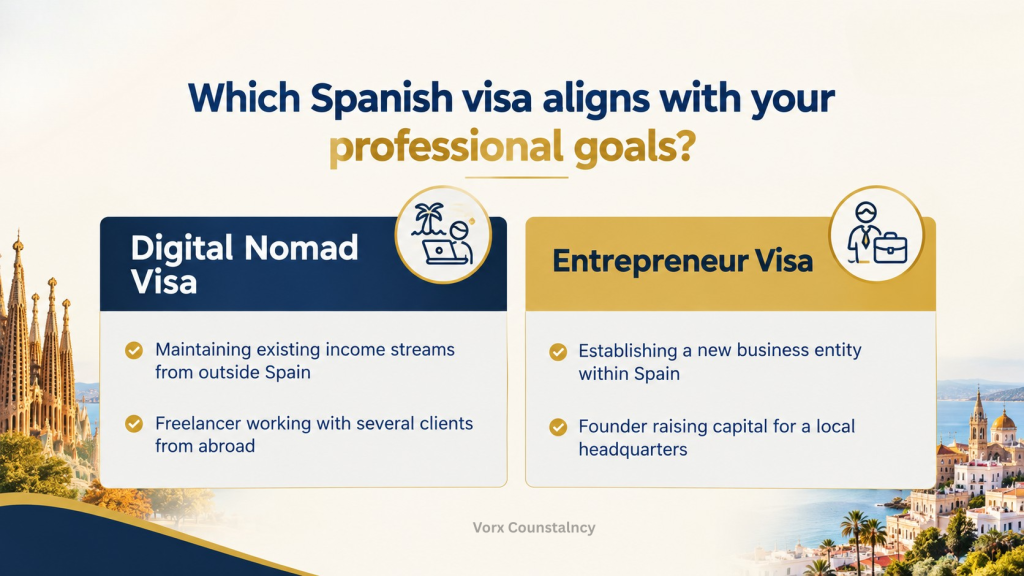
When a freelancer is working with several clients from abroad on a regular basis, that person definitely belongs to the Digital Nomad Visa category.
When a founder is raising money in order to establish a software-based company with headquarters in Madrid, he obviously falls into the category of the Entrepreneur Visa. But what if a person is working as a freelance consultant and simultaneously establishing a small local business?
Both categories exist within the same legislative framework created initially with the help of the Law 14/2013 and subsequently supplemented by the Spanish Startup Law of 2022. The core differences between those two categories are actually quite different.
What Is the Spain Digital Nomad Visa?
The Digital Nomad Visa lets non-EU nationals live in Spain while continuing to work remotely for employers or clients based outside the country. It is built for people whose work does not depend on being physically present in Spain.
To qualify, applicants generally need a stable monthly income above a set threshold, recalculated annually as a percentage of Spain’s minimum wage, so it is worth checking the current year’s exact figure rather than relying on an older article.
The one requirement that trips up the most applicants: income from Spanish clients cannot exceed 20 percent of total earnings, which is how Spain distinguishes a genuine remote worker from someone effectively running a Spain-based business.
Applicants can apply from a Spanish consulate before arriving, which grants a one-year visa later converted into a residence card, or from inside Spain if already on a valid visa, which grants a three-year permit directly.
It can be renewed up to five years of legal residence, though a visa and permanent residency remain separate statuses.
For Indian applicants, this usually runs through the consulates in New Delhi or Mumbai, and takes roughly three to four weeks once documents are complete.
Police clearance certificates need to be apostilled through India’s Ministry of External Affairs first, so it is worth starting that step early.
Read this guide: Spain Digital Nomad Visa: Complete Guide for Indian Applicants in 2026
What Is the Spain Entrepreneur Visa?
The Entrepreneur Visa works on a different premise entirely. Instead of proving existing income, applicants need to show that the business they plan to launch is innovative and of genuine economic interest to Spain, validated by ENISA, the public entity that reviews these business plans before the residency application can proceed.
Applicants can apply from a consulate abroad, which issues a one-year visa, or from inside Spain through the UGE-CE unit if already on another valid status, which grants a three-year authorization directly.
That second route is common among founders who first entered on a Digital Nomad Visa or tourist visa and later formalized a business.
Worth flagging: the often-cited 20 working day resolution period applies to the UGE-CE’s review, not the ENISA validation that has to happen first.
Getting a plan through ENISA typically takes considerably longer than that headline number suggests.
Vorx Consultancy Insight: The Entrepreneur Visa is not a faster version of company registration. The plan needs a genuine case for economic contribution, and generic or templated plans tend to struggle at the ENISA stage.
Digital Nomad Visa vs Entrepreneur Visa: Comparison Table
Factor | Digital Nomad Visa | Entrepreneur Visa |
Who it’s for | Remote employees and freelancers already earning from outside Spain | Founders launching a new business with economic value to Spain |
Core requirement | Minimum income threshold | ENISA-validated business plan |
Spanish client income limit | Capped at 20 percent of total earnings | No such restriction |
Initial visa validity (from abroad) | 1 year, then TIE conversion | 1 year, then TIE conversion |
Initial validity (applied from inside Spain) | 3-year TIE | 3-year authorization |
Renewal path | Renewable up to 5 years total | Renewable, tied to continued business activity |
Beckham regime eligibility | Available, subject to conditions | Available, subject to conditions |
Best suited for | Employees, consultants, freelancers with existing clients | Startup founders, investors, business builders |
This table is a starting point for comparison, not a substitute for reviewing your specific situation against current requirements, which can shift from year to year.
What Does ENISA Validation Actually Involve?
ENISA evaluates four things: how innovative the business is, whether the financial projections are realistic, what impact it would have in Spain, and whether the founder’s background supports execution of the plan.
Here is the part most guides skip. ENISA reviewers see a high volume of applications, and certain patterns get flagged repeatedly. Business plans that describe a generic SaaS product without explaining why it needs to be built in Spain specifically.
Financial projections that do not line up with the founder’s actual available capital. Innovation claims that read more like marketing copy than a substantive explanation of what makes the business different.
None of this means the bar is unreasonably high. It means the plan needs to be specific, honestly cost, and clearly tied to Spain rather than written as a generic pitch deck adapted for a visa application.
How Does the Beckham Regime Apply to Each Visa?
The Beckham regime, formally Spain’s special expatriate tax regime under Article 93 of the Personal Income Tax Law, allows qualifying new residents to pay a flat rate on Spanish-sourced income instead of the country’s standard progressive tax scale, for a limited number of tax years.
Both Digital Nomad Visa and Entrepreneur Visa holders can potentially apply for this regime, but it is a separate application filed with Spanish tax authorities, not something that comes automatically with the residency visa.
The filing window is tied to a specific triggering event, generally social security registration or the start of the qualifying activity in Spain, and that window does not get extended for late filers.
The trigger point differs depending on which visa route you are on, since a Digital Nomad Visa holder’s registration timing looks different from a founder registering a new Spanish company.
This is one area where getting professional tax advice before, rather than after, arrival genuinely pays off, since missing the filing deadline usually means losing access to the regime entirely for that residency period.
What About Social Security Contributions?
This question gets skipped in most comparisons, but it matters more than people expect, particularly for employees applying under the Digital Nomad Visa.
If you are employed by a foreign company and applying as a remote worker, Spain generally wants proof that you remain covered by a social security system somewhere, either through continued contributions in your home country under a bilateral agreement, or through registration in the Spanish system if no such agreement applies.
Whether that agreement exists between Spain and a given country is something worth confirming directly with official sources at the time of application, since bilateral agreement coverage can change and is not always consistent across every professional category.
For applicants without a straightforward agreement in place, registering as a self-employed freelancer, known locally as autónomo, is often the more practical path, since it means handling your own contributions in Spain rather than depending on a foreign employer’s willingness to register with Spanish authorities.
Entrepreneur Visa holders generally do not face this same question in the same way, since setting up a Spanish company naturally brings the founder into the Spanish social security system as part of standard business registration.
Which Visa Fits Your Profile?
If you already have stable income from outside Spain today, whether from an employer or a client base, and you are not planning to build a Spain-facing business, the Digital Nomad Visa is generally the more direct route.
If you are launching something new that will operate in Spain, serve the Spanish market, or build a team locally, and you can put together a credible case for its economic contribution, the Entrepreneur Visa is the path built for that.
The harder cases sit in between. A freelancer whose Spanish client work is creeping toward that 20 percent ceiling, or a remote employee whose side project is starting to look like an actual company, should think carefully about direction rather than defaulting to whichever visa feels easier to apply for right now.
Not Sure Which Spain Visa Fits Your Profile?
Your income, business model, client base and plans for Spain can all affect which route makes sense.
Speak with Vorx Consultancy to review your Spain Digital Nomad Visa or Entrepreneur Visa options.
Can You Switch Between the Two Visas?
Yes, in principle, though it is not a simple add-on to an existing visa. A Digital Nomad Visa holder whose business grows into something that genuinely warrants an ENISA-backed application would need to apply for the Entrepreneur Visa as a fresh authorization, generally through the UGE-CE if already resident in Spain.
The reverse situation happens too. A founder whose ENISA validation stalls while they are already in Spain may need to fall back on a different route, such as a Digital Nomad Visa application if they genuinely qualify as a remote worker, or self-employment registration.
It is also worth remembering that eligibility is not a one-time hurdle. Digital Nomad Visa holders need to maintain their income level and stay under the 20 percent Spanish-client cap at renewal, and Entrepreneur Visa holders need their business to still meet the economic interest standard it was originally approved under.
Treat this as an ongoing requirement rather than something you only think about at the application stage.
Common Mistakes to Avoid
The most frequent mistake is using a Digital Nomad Visa to effectively run a Spanish company.
The 20 percent Spanish income cap makes this self-reporting rather than something that quietly slips through, so it tends to surface at renewal if not before.
Missing the Beckham regime’s filing deadline is another one. Once residency itself is secured, this deadline is easy to lose track of, but it does not get extended.
For Entrepreneur Visa applicants, submitting a business plan that reads as generic rather than Spain-specific is a recurring issue at the ENISA stage.
And for Indian applicants specifically, underestimating how long document legalization takes is a common and avoidable delay.
Apostille processing for police clearance certificates through India’s Ministry of External Affairs runs on its own timeline, and starting this step late can push back an otherwise straightforward application.
Conclusion
The fastest way to decide between these two visas is to be honest about which one actually describes your current situation: are you already earning from outside Spain, or are you building something new inside it?
That single question resolves most of the confusion before you even get to income thresholds or ENISA criteria.
What is less obvious is that eligibility for either visa is not something you meet once and forget about. Both routes come with ongoing obligations, and the visa that fits you today may not be the one that fits your business a year from now.
At Vorx Consultancy, we help founders and remote professionals map out which route genuinely fits their situation, and how it might need to evolve.
If you are weighing these two paths, a short review of your specific circumstances against current requirements is usually worth doing before you commit time and paperwork to either one.
Planning to move or build a business in Spain?
Get professional guidance on choosing the right residency route for your goals.
