


Cyprus appeals to Indian founders for practical reasons. It is an EU member with euro banking, an English-speaking business environment, and a convenient base for reaching European clients and suppliers. Many founders set up a company there and assume the bank account will follow within days.
It usually doesn’t. Opening an account for a business in Cyprus requires due diligence on the part of the banks. The bank will examine everything about the business such as ownership, the type of business and where the money comes from. Preparing well in advance will help the bank get acquainted with the business.
This guide will take you through the eligibility, documents required, procedure, and Indian regulatory requirements that other articles do not talk about.
Can Indian Entrepreneurs and Foreign Companies Open a Business Bank Account in Cyprus?
Indeed, it is possible. The decision is based on your business credentials, the information provided and the risk assumptions of the bank. Citizenship does not matter.
Here are two typical scenarios:
A Cyprus company with Indian owners: This is the more common route. The company is registered in Cyprus, and the founders apply as non-resident shareholders or directors.
An Indian or other foreign company applying directly: This is possible, however, banks will require more questions to be answered such as why a foreign corporation needs a Cyprus bank account.
Can you open an account remotely? Although remote or assisted onboarding are provided by some banks, most of them require at least one video call or in-person meeting.
Please note that policies are subject to change, and they differ from bank to bank.
Vorx Consultancy Insight: For Indian entrepreneurs, the key consideration is usually the “why Cyprus” question.If there is a clear connection, such as with European customers, a Cyprus-based supplier, or an EU services center, the application looks much more realistic.
Why Do Indian Businesses Open Accounts in Cyprus?
The reasons are usually operational:
- Receiving euro payments from European clients without heavy conversion costs
- Paying EU suppliers and contractors through SEPA transfers
- Holding a treasury or investment structure in an EU jurisdiction
- Giving international partners a banking relationship they recognise
Tax is often part of the decision too. Cyprus has an extensive double tax treaty network, including one with India, and its corporate tax regime was updated in recent years.
The headline rate is understood to have moved to 15% from 2026, but confirm the current position with a tax adviser. A bank account alone does not create tax benefits. Tax outcomes depend on your structure, activity and residency position.
What Indian Regulations Should You Check First?
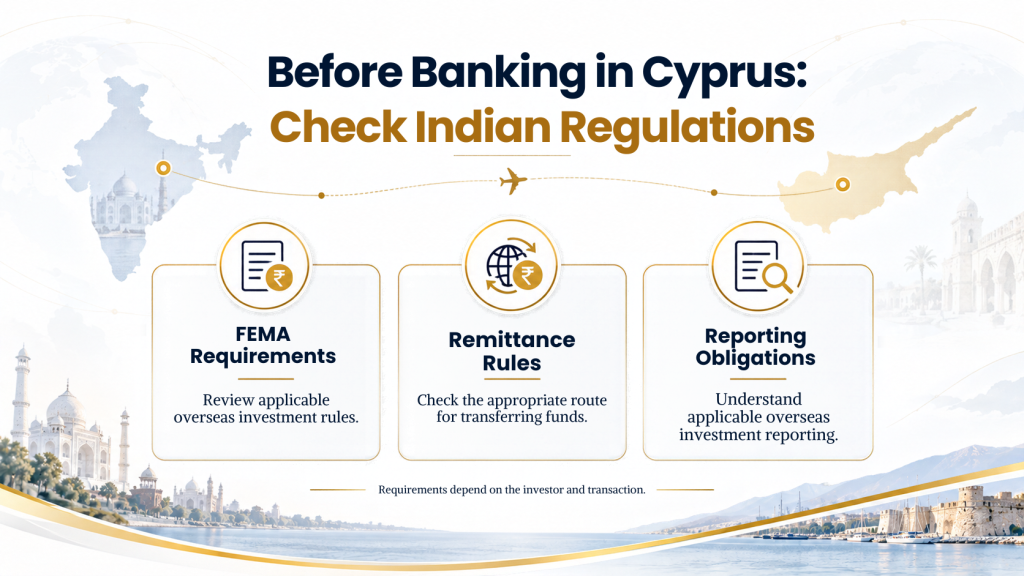
Most Cyprus banking guides ignore this, and it matters. If you are an Indian resident investing in or funding a foreign company, India’s foreign exchange rules apply to you.
In practice, that means:
Overseas investment rules under FEMA: Putting money into a Cyprus company you own is generally treated as an overseas investment, with its own conditions and reporting.
Remittance routes: Funds should move through an Authorised Dealer bank in India, using the correct route and purpose code.
The Liberalised Remittance Scheme has annual limits and purpose restrictions, so check current thresholds before sending money.
Reporting: Overseas investments typically involve filings and periodic reporting through your Authorised Dealer bank.
Getting this wrong can create problems later, including difficulty proving your source of funds to the Cyprus bank. Speak to a chartered accountant or FEMA adviser before you remit anything, and check the RBI’s current master directions.
Planning to Open a Business Bank Account in Cyprus?
Understanding your company structure and Indian regulatory requirements is an important first step. Let Vorx Consultancy help you assess your banking requirements before you apply.
Which Cyprus Banks Work for Foreign-Owned Companies?
There are various banks in Cyprus including Bank of Cyprus, Hellenic Bank, Eurobank Cyprus, Alpha Bank Cyprus, and Ancoria Bank. However, bank ownership and the names of some banks have been altered recently.
Rather than ranking banks, it helps to know what to compare:
What to compare | Why it matters |
Appetite for non-resident owners | Some banks are more open to foreign ownership than others |
Minimum balance or deposit | Requirements vary and can affect small startups |
Online banking and multi-currency options | Important for INR-linked trade, EUR and USD flows |
Industry preferences | Banks differ in how they treat trading, IT services, holding companies, and higher-risk sectors |
Onboarding method | Remote, video, or in-person can change your timeline |
What about EMIs and payment institutions? E-money institutions can be faster to open and are sometimes used as an interim solution.
They usually do not offer the full range of services a traditional bank does, so many businesses treat them as a supplement rather than a replacement.
How Does the Application Process Work?
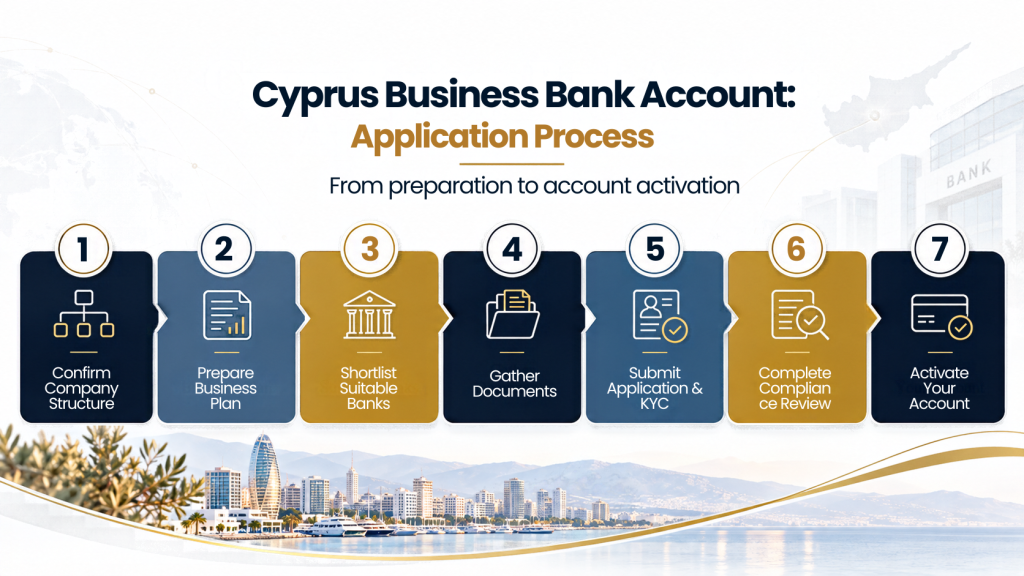
The exact sequence varies by bank, but most applications follow this pattern:
Confirm your company structure: The company should be incorporated with a clear ownership chain.
Prepare your business plan and economic rationale: Explain what the company does, who it serves, and how money will flow.
Shortlist banks: Match your business profile to the bank’s typical client base before you apply.
Gather and legalise documents: This is where delays often begin.
Submit the application and complete KYC: Expect follow-up questions and possibly an interview.
Wait for compliance review: The bank verifies ownership, activity, and source of funds.
Activate the account: This can involve an initial deposit and setting up online banking and cards.
How long does it take? Often several weeks, and longer for complex structures or missing paperwork. Treat any promise of a fixed timeline with caution.
Read this guide: Cyprus Company Formation for Foreigners: A Complete 2026 Guide
What Documents Are Required?
Requirements differ by bank and applicant, but Indian founders should expect to prepare the following.
Company documents
- Certificate of incorporation
- Memorandum and Articles of Association
- Registers of directors, shareholders, and beneficial owners
- Certificate of good standing (if applicable)
- A structure chart showing ownership up to the individual owners
Personal documents for directors, shareholders, and beneficial owners
- Passport
- Proof of residential address
- Professional or bank reference
- CV or professional profile
Documents that often apply to Indian applicants
- PAN and other ID the bank requests
- Income tax returns or financial statements
- CA-certified net worth or source-of-funds documentation
- MCA records if an Indian company is part of the structure
Apostille and certification: India is a member of the Hague Apostille Convention, so documents can generally be apostilled through the Ministry of External Affairs.
Banks often want certified copies and may ask that address proofs be recent, commonly within the last three months. Confirm each bank’s rules before you start.
Read this guide: Cyprus Company Formation Requirements: A Complete 2026 Guide
What Do KYC and Source of Funds Actually Mean?
KYC means the bank verifies who you are. Source of funds and source of wealth go a step further and ask where the money comes from.
For an Indian founder, this might mean showing:
- Business profits, supported by financial statements and tax returns
- Salary or professional income
- Proceeds from selling property or shares
- Dividend records
Cyprus has a register of beneficial owners as per the EU anti-money laundering regulations.
Banks are also obliged to report some of their customers’ information through CRS and FATCA regulations. This is expected, but this is the reason for which compliance is dictating the schedule.
What Do Banks Want to See Beyond Paperwork?
Substance means that banks want to see that there is indeed a business. It is also known as the economic rationale.
An example illustrates the difference. Consider two Indian owners, both of whom have IT services companies operating out of Cyprus.
The first company submits just a one-liner description, which goes: “IT consultancy.” No website, client contracts, or economic rationale for operating out of Cyprus is provided.
In contrast, the second company submits an elaborate two-page business plan, a working website, an executed contract with a German client, projected monthly transactions, and a mention that the company works with a Cyprus-based accountant and registered office.
Both may be legitimate businesses, but the second file gives the bank far more to work with.
Useful supporting material includes:
- Client contracts, invoices, or letters of intent
- A clear explanation of expected turnover and payment flows
- Evidence of local presence, such as a registered office, service providers, or resident directors where relevant
Why Do Applications Get Delayed or Declined?
Common reasons include:
High-risk zones: Crypto, forex, gambling, logistics and certain types of trading frequently attract greater attention.
Complicated ownership structure: This complicates the task of proving the true owner.
Weak source-of-funds evidence: Inconsistent documents raise questions quickly.
No visible link to Cyprus or Europe: The bank may wonder why the account is needed.
Vague business descriptions: If the bank can’t understand the business, it can’t assess the risk.
What if you are declined? A refusal is not always final. Many founders strengthen their file, address the bank’s concerns, and apply elsewhere.
Some use an EMI temporarily while they build a track record. Avoid submitting multiple applications without a strategy, since it can create confusion.
Prepare Your Cyprus Banking Application with Confidence.
From documentation to banking requirements, Vorx Consultancy helps foreign business owners assess their application readiness and prepare for the banking process.
What Mistakes Do Indian Founders Commonly Make?
- Remitting funds before checking FEMA and overseas investment requirements
- Assuming an account is automatic once the company is registered
- Submitting documents that are unapostilled, outdated, or inconsistent
- Applying to several banks at once with different explanations of the business
- Underestimating how much detail the bank needs about the business model
Read this guide: Cyprus Company Compliance Requirements: A 2026 Guide for Foreign Business Owners
Do You Need Professional Help?
Not always. A simple structure with a clear business model and well-organised documents can sometimes be handled directly.
Professional support tends to help when the structure involves several entities, when the business sits in a sector banks scrutinise, or when you want to avoid avoidable delays.
A good adviser can pre-screen your profile, help prepare the business case and identify which banks may suit your structure.
At Vorx Consultancy, we help founders evaluate their structure and readiness before they approach a bank, so the application matches what compliance teams expect to see.
We cannot guarantee approval, since the decision always rests with the bank. If you are considering Cyprus, book a consultation to review your situation.
Conclusion
Opening a business bank account in Cyprus is realistic for Indian founders who prepare properly.
Start with the FEMA and remittance side, develop a sound business case, gather clean documentation, and select a bank which suits you rather than apply to all banks.
The above article is meant for general knowledge only and does not provide legal, tax, and financial advice. Requirements differ from applicant to applicant and may change over time.
Ready to Open Your Business Bank Account in Cyprus?
Vorx Consultancy helps Indian entrepreneurs navigate Cyprus company formation and banking application requirements. Speak with our team to discuss your business structure, documentation and next steps.