


If you’re an Indian founder, exporter, or consultant weighing whether France is worth the paperwork, here’s the short answer: yes, you can register a company in France as a foreigner, and you don’t need to be an EU citizen, hold a French visa, or even set foot in the country to do it.
What trips people up isn’t whether it’s possible, it’s understanding which parts of the process need a visa and which don’t, because those two things get mixed up constantly, even in guides written specifically for this topic.
This article walks through exactly where that line sits, what structure makes sense for your situation, what the registration process actually looks like, and what’s changed for Indian founders specifically now that the India-France tax treaty has been updated for 2026.
Can Indian Entrepreneurs Legally Register a Company in France?
Yes. There is no nationality restriction on who can own a French company.
France has no rule that says you must be a resident, an EU citizen, or physically present in the country to hold shares in a French business entity.
Here’s where the confusion usually starts: people conflate owning a company with running one. These are two separate legal questions under French law, and they have completely different visa requirements.
Owning shares in a French company even 100% of them carries no immigration obligation whatsoever. Running one, in the sense of acting as its legal representative on French soil, is where residency and visa rules kick in.
Because India is not an EU/EEA member state, any visa requirements that apply to Indian entrepreneurs will fall under the category of non-EU regulations.
This aspect makes the difference between the two types of entrepreneurs more significant than many people think, so it deserves its own paragraph before I move forward.
Also Read This blog: Can You Register a Company in France Remotely? Complete Step-by-Step Guide
The Legal Distinction That Actually Matters: Owning a Company vs. Running One
Think of it as three separate scenarios, because French authorities treat them separately too.
Scenario 1: You’re a shareholder, not a manager. If you choose to create a company in France but somebody else (a partner, a co-founder, or even an appointed director) holds the position of the president (of a SASU) or the gérant (of a SARL), then you do not require any visa to enter and stay in France.
This applies to everybody irrespective of their nationalities, and you can take decisions regarding your company sitting in India.
Scenario 2: You want to be the legal representative, and you’re moving to France.
If you plan to become the President/Gérant of your company and also want to work and live in France, you will have to obtain a residency permit for professional purposes – usually the Talent Passport (Passeport Talent) for entrepreneurs or VLS-TS visa for self-employed persons.
It is a proven route, however, one that requires relocation.
Scenario 3: You wish to become the legal representative and remain in India.
This is the scenario that trips up almost every guide on this topic, because the answer is genuinely murky.
French administrative guidance states that non-residents generally cannot act as a corporate officer of a French company; the role that comes with legal responsibility for signing on the company’s behalf typically requires French residency.
In practice, most Indian founders who want to keep their company French-registered but themselves based in India solve this by appointing a local representative or co-founder to hold the officer title, while they remain a shareholder pulling the strategic and financial levers from home.
If your goal is a French entity for market access, credibility with European clients, or an export/e-commerce presence without moving your life to France Scenario 1 (or Scenario 3 with a local appointee) is almost certainly your path, and it’s the one most Indian entrepreneurs actually need.
Which Business Structure Should You Choose?
France offers several legal structures, but for foreign founders, three come up again and again. Here’s how they stack up:
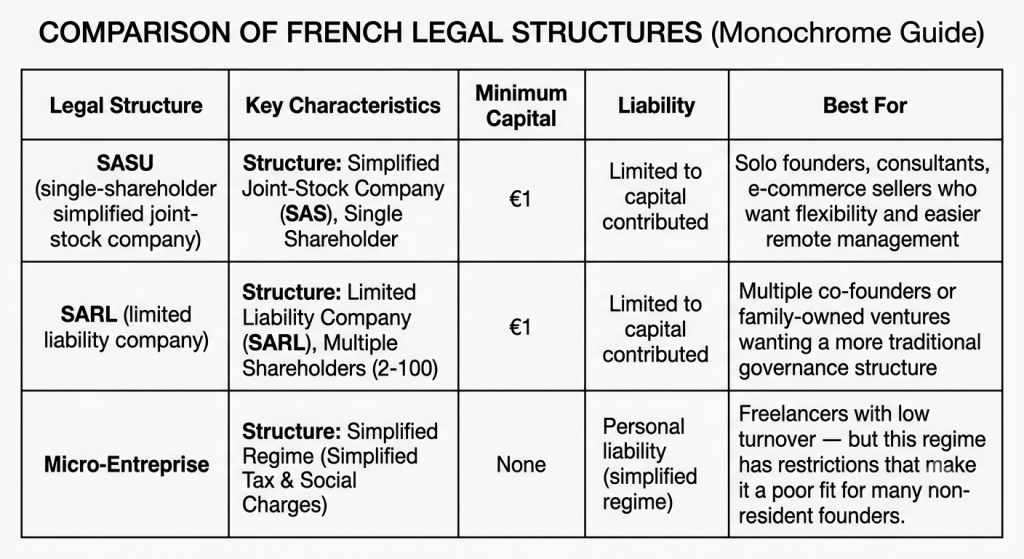
For most Indian entrepreneurs in this audience consultants, e-commerce sellers, exporters, small investors the SASU tends to be the practical default.
It’s built for a single founder, it’s flexible about how you structure your role (President vs. shareholder), and its social security treatment for the president is generally more foreigner-friendly than the alternatives.
The SARL makes more sense once you’re bringing in a co-founder or Indian business partner and want a more formal, multi-member governance setup from day one.
The Micro-Entreprise regime, despite being the simplest option on paper, is one that non-resident founders often pick by default and then regret.
It has turnover caps and administrative quirks that don’t suit a business built around exporting to or from India at any real scale.
Do You Need a Visa to Register a Company in France as a Foreigner?
If you’re not relocating and you’re not acting as the company’s legal representative, the answer is simply no you can complete company registration entirely from India.
If you are planning to relocate and manage the company in person, here’s what the visa landscape actually looks like:
Talent Passport – Créateur d’entreprise: The standard route for founders launching and running a genuine, viable business project in France.
Requires demonstrating the seriousness and viability of your project.
VLS-TS Entrepreneur/Profession Libérale: Suited to freelancers and independent professionals setting up shop in France.
Talent Passport – Corporate Officer: This one has hard numeric thresholds worth knowing if it applies to you applicants generally need at least three months’ prior seniority as an employee or officer within the same corporate group, must demonstrate they’ve genuinely been appointed as the legal representative of the French entity, and must show resources of roughly €65,600 per year.
This route is really designed for people transferring within an existing multinational structure, not first-time solo founders.
The visa question genuinely doesn’t need to be scary. Most Indian founders reading this article will never need to touch it, because they’re not planning to move to France; they want a French entity, not a French address for themselves.
Step-by-Step: How to Register a Company in France as a Foreigner
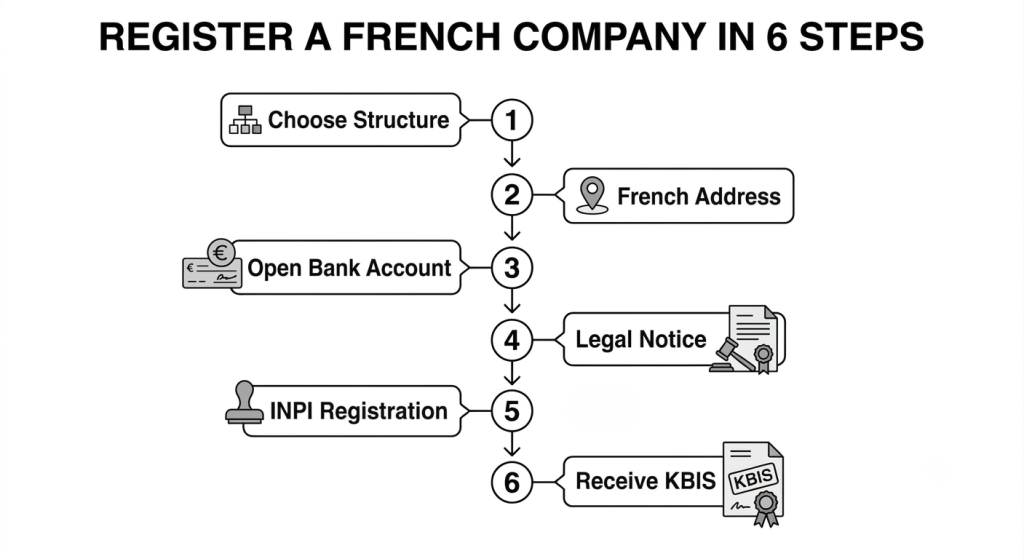
Once you’ve settled on a structure and confirmed you don’t need a visa (or you’ve sorted your visa separately), the registration process itself is fairly linear:
Set up your French business address (domiciliation). You need a registered French address for your company.
This doesn’t require owning or renting physical office space; virtual office and domiciliation services are widely available and commonly used by non-resident founders specifically for this purpose
Draft your Articles of Association. These must be in French and signed by all founders/shareholders.
If you’re not fluent, budget for a certified translator or a bilingual lawyer/accountant to draft this correctly. The first time errors here cause real delays later.
Open a business bank account and deposit your capital. This is, honestly, the step where most non-resident founders hit friction.
Traditional French banks can be slow and cautious about opening accounts for founders who aren’t physically present.
Business-focused fintech providers (like Qonto and similar) have become the more common workaround for remote founders, since they’re built for faster, more digital onboarding.
Note that while the legal minimum capital is just €1, in practice banks often expect a more substantial deposit before they’ll take your account seriously.
Publish a legal notice. Your company formation has to be announced in an authorized legal journal as a formality, but a mandatory one.
File through the Guichet Unique (INPI’s online business portal). This single online portal is where your registration actually gets submitted to French authorities.
With complete documentation, most companies register within two to four weeks.
Receive your KBIS. This is your company’s official proof of existence, the French equivalent of a certificate of incorporation, and the document banks, clients, and partners will ask to see.
None of these steps individually are complicated.
What catches people out is sequencing, trying to open a bank account before your Articles of Association are finalized, for instance, or discovering the translation requirement after you’ve already drafted documents in English.
Also Read This Blog : How to register a company in France from india
What the 2026 India-France Tax Treaty Update Means for You
This is something that is hardly found in any other guide on this subject matter, but this is important for Indian founders as in February 2026, India and France agreed upon Amending Protocol on Double Taxation Avoidance Agreement which was originally signed in 1992.
Some interesting facts are:
Capital gain from the sale of shares is subject to taxation in the country of residence of the company so your capital gain from the sale of shares of your French company will be subject to taxation in France and not in India.
Withholding tax on dividend is reduced to 5% for shareholders with 10% or more of the capital and 15% for others from the previously set flat rate of 10%.
The Favoured Nation clause has been eliminated.
This clause used to create years of litigation and ambiguity between Indian and French tax authorities over whether France automatically got the same favorable rates India extended to other countries.
Its removal actually creates more certainty going forward, even though it sounds like a reduction in benefits.
For a practical example: if you’re an Indian consultant who sets up a SASU in France, remains its majority shareholder from India, and takes dividends out each year, you’d generally be looking at that 5% or 15% withholding rate on dividends under the updated treaty, with the DTAA framework still preventing you from being taxed twice on the same income.
This is genuinely useful information for financial planning but it’s also a fast-moving area, so treat this as a starting point for a conversation with a cross-border tax advisor rather than the final word.
A Real Example: How This Plays Out in Practice
Consider a composite, realistic scenario that reflects how many Indian founders in this exact situation approach it: a Bangalore-based export consultant, sourcing textiles from Indian manufacturers and selling to boutique retailers across the EU.
She’d been paying French clients invoiced in euros through an Indian entity, but kept hitting friction. Clients wanted a French VAT number and a local point of contact, and payment delays from cross-border banking were eating into margins.
Instead of relocating, she set up a SASU with a French domiciliation address in Paris, using a local accountant as a minority co-signatory to help with day-to-day banking administration while she remained the sole shareholder and effective decision-maker from Bangalore.
The whole registration Articles of Association, bank account with a digital-first business bank, legal notice publication, and Guichet Unique filing took about three weeks once her documents were translated and finalized.
The outcome: her French clients now see a French VAT number and a KBIS-registered entity, which resolved the credibility question outright.
She never applied for a visa, never lived in France for a single day of the process, and structured her dividend withdrawals to fall under the reduced treaty rate.
The friction wasn’t the registration itself, it was making sure her documents were translated correctly the first time and picking a bank that didn’t require an in-person visit.
This is the pattern for most Indian founders pursuing this path: the legal barrier to entry is lower than expected, and the real work is in the administrative sequencing.
Common Mistakes Indian Founders Make
A few patterns show up repeatedly, and they’re worth flagging explicitly:
Assuming residency is required to own a company. It isn’t. This single misconception stops more people from starting than any actual legal obstacle does.
Underestimating how long bank account opening can take. Budget extra time here, and consider a digital-first business bank from the outset rather than a traditional French bank.
Skipping certified translation of the Articles of Association. Documents drafted informally in English and translated later often need to be redone, costing time and money.
Blurring “no visa needed to own” with “no visa needed to manage.” These are different questions with different answers see the three scenarios above.
Defaulting to Micro-Entreprise for simplicity. It looks easiest on paper, but its turnover caps and structural limitations make a SASU the better long-term choice for anyone planning to scale exports or e-commerce activity.
Why France, Specifically, for Indian Businesses
France isn’t just “another EU country” for market entry; it’s the eurozone’s second-largest economy, with deep sector strength in areas like luxury goods, pharmaceuticals, aerospace, and food and beverage, and a strategic position for reaching the wider EU single market without separate registrations in each country.
For Indian exporters and e-commerce sellers, a French-registered entity solves the credibility and VAT-registration problems that come with invoicing EU clients from an Indian entity, while the 2026 DTAA update makes the tax picture on profit repatriation and eventual exits noticeably clearer than it was even a year ago.
Conclusion:
Registering a company in France as a foreigner especially as an Indian entrepreneur is more accessible
The real question isn’t “can I do this” it’s “do I need a visa,” and for the vast majority of Indian founders who want a French entity without relocating, the answer is no.
Get your structure right, budget time for translation and banking, and the rest of the process is genuinely procedural rather than a legal obstacle course.
