
If you’re reading this from Bangalore, Mumbai, or Delhi with a French company on your mind, you’ve probably already found a dozen articles explaining what SAS and SARL mean.
What most of them skip is the part that actually matters to you: how this choice plays out when you’re incorporating from another continent, drawing a salary while relocating, sending profits back to India, or trying to convince a French consulate that your business is legitimate enough for a visa.
This guide covers all of that. We’ll define both structures, but we’ll spend most of our time on the parts that change your tax bill, your visa odds, and your ability to raise money later because those are the decisions you can’t easily undo once you’ve filed the paperwork.
Why Indian Entrepreneurs Are Expanding to France in 2026
France gives you a foothold in a market of over 450 million EU consumers without the regulatory maze of setting up separately in five different countries.
For Indian IT and SaaS companies, it’s also a market that already trusts Indian tech talent you’re not introducing yourself from scratch.
For textile, pharma, and engineering exporters, France’s position as a logistics and trade hub inside the EU means goods can move onward without another customs event.
None of that tells you whether to pick an SAS or an SARL, though.
That decision comes down to five things: how you want to run the company day-to-day, how much you’ll personally take home after social charges, how dividends get taxed when you send them to India, whether you’ll ever raise outside investment, and how easily you can exit or bring in new partners later. Let’s go through each one.
Beyond SAS and SARL: A Quick Map of French Business Structures
Before we go further if you’re a solo founder, SAS and SARL might not even be your real options. France has single-shareholder versions of both:
SASU : a one-person SAS. Same flexibility, same investor-friendliness, just one shareholder.
EURL : a one-person SARL. Simpler, cheaper to run, but less flexible if you plan to bring in partners later.
Micro-entreprise : a simplified sole-proprietor regime with revenue caps, mostly useful for testing an idea before committing to a full company.
Branch office : an extension of your existing Indian company rather than a new French legal entity, useful if you want to keep everything under one corporate umbrella.
This article focuses on SAS and SARL because they’re the structures you’ll actually need once you have (or plan to have) more than one stakeholder, or once you want a company that can grow, raise funding, or bring on a co-founder without a full legal overhaul.
If you’re a solo consultant just starting out, keep SASU and EURL in your back pocket. We’ll point out where they beat the multi-shareholder versions.
Also Reads: Can Foreigners Register a Company in France? Requirements & Eligibility
What Is an SAS (Société par Actions Simplifiée)?
An SAS is France’s answer to “give me a company I can shape however I want.” It needs just one shareholder to start (called the président, who runs the company), there’s no cap on how many shareholders you can add, and the bylaws of the internal rulebook are written from scratch rather than pulled from a fixed template.
Want a board of advisors with no formal voting power? Fine. Want three classes of shares with different rights? Fine. Want a preemption clause that gives existing shareholders first refusal before new investors join? You draft it in.
Minimum share capital is €1. Yes, really the number people assume is a barrier to entry is not the barrier at all.
This flexibility is exactly why SAS has become the default recommendation for startups, SaaS companies, and anyone who thinks they might raise outside capital someday.
Venture investors in France are used to SAS bylaws; they’re far less comfortable structuring a deal around an SARL.
What Is an SARL (Société à Responsabilité Limitée)?
An SARL is closer to what most people picture when they think “limited company.” It needs 2 to 100 partners (associés), is run by one or more managers (gérants), and its governance follows the French Commercial Code more closely — there’s less room to customize how decisions get made.
That rigidity isn’t a downside for every business; it’s often exactly what a family business or a small trading company wants, because the rules are predictable and don’t need a lawyer to reinterpret every time a decision comes up.
Same €1 minimum capital as SAS. The single-shareholder version is the EURL.
One feature worth knowing about even if you never use it: the SARL de famille. If every partner is a family member, you can elect to be taxed under personal income tax indefinitely instead of corporate tax with no time limit, unlike the equivalent option available to other structures.
For a family-run import-export or manufacturing business where profits are modest and partners want simplicity, this is a real, underused advantage that SAS simply doesn’t offer.
What SAS and SARL Have in Common
Before we get into what separates them, here’s what doesn’t:
- Both cap your personal liability at what you’ve put into the company your house in Chennai is not on the line if the French business runs into debt
- Both need only €1 in share capital to form
- Both require a registered French address and a French bank account to deposit that capital
- Both default to corporate tax (impôt sur les sociétés), with an option to elect income tax treatment under certain conditions
If someone tells you SARL is “safer” because of liability protection, they’re repeating something that stopped being a real differentiator years ago. The actual differences live elsewhere.
Key Differences Between SAS and SARL (2026 Breakdown)
Management and Governance
SAS gives you a président and whatever additional structure you want to write into the bylaws: a management committee, multiple decision-makers, custom voting thresholds for specific decisions.
SARL gives you one or more gérants operating under rules set largely by the Commercial Code.
If you’re the kind of founder who wants a shareholder agreement that can evolve as your cap table changes, SAS is built for that.
If you want a structure where the rules are already decided and nobody can quietly rewrite them, SARL’s rigidity is a feature.
The Social Security Regime — The Cost Question Almost Nobody Explains Clearly
This is the single biggest financial difference between the two structures, and it’s the one most comparison articles gloss over in a single vague sentence.
An SAS président is classified as assimilé salarié treated like a salaried employee for social security purposes, even though you’re the owner. A majority SARL gérant is classified as TNS (travailleur non salarié, self-employed).
Here’s what that means in practice: to get the same amount of money into your personal bank account, the assimilé salarié route under SAS costs the company roughly 65–80% in combined employer and employee social charges on top of net pay, while the TNS route under SARL typically runs 30–45%.
That’s a genuinely large gap on a founder salary of €50,000 net, you could be looking at a difference of several thousand euros a year in charges alone.
The trade-off: assimilé salarié status gives you fuller social protection (health coverage, pension contributions, unemployment-adjacent benefits in some cases), while TNS status is cheaper but thinner on the safety net.
If you’re relocating to France and care about the social protection that comes with it, especially if you have a family moving with you, that’s worth weighing against the extra cost.
If you’re keeping your salary low and taking most of your return as dividends instead, the gap matters less.
Example: Say you’re running a SaaS company through an SAS and want €4,000 net per month for yourself. Because of the assimilé salarié charges, your company needs to budget close to €7,000–€7,500 gross to get you there.
Run the same numbers through an SARL as a majority gérant, and you’d likely need somewhere closer to €5,500–€6,000 gross for the same €4,000 net. Over a year, that’s a difference that can fund a hire.
Dividend Taxation (2026 Update)
As of 2026, dividends from either structure are taxed under the flat tax (prélèvement forfaitaire unique, or PFU) at 31.4% — split between 12.8% income tax and 18.6% social levies.
Both structures also let you opt into the progressive income tax scale instead, with a 40% allowance on dividends, which can work out better if your overall French income is on the lower end.
Here’s the asymmetry that actually matters: in an SARL with a majority gérant, any dividends above 10% of the share capital get hit with additional social contributions on top of the standard flat tax. SAS dividends don’t carry this extra layer, regardless of amount.
If your plan involves keeping share capital low (which most founders do, since €1 is legal) and paying yourself meaningfully through dividends later, that 10% threshold in an SARL gets crossed almost immediately, and the extra charges start eating into what you take home.
Raising Capital, Investors, and Equity
If there’s a startup founder or SaaS company reading this and wondering whether to even consider SARL — don’t.
SAS supports share classes, BSPCE (employee stock option plans, France’s equivalent of ESOPs), and vesting schedules. SARL supports none of this cleanly.
French investors, incubators, and VCs are structured to work with SAS bylaws as a matter of course; asking one to invest into an SARL is asking for friction you don’t need.
If fundraising is anywhere in your plan even a maybe, even eighteen months out incorporate as an SAS from day one. Converting a structure later is possible, but it’s slower and pricier than getting it right the first time.
Transferring or Exiting Shares
SAS shares transfer relatively freely, governed by whatever your bylaws say. SARL share transfers to outside parties require approval from a majority of existing partners (the agrément process) — which protects the current partners from an unwanted new co-owner, but also slows down an exit if you’re trying to sell your stake or bring in a buyer for the business.
If you’re running an import-export or manufacturing business with an eventual sale or generational handover in mind, factor this in SARL’s protection can become a bottleneck exactly when you need speed.
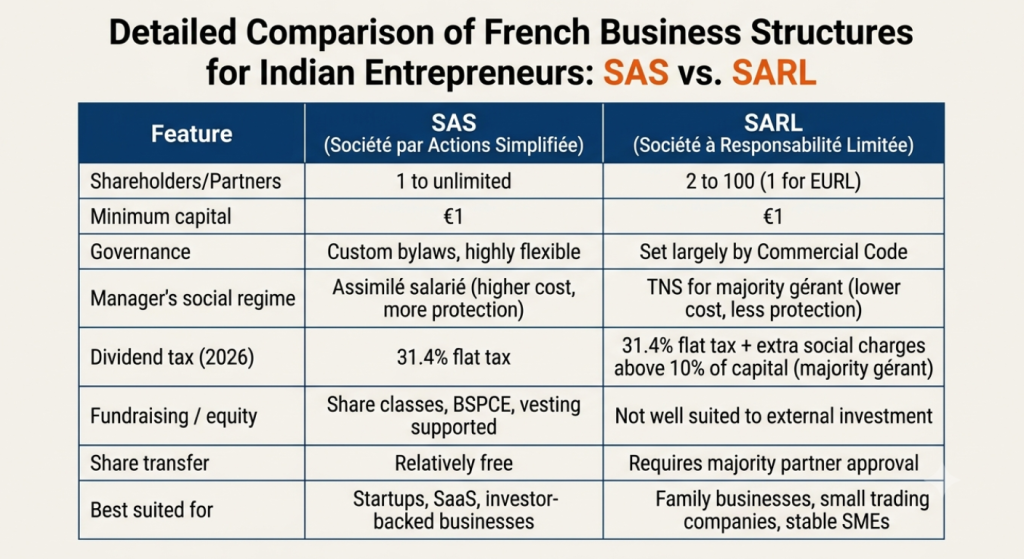
SAS vs SARL: Comparative Table
Which Structure Fits Your Type of Business?
Startup founders and SaaS companies: SAS, almost without exception. You’ll want the fundraising flexibility and BSPCE access before you think you need it.
E-commerce businesses: SAS if you’re scaling with multiple stakeholders or planning outside investment. If it’s just you, SASU gets you the same flexibility without the overhead of a multi-shareholder structure.
IT and consulting firms: This one genuinely depends on size. A solo consultant is usually better off with an EURL lower social charges, simpler admin.
A multi-partner consulting firm often does well with an SARL for cost control and predictability, unless you’re planning to bring in outside talent as equity partners, in which case SAS’s flexibility earns its keep.
Small business owners and family businesses: SARL, and specifically look at the SARL de famille election if every partner is related. The indefinite income-tax treatment can meaningfully simplify your tax situation.
Manufacturing businesses: SARL tends to read as more stable to French banks and traditional B2B partners you’ll be negotiating supply and credit terms with. If you’re planning to raise capital for expansion, SAS becomes the better fit.
Import-export companies: SARL works well for straightforward trading operations with a small, fixed group of partners. If you’re building toward multi-country expansion or bringing in investors to fund growth, move to SAS.
Foreign investors not managing day-to-day: SAS. It’s easier to structure passive shareholding, custom voting rights, and exit terms without needing to be physically involved in governance.
Professionals planning broader EU expansion: SAS. It’s the easier structure to restructure, add shareholders to, or use as a template when you replicate the setup in another EU country later.
Special Considerations for Indian Entrepreneurs
This is the part most guides skip entirely, and it’s usually where the real decision gets made.
You don’t need to relocate to own a French company. This surprises a lot of people. Incorporating an SAS or SARL and holding shares in it carries no residency requirement at all; you can own 100% of a French company from your desk in India.
The visa question only comes up if you plan to actively manage the business from inside France yourself.
Visa pathways, if you do plan to relocate: The Talent Passport Business Creator route is built for founders setting up and personally running a business in France.
If your business is tech-sector and genuinely innovative, the French Tech Visa (officially “Talent, Porteur de projet économique innovant”) is the other option but it requires your project to be endorsed by a recognized incubator or accelerator (Station F and Bpifrance-backed programs are common routes) and proof of sufficient financial resources to support yourself while the business gets going.
A 2025 rule change that affects your timeline: Since a June 2025 decree, the Entrepreneur/Profession libérale visa route now requires a prior economic-viability assessment of your project by French labour authorities before approval.
This isn’t a rubber stamp to build extra weeks into your planning, and make sure your business plan is genuinely investor-grade before you submit, not just a formality document.
Remote incorporation is real, but the bank account is where things slow down. You can handle most of the incorporation paperwork remotely with apostilled and translated documents and a registered French business address.
The actual friction point is opening the mandatory business bank account to deposit your share capital.
Traditional French banks often want an in-person meeting before they’ll open an account for a foreign-owned entity which obviously creates a chicken-and-egg problem if you’re trying to incorporate before you travel.
Neobanks like Qonto and HSBC France’s business offering support remote account opening for foreign founders and are usually the practical starting point.
DTAA and sending money home: The India-France Double Taxation Avoidance Agreement governs how dividends and profits you repatriate to India get taxed on both ends and it can meaningfully affect whether you’re better off drawing more salary or more dividends, given the differences we walked through above.
This isn’t something to work out on your own; a cross-border tax advisor who understands both jurisdictions should be involved before you finalize how you’ll pay yourself, not after your first year of filings.
Documents you’ll need as an Indian applicant: an apostilled copy of your passport, Articles of Association translated into French, proof of your Indian address, and if you’re setting up a branch or subsidiary of an existing Indian company rather than a standalone entity your Indian company’s incorporation documents as well.
Also Read: Can You Register a French Company Remotely? Step-by-Step Guide
Common Mistakes Indian Entrepreneurs Make When Choosing Between SAS and SARL
Assuming you need to be a French resident to incorporate. You don’t. This misconception alone delays a lot of founders by months.
Picking SARL because it seems “cheaper to start.” Both structures have the same €1 minimum capital. The cost difference between them shows up later, in social charges and dividend tax not at formation.
Ignoring the social charges gap until the first payroll run. Founders often pick a structure based on governance style alone, then get an unpleasant surprise when the first month’s charges come in. Run the numbers on assimilé salarié vs. TNS before you incorporate, not after.
Using a free template for SAS bylaws instead of customizing them. SAS’s whole value is in the customization.
A generic template with no thought given to preemption rights, exit clauses, or related-party rules will bite you the moment a second investor or co-founder joins and rewriting bylaws after the fact is more expensive than getting them right at formation.
Not planning your fundraising path before incorporating. If there’s even a reasonable chance you’ll raise outside money, start as an SAS.
Converting an SARL to an SAS later is possible but adds legal cost and delay right when you’re trying to close a round.
Underestimating visa or incubator approval timelines. Incorporating before your business plan is genuinely viability-ready especially under the post-2025 assessment rules just means resubmitting later. Get the plan right first.
Step-by-Step: How to Register an SAS or SARL From India
- Choose your company name and confirm it’s available
- Draft the bylaws (statutes) — budget more time for this with an SAS, since there’s more to customize
- Deposit your share capital into a blocked account and get the attestation de dépôt de fonds
- Appoint your président (SAS) or gérant (SARL)
- File your formation documents through France’s INPI one-stop business formalities portal
- Receive your K-bis extract and SIRET number — your company now officially exists
- Register for the relevant tax and social security regimes
- If you’re relocating to manage the business in person, apply for your visa — ideally with your entity already formed and your business plan finalized.
Read this Guide: How to Register a Company in France from India (2026 Guide)
SAS or SARL — Which Should You Choose?
If you strip away everything else, the decision usually comes down to a handful of questions:
- Are you solo? Look at SASU or EURL before either SAS or SARL.
- Planning to raise investment, even eventually? SAS.
- Family-owned and planning to stay small? SARL — and check whether the SARL de famille election fits.
- Multiple unrelated partners who want predictable, structured governance? SARL.
- Multiple partners who want flexible, investor-ready governance? SAS.
Getting this wrong isn’t fatal, but it’s expensive to fix new bylaws, new filings, and in some cases a fresh visa conversation.
It’s worth a proper consultation before you commit, not a decision made from a comparison table alone.
How We Help Indian Entrepreneurs Set Up in France
Vorx Consultancy works with Indian founders through exactly this decision every week from choosing between SAS and SARL, to drafting bylaws that won’t need a rewrite the moment your first investor shows up, to navigating the bank account bottleneck and the visa paperwork in parallel rather than in sequence.
If you’re weighing this decision right now, talk to us before you file anything. It’s a lot cheaper to get the structure right the first time than to restructure it a year in.
Conclusion
If there’s one thing to take away from all of this: the SAS-vs-SARL decision isn’t really about which structure is “better” it’s about which one matches what you’re actually planning to do.
SAS earns its higher cost and complexity the moment fundraising, multiple future partners, or serious scaling are part of your plan.
SARL earns its simplicity when you’re running a smaller, stable business with partners you already trust, especially if family is involved.
Get honest with yourself about which one describes your next three years, not just your first, and the choice usually makes itself. If it doesn’t, that’s exactly what a consultation is for talking to us before you file.