
If you’ve been circling this question for a while, here’s the short version: yes, foreigners can register a company in the Netherlands.
But “yes” hides a lot of nuance that most guides skip over and that nuance is exactly what decides whether your registration takes two weeks or two months.
The Netherlands has become a default landing spot for Indian founders eyeing Europe. It’s English-friendly, has one of the most efficient company registries in the EU, and gives you a legal base to invoice EU clients, hold EU-facing IP, or run VAT-compliant e-commerce across the continent.
But the rules that apply to you depend heavily on one thing most articles bury on page two: where you’re a citizen of, and whether you plan to actually live in the Netherlands or just own a company there.
This guide walks through both, with the real requirements, and the mistakes that trip up first-time founders.
Can Foreigners Register a Company in the Netherlands? (Quick Answer)
Yes, with one dividing line that determines everything else: are you an EU/EEA/Swiss citizen, or not?
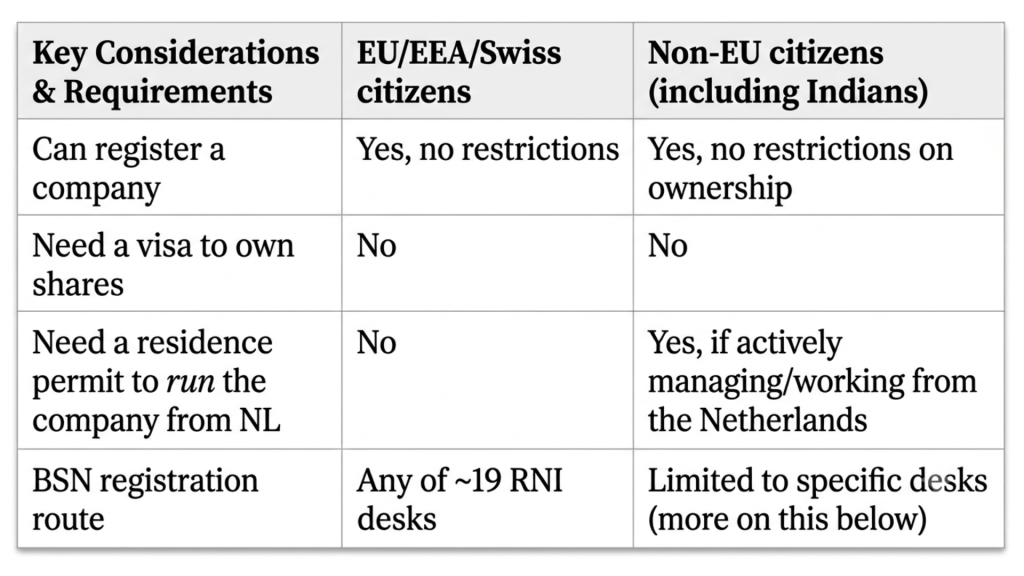
That last row is the one nobody talks about, and it’s the practical bottleneck for most Indian founders. We’ll get to it.
For now, the headline point: owning a Dutch company and running it from inside the Netherlands are two different legal situations.
A lot of confusion and a lot of wasted time comes from treating them as the same thing.
EU/EEA Nationals vs Non-EU Nationals What's Actually Different
If you’re an EU, EEA, or Swiss citizen, the Dutch system barely blinks at your nationality.
You register, you get a citizen service number, you’re done the same process a Dutch national goes through.
If you’re Indian (or from any non-EU country), you sit in a different bucket. Here’s what that actually means in practice:
You can own 100% of a Dutch company — shares, voting rights, everything with zero nationality restriction. The Netherlands doesn’t require a local co-owner or a Dutch shareholder.
You do not automatically get the right to live or work in the Netherlands just because you own a company there. Ownership and residency are handled by completely separate legal frameworks.
If you want to physically run the business from Dutch soil, sit in an office, meet clients, manage staff day-to-day you’ll need a residence permit tied to entrepreneurship, or a startup visa.
This is the distinction that decides your entire next step. A founder who wants to open a holding company and never set foot in Amsterdam has a completely different (and much simpler) path than a founder who wants to relocate and run operations locally.
Do You Need to Live in the Netherlands to Register a Company?
No, and this is worth sitting with, because it changes how a lot of Indian entrepreneurs should be thinking about this.
Take a composite example that mirrors what we see often: an IT consultant in Pune wants to invoice European clients through a Dutch entity for tax and credibility reasons, but has no intention of relocating.
In this case, they can be the sole director and shareholder of a Dutch BV, run it remotely, and never apply for a residence permit because they’re not physically working from the Netherlands.
Compare that to a founder building a D2C brand who wants to be on the ground in Rotterdam, hiring locally and managing warehousing in person.
That founder needs a residence permit, because they’re now an active participant in the Dutch labor market, not just a remote owner.
The rule of thumb: residency permits apply to work, not to ownership. If you’re not working from within the Netherlands, you generally don’t need one to hold a company there.
This single point resolves a huge chunk of the confusion in this space, and most guides don’t spell it out this plainly.
That said, “remote” doesn’t mean “paperwork-free.” You’ll still need a Dutch business address, a notary for incorporation (if you’re forming a BV), and this is the part that catches people off guard with a citizen service number, even as a non-resident owner.
Eligibility Checklist for Foreign Entrepreneurs
Before you can register anything, you need these four things lined up. Get them out of order and you’ll spend more time waiting on appointments than actually building your business.
- A BSN (Citizen Service Number). This is the Dutch equivalent of a tax ID crossed with a national ID number, and the Chamber of Commerce (KVK) requires it before your company can be registered. You can’t skip it, and you can’t fake your way around it with a foreign tax number.
- A registration route for that BSN. If you’re relocating and staying more than four months, you register with the Personal Records Database (BRP) at your local municipality.
If you’re staying under four months or registering remotely as a non-resident, you go through the Non-Resident Records Database (RNI) instead.
As of 2026, non-EU passport holders can only use a small number of designated RNI desks (Breda and Venlo, specifically), while EU/EEA/Swiss citizens have access to roughly 19 locations.
If you’re Indian and planning to register without relocating, book your RNI appointment early. These desks fill up.
3. A Dutch business address. This can be your own home if you’re relocating, a rented office, or a virtual/business address arrangement (commonly through an accountant, who signs a consent letter allowing you to use their address).
A P.O. box will get your application rejected outright if the KVK wants a real, inspectable location.
4. A civil-law notary, if you’re forming a BV. Sole proprietorships (eenmanszaak) skip this step, but a BV requires a notarial deed of incorporation.
This is also where remote incorporation becomes possible: notaries can work via power of attorney, so you don’t necessarily need to be physically present for this part, even if the BSN process does eventually require in-person ID verification.
Step-by-Step Process to Register a Company in the Netherlands
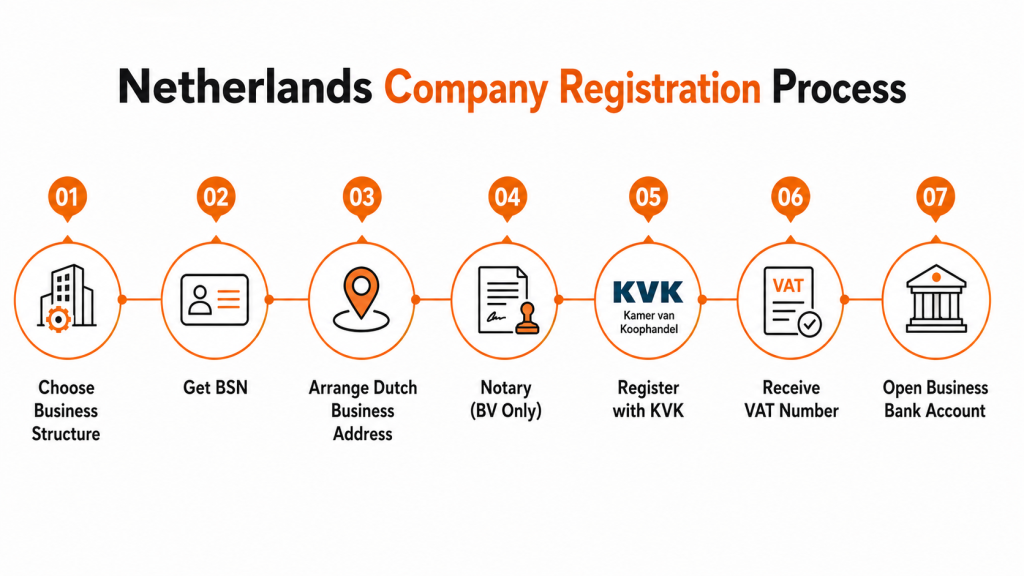
Once the four pieces above are in place, the actual registration moves fast, often just a few days from your KVK appointment to a live registration.
Pick your legal structure (covered in detail below — this decision affects your notary requirement, liability, and tax treatment).
Secure your BSN through BRP or RNI, depending on your residency plan.
Draft the incorporation deed with a notary — only if you’re forming a BV. Sole proprietorships skip straight to step 4.
Register with the KVK — book an appointment, bring your ID and address proof, pay the registration fee, and the KVK verifies everything on the spot.
Get passed through to the Belastingdienst — the KVK automatically forwards your details to the Dutch Tax Administration, and you’ll receive a VAT (BTW) number within about two weeks.
That’s the whole spine of it. Everything else: bank accounts, compliance, tax filings happens after you’re registered, not before.
Read This guide: How to Register a Company in the Netherlands
Business Structures Available to Foreigners
Which structure fits you depends less on nationality and more on what kind of founder you are:
Eenmanszaak (sole proprietorship) — the simplest option, no notary needed, minimal setup cost.
This is what most solo IT consultants, freelance developers, and single-operator agency owners choose. The tradeoff: no liability separation, so business debts are personal debts.
BV (private limited company) — the equivalent of a private limited company back home. Requires a notary and slightly more upfront cost, but gives you liability protection and credibility with EU clients and banks.
This is the default choice for SMEs, e-commerce brands scaling into the EU, and agencies hiring a team.
Branch office — if you already run a company in India and want an EU-facing extension rather than a separate legal entity, a branch lets you operate under your existing corporate identity. Common among exporters and importers who need an EU presence for customs and logistics purposes without fully re-incorporating.
Holding BV structures — investors often set up a holding company that owns operating subsidiaries underneath it, mainly for tax planning and liability separation between different ventures.
This is a more involved setup and usually warrants its own dedicated planning session rather than a DIY approach.
Read this Guide: Dutch BV vs Sole Proprietorship: Which Business Structure Is Best for Foreign Entrepreneurs?
Not sure if a BV or sole proprietorship fits your business?
Get a free structure consultation with our experts and find the right business structure for your goals.
Visa and Residency Options for Company Owners
This section only applies if you’re planning to actually relocate and work from the Netherlands remember, ownership alone doesn’t require any of this.
Self-employed/entrepreneur residence permit — for founders who’ll run their business hands-on from Dutch soil.
Requires demonstrating your business serves a “Dutch interest” (economic value, innovation, or job creation), assessed through a points-based system.
Residence permit for foreign startups — a lighter-touch route for early-stage founders, requiring a facilitator (an established Dutch business or incubator) to support your application.
Built specifically for startup founders entering the EU market, not established SMEs.
Highly Skilled Migrant permit — relevant if you’ll be drawing a salary from your own Dutch company and meet the minimum income threshold; more common for founders who structure themselves as an employee of their own BV.
If you’re just a shareholder or remote director and not drawing income from active work inside the Netherlands, none of these apply to you.
Opening a Business Bank Account as a Foreign Founder
This is where a lot of remote founders hit friction they didn’t expect. Dutch banks apply strict KYC checks, and non-resident directors even with a fully registered company sometimes get declined or face long onboarding delays simply because they don’t have a Dutch residential history.
Two realistic paths: apply with a traditional Dutch bank and expect the process to take weeks, or use an EU-regulated fintech business account, which tends to onboard non-resident founders faster.
Either way, budget time for this step it’s rarely instant, and if you’re e-commerce or export-focused, Dutch and EU clients will often expect payments through a Dutch IBAN specifically, so this isn’t a step you can skip or delay indefinitely.
Tax Considerations for Foreign-Owned Dutch Companies
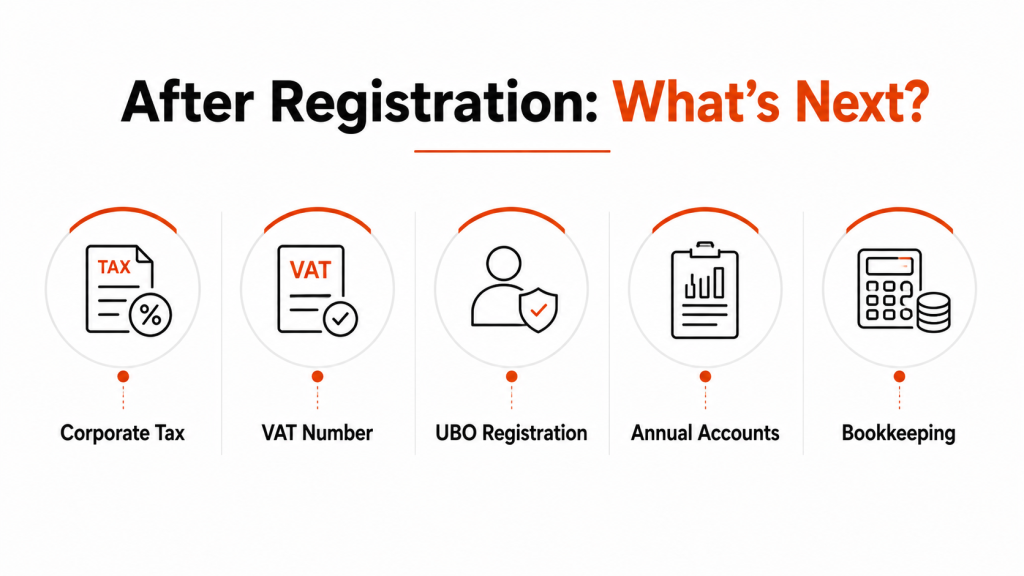
Corporate tax applies to BVs regardless of where the owner lives the company pays Dutch corporate tax on its profits, currently structured in bands, with the lower rate applying up to a set profit threshold and the higher rate above it.
VAT and the OSS scheme matter a lot if you’re selling to consumers across the EU.
The One Stop Shop scheme lets you file VAT for multiple EU countries through a single Dutch registration instead of registering separately in each one, a genuine advantage for e-commerce sellers scaling across borders.
Substance requirements are worth taking seriously. A Dutch company with no real address, no local activity, and no economic substance can get flagged as a shell entity by tax authorities, which undermines the exact tax efficiency you’re likely setting the company up for.
The India–Netherlands Double Taxation Avoidance Agreement (DTAA) prevents you from being taxed twice on the same income across both countries relevant if you’re drawing dividends or income back to India from your Dutch entity.
This is worth a proper conversation with a cross-border tax advisor rather than a DIY read of the treaty text.
Compliance and Ongoing Obligations
Registration is the start line, not the finish line. Once you’re operating, a few things stay on your plate every year:
UBO (Ultimate Beneficial Owner) registration — anyone owning 25% or more of the company must be declared in the UBO register. This isn’t optional, and failing to register carries real fines.
Annual accounts filing — BVs must file annual financial statements with the KVK.
Bookkeeping — Dutch tax authorities expect proper, ongoing bookkeeping, not an end-of-year scramble.
Most foreign owners hire a local accountant for this rather than attempting it themselves from abroad.
Common Mistakes Foreign Entrepreneurs Make
Registering before securing a BSN appointment. The BSN process especially through the limited non-EU RNI desks can take longer than expected. Founders who don’t plan for this end up delaying their entire timeline.
Using a P.O. box as a business address. It gets rejected every time. Use a real address, even if it’s a shared or virtual business address arrangement.
Underestimating notary and accountant costs. The KVK fee is small; the real cost sits in notary work and ongoing bookkeeping, and founders who budget only for the €85 registration fee are consistently caught off guard.
Assuming you need a local Dutch director. You don’t. Unlike some countries that require a resident director on paper, the Netherlands has no such rule; you can be your own sole director as a foreign national.
How Vorx Consultancy Helps
Everything above is doable on your own but most Indian founders don’t have the bandwidth to chase RNI appointments, coordinate with a Dutch notary, and figure out KVK paperwork while also running their actual business. That’s the gap Vorx fills.
Vorx handles the full registration process end-to-end: securing your BSN, arranging the notary for BV incorporation, completing your KVK filing, and getting your VAT number sorted with the Belastingdienst.
If you’re going the remote-owner route, Vorx coordinates the power-of-attorney paperwork so you never have to fly out just to sign a form.
And once you’re registered, the same team can take on your ongoing bookkeeping, UBO filing, and annual compliance so your Dutch entity stays in good standing without eating into the time you’d rather spend on growth.
For founders still deciding between a sole proprietorship, a BV, or a branch office, Vorx Consultancy also offers a quick structure consultation before you commit to anything worth doing before, not after, you’ve paid notary fees.
Is the Netherlands Right for Your Expansion?
If you’re a startup founder chasing EU market entry, an SME owner wanting BV-level credibility, an e-commerce seller who needs the VAT efficiency of the OSS scheme, an IT consultant invoicing European clients, an exporter needing an EU logistics presence, or an investor structuring a holding entity the Netherlands accommodates all of these, and none of them strictly require you to relocate.
The real decision point isn’t “can I register a company as a foreigner“, the answer is yes, consistently.
It’s whether you want to run it from India or from inside the Netherlands, because that single choice determines whether you’re dealing with a straightforward registration or a full residence permit application on top of it.
Get that decision right first, and the rest of the process BSN, notary, KVK, tax registration is genuinely one of the more efficient company formation systems in Europe.