
Starting a business in Hong Kong involves more than registering a name and opening a corporate account. The Types of Business Entities in Hong Kong available to you can affect your personal liability, ownership, tax obligations, compliance workload and ability to expand later.
There are several common types of business entities in Hong Kong, including private limited companies, sole proprietorships, partnerships, agencies, and representative offices. Each entity has specific characteristics and requirements, and potential advantages and disadvantages. Understanding these intricacies is particularly important for Indian entrepreneurs and other foreign nationals looking to do business in Hong Kong.
In this article, you’ll learn about the main types of business entities in Hong Kong, their differences and how to choose the most suitable one for your business needs.
Hong Kong Business Structures at a Glance
Before looking at each structure separately, the following Hong Kong business structure comparison provides a quick overview of the main differences.
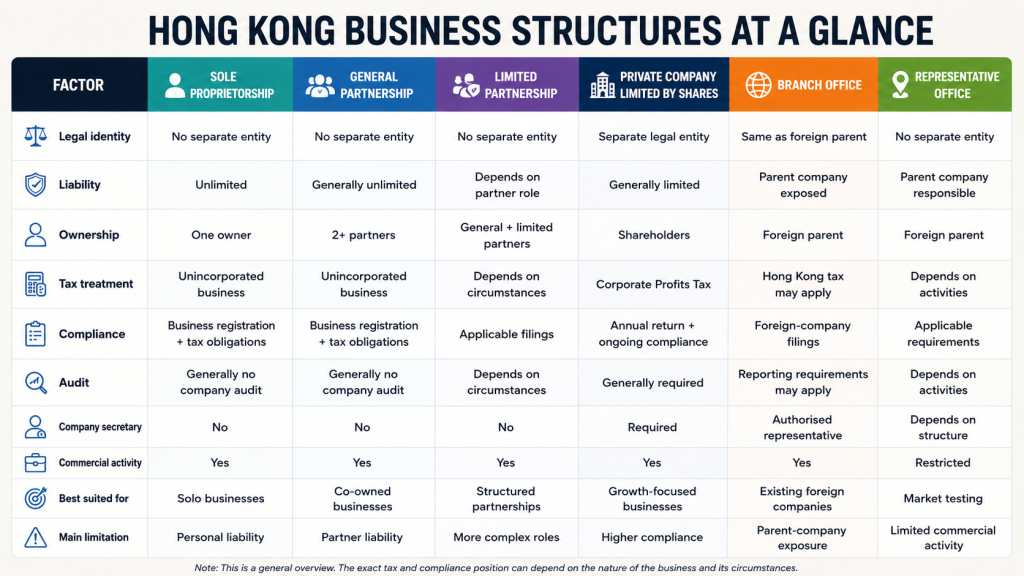
Note: This table is a practical overview. The exact tax and compliance position can depend on the nature of the business and its circumstances.
Recommended Reading:
If you want to understand the registration process step by step, read our guide on How to Register a Company in Hong Kong before choosing your business structure.
Private Company Limited by Shares:
A Private Company Limited by Shares is a separate legal entity from its shareholders. This separation is one of its biggest advantages because the company’s liabilities are generally distinct from the personal liabilities of its owners. For businesses planning to operate for the long term, this structure offers greater flexibility around ownership and shareholding. It can also provide a more suitable framework when a business expects to hire employees, enter larger contracts, work with international clients or bring in additional shareholders later.
A Hong Kong private company must have at least one director and a company secretary, with specific requirements applying to their eligibility. The company also has ongoing filing and record-keeping obligations.
Best for: Startups, SMEs, e-commerce businesses, consultants and international entrepreneurs planning a long-term operation.
Sole Proprietorship:
A sole proprietorship is one of the simplest ways for an individual to operate a business. There is only one owner, and the business does not have a separate legal identity from that person. This simplicity can make it suitable for freelancers, independent consultants and very small businesses with relatively low commercial risk. The trade-off is unlimited personal liability. If the business cannot meet its obligations, the owner’s personal assets may be exposed.
Tax and registration requirements also apply. A sole proprietorship falls within the rules for unincorporated businesses rather than being taxed as a separate incorporated company.
Best for: Solo entrepreneurs running small and relatively low-risk businesses.
General Partnership:
A general partnership allows two or more people to operate a business together. Partners can share responsibilities, profits and decision-making according to their partnership agreement. It can be useful when several founders want to work together without creating a limited company. However, liability is an important consideration because general partners can have significant personal responsibility for partnership obligations.
For this reason, the relationship between partners should be clearly defined from the beginning. Ownership percentages, profit sharing, management responsibilities and what happens if a partner leaves should ideally be agreed before the business starts operating.
Best for: Small businesses with multiple owners who want a relatively straightforward partnership structure.
Limited Partnership:
A limited partnership is different from a general partnership because partners can have different levels of responsibility. A general partner typically has broader management responsibilities and greater liability, while limited partners have a more restricted role and liability subject to the applicable rules. This structure can be useful when the people contributing capital do not necessarily want the same management role as the person running the business.
Hong Kong also has a Limited Partnership Fund regime designed specifically for private funds and investment management. It is therefore important not to assume that every limited partnership is simply another form of ordinary operating company.
Best for: Structured partnership and investment arrangements where partners have clearly defined roles.
Branch Office:
A branch office is particularly relevant when an existing foreign company wants to establish a presence in Hong Kong. Unlike a subsidiary, a branch does not create a completely separate legal entity. It is an extension of the overseas company. This can allow the parent business to maintain closer control over its Hong Kong operations while carrying out permitted business activities there.
The main consideration is liability. Because the branch and parent company are legally connected, the overseas parent remains responsible for the branch’s obligations. Registered non-Hong Kong companies must also meet applicable registration and filing requirements in Hong Kong.
Best for: Established foreign companies that want to extend their existing business into Hong Kong.
Representative Office:
A representative office is designed for a very different purpose. It can allow a foreign business to explore the Hong Kong market, conduct research, build relationships and promote its business before establishing a full commercial operation. The key limitation is that a representative office cannot operate like a normal trading company. It is not intended for ordinary profit-making commercial activities.
For example, a foreign company may use this type of presence while assessing customer demand or building a network in Hong Kong. If it later decides to conduct full commercial operations, it may need to consider another structure.
Best for: Foreign companies that want to explore the Hong Kong market before establishing a full operating presence.
Branch vs Subsidiary : What Should Foreign Companies Choose?
For an existing overseas business, deciding between a branch and a subsidiary can be more important than simply choosing a registration method.
A branch remains legally connected to the foreign parent. A Hong Kong subsidiary, normally established as a private company limited by shares, is a separate legal entity with its own corporate structure.
Factor | Branch | Subsidiary |
Legal identity | Same as parent | Separate entity |
Liability | Parent exposed | Generally limited to subsidiary |
Ownership | Foreign parent | Shareholders |
Structure | Extension of existing business | Separate Hong Kong company |
Suitable for | Extending an existing operation | Building an independent operation |
If you want the Hong Kong operation to function as a more independent business, a subsidiary may offer greater flexibility. If maintaining a direct connection with the overseas parent is more important, a branch may be worth considering.
There is no universal answer; the right choice depends on liability, control, operations and long-term plans.
How to Choose the Right Hong Kong Business Entity?
There is no one-size-fits-all business structure in Hong Kong, it ultimately depends on the goals and needs of the entrepreneur. Consider the following factors:
- business activity– what will be your business activity including trading, consulting, investing or research activities?
- Potential liability – how much risk is the owner or parent company willing to undertake?
- Ownership considerations – will any partners, shareholders, or investors be required to be brought on board?
- The growth of the business – is it a test-market launch, or does the company intend to scale up its operations?
For a small solo activity, a sole proprietorship may be sufficient. A growing business may benefit from a private limited company, while an existing foreign company needs to compare a branch with a subsidiary. A representative office may be more appropriate when the immediate goal is market research rather than commercial trading.
This is the practical way to choose a business structure in Hong Kong rather than selecting one simply because it appears easy to register.
What Are the Tax and Compliance Considerations ?
While tax considerations should not be the sole determining factor in structuring, other factors also should be taken into account.
Hong Kong operates under a territorial Profits Tax system, and the two-tier system saw a reduction in the effective tax rate for qualifying companies for the first HK$2 million of assessable profits. The exact rates will depend on whether the company is incorporated or unincorporated and will follow separate sets of rules.
In addition to filing taxes, businesses must continue to fulfill other requirements depending on the structure. Businesses must file documents in Companies Registry (for local limited companies) or equivalent agencies (for overseas entities). Accounting requirements, audit requirements, and ongoing secretarial/administration duties must also be fulfilled.
The important point is simple: incorporation is only the beginning of running a compliant business.
Which Hong Kong Entity Is Best for Indian Entrepreneurs?
For Indian entrepreneurs, the right structure depends largely on whether you are starting a new business or expanding an existing Indian operation. A freelancer or consultant working on a small, low-risk activity may find a sole proprietorship practical. An Indian founder building an e-commerce company, consulting business or international service company may prefer a private limited company because it provides a separate corporate structure for long-term growth.
If you already operate an Indian company, a branch or subsidiary deserves closer consideration. A representative office can be useful if you are still researching the Hong Kong market and are not ready for full commercial operations.
For most serious business expansion plans, the decision should go beyond the initial registration process. Ownership, liability, banking, compliance and future expansion should all be considered before choosing a structure.
Recommended Reading:
Indian entrepreneurs planning to establish a business in Hong Kong can also explore our detailed guide on how to register a company in Hong Kong from India, including the key requirements and setup considerations.
Can You Change Your Hong Kong Business Structure Later?
Yes, but changing one’s structure often requires more substantial paperwork than just updating the business registration. It depends on what structure is being changed and what it is being changed to. For example, a sole proprietorship or partnership is not transformed automatically into a limited company by virtue of updating the business registration in Hong Kong. The owner(s) will have to apply for incorporation of a limited company withCompanies Registry. This Registry requires proprietorships/partnerships that wish to become limited companies to apply for incorporation of a new company under theCompanies Ordinance.
In practical terms, the transition may involve:
- Incorporation of the new company, including submission of relevant incorporation documents, such as the incorporation form and Articles of Association.
- Cancellation or other processing of the previous business registration, if applicable.
- Migration of business aspects, such as agreements, assets, employees, licences or permits, if applicable.
- Updating of banks, customers, suppliers and other business partners.
- Settlement and updating of tax and accounting records so that they reflect the change.
In addition, if a company is incorporated in Hong Kong, but it wishes to change some aspects of its structure (rather than changing incorporation from, say, a proprietorship to a limited company), additional submissions may be required by Companies Registry. For example, there are specific forms required when changes are made to company particulars, directors, company secretary, articles of association, and company status.
The Key Point is, changing business structure is possible, but it always involves more paperwork than just updating the business registration. What precisely has to be done depends on what structures are involved.
Common Mistakes Foreign Entrepreneurs Make
Foreign founders often focus heavily on registration and overlook what happens after the business is established. The most common mistakes include:
- Choosing a structure only because it is simple to register
- Treating a branch and subsidiary as the same thing
- Assuming a representative office can conduct normal commercial activities
- Looking at tax rates without considering liability and compliance
- Ignoring future ownership or expansion plans
A structure that works for a small consulting activity may not be suitable once the business begins hiring employees, signing larger contracts or taking on significant commercial risk.
Quick Decision Guide:
You can use the following quick guide to see which Hong Kong business structure may best match your business needs, ownership plans and long-term goals. It offers a simple comparison to help you narrow down the most suitable option before making your decision.
Your situation | Structure to consider |
Solo founder with a small, low-risk activity | Sole Proprietorship |
Building a scalable business | Private Company Limited by Shares |
Starting a business with partners | General Partnership |
Structured investment or partnership arrangement | Limited Partnership |
Existing foreign company entering Hong Kong | Branch Office |
Testing the Hong Kong market | Representative Office |
How Can Vorx Help You Choose the Right Structure?
Choosing between different Hong Kong business structures can be difficult when you also need to think about ownership, compliance, banking and international expansion.
Vorx Consultancy helps international entrepreneurs understand their business setup options and navigate company formation requirements. Whether you are an Indian entrepreneur starting a new business, an overseas company expanding into Hong Kong or a founder exploring the market, the right structure can make the next stages of your business easier to manage.
If you are considering Hong Kong company formation for foreigners, Vorx can help you assess the structure that best fits your business objectives and guide you through the setup process.
Need Strategic Guidance?
Book a Strategy Call: (Calendly Link)
Visit: www.vorxcon.com
Email: support@vorxcon.com
Final Thoughts:
Choosing the right business entity in Hong Kong is essential for several reasons. First and foremost, this decision will define the liabilities, obligations, responsibilities, and even the organizational structure of the company. Whereas the simplest structures like sole proprietorships and partnerships are the best choice for small-scale enterprises, a private limited company is more advantageous for long-term projects. Moreover, for foreign organizations, a branch office or representative office may be the most beneficial option.
For international and Indian entrepreneurs, the best structure should be based on the nature of the business, risk exposure, ownership plans and expansion goals—not simply on how easy it is to register. Taking the time to select the right structure at the beginning can help avoid unnecessary changes later and create a more suitable foundation for doing business in Hong Kong.
The real question is not simply “Which business entity is best in Hong Kong?” It is “Which structure fits my business, risk level and future plans?”