


For a growing number of foreign entrepreneurs, Spain has become a serious option for international expansion.
It offers access to the EU single market, a strong consumer base, and a business culture that is far more approachable than founders often expect.
For Indian entrepreneurs in particular, Spain is increasingly seen as a practical entry point into Europe, whether the goal is a Spanish subsidiary, a branch office, or an SL formed to serve EU clients directly.
But there is one step that trips up almost every foreign founder at some point: opening the company’s bank account.
It sounds like paperwork. In practice, it is often the single biggest source of delay in an otherwise smooth company formation process.
This guide walks through what actually happens when a foreign company opens a business bank account in Spain, why the process works the way it does, and where most applications lose time.
If you are setting up a Spanish company from India, the UK, the US, or anywhere outside Spain, this is written specifically with your situation in mind.
Can a Foreign Company Open a Business Bank Account in Spain?
Yes, and this applies whether you are incorporating a new Spanish SL, opening a branch of an existing foreign company, or setting up a subsidiary.
Spanish banks work with foreign-owned businesses regularly, and there is no rule that prevents a non-resident director or shareholder from holding a Spanish business account.
It is worth being clear about what this guide covers, though. If you are an individual planning to move to Spain and simply want a personal account as a non-resident, the process is different and considerably simpler.
This guide is written for company accounts, where the applicant is a business entity, not a person.
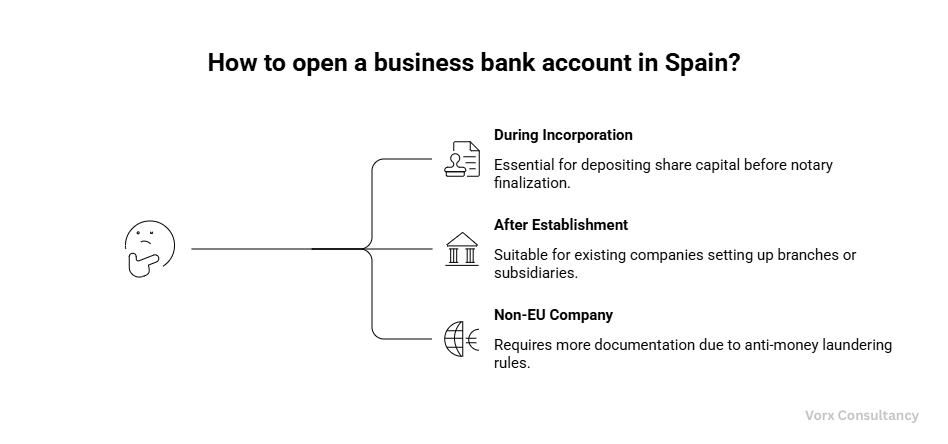
There are generally two points at which foreign companies open their accounts. Some open it during incorporation, because a new SL needs a Spanish bank account to deposit its share capital before the notary can finalise the company.
Others open it afterwards, once an existing foreign company has decided to operate in Spain through a branch or subsidiary. The documentation overlaps significantly either way, but the sequencing differs slightly, which we will come back to.
One more point that matters early on: if your company is based outside the EU, as is the case for Indian companies, banks will typically ask for a more complete documentation trail than they would from an EU-based applicant.
This is not unusual or a red flag. It simply reflects how EU anti-money laundering rules treat non-EU corporate structures.
Vorx Consultancy Insight: We often see Indian founders assume the bank account is a formality that happens automatically once the company is registered. In reality, it runs on its own timeline and its own document requirements, and treating it as an afterthought is one of the most common causes of delay we see.
Read this guide: Spain Company Formation Requirements 2026: A Complete Guide
Company NIF vs. Personal NIE: What You Actually Need First
This is the part of the process that catches almost everyone off guard, and it is worth understanding properly before you go anywhere near a bank.
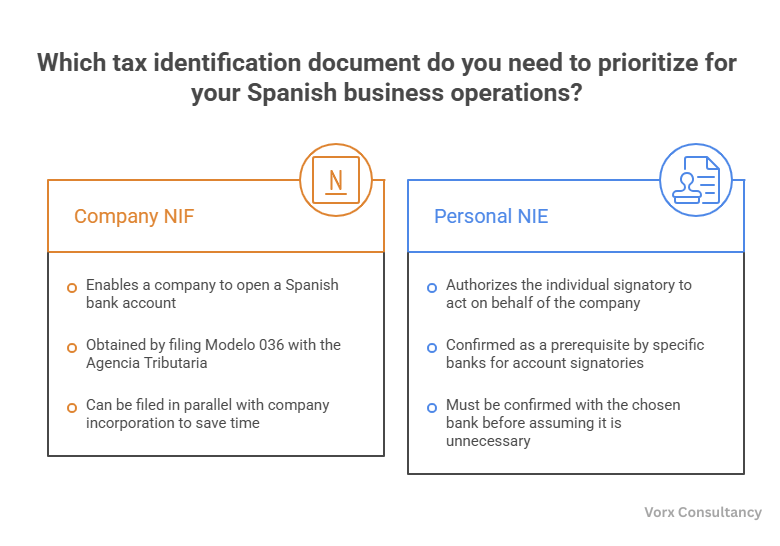
A Spanish company needs its own tax identification number, called a NIF, before a bank will open an account in the company’s name.
For a foreign company with no permanent establishment in Spain, this NIF starts with the letter N, which distinguishes it from Spanish-incorporated companies (which carry an A or B prefix). This is separate from the personal NIE that individual directors or shareholders may also need.
The company NIF is obtained by filing Modelo 036 with the Agencia Tributaria, Spain’s tax authority.
This can typically be done through a power of attorney, meaning the founder does not need to travel to Spain to get it filed. That said, the certificate of good standing, incorporation documents, and POA all need to be apostilled and translated by a sworn translator before they can be submitted, and that groundwork takes time.
Here is where founders often lose weeks without realising it: they wait until the company is fully incorporated before starting the NIF application, when the two processes can often run in parallel.
Filing for the NIF early, alongside incorporation, tends to save meaningful time down the line.
Separately, some banks will also require the person who will actually sign on the account, the authorised signatory, to hold their own personal NIE.
This is worth confirming with your chosen bank before you assume the company NIF alone is enough.
Vorx Consultancy Insight: For Indian entrepreneurs specifically, the apostille step is usually the slowest part of this stage, since it depends on Indian government processing times rather than anything happening in Spain. It is worth starting this early, well before the bank stage.
What Documents Do You Need to Open the Account?
Every bank has its own internal checklist, but for a foreign company, the core documentation set tends to look fairly consistent:
- The completed Modelo 036, confirming your company NIF
- Your company’s certificate of good standing or equivalent constitutional document from its home jurisdiction, apostilled and translated into Spanish by a sworn translator
- A notarised power of attorney authorising your Spanish representative, apostilled if signed outside Spain
- Identification documents for company directors
- Identification and ownership documentation for anyone classed as an Ultimate Beneficial Owner (UBO), meaning anyone who holds more than 25 percent of the company’s capital or voting rights, directly or indirectly
- Evidence that the company will actually be active in Spain, such as a lease agreement, a supply contract, or a draft commercial agreement
- The NIE or NIF of the Spanish representative handling the application
The UBO piece deserves a closer look, because it is where many applications from group structures get stuck.
If your company is owned by another holding company, rather than by individuals directly, the bank will usually want documentation at each layer of that ownership chain, not just at the top.
A founder who owns their Indian company outright will find this stage fairly quick. A founder whose Spanish subsidiary sits under two or three layers of holding entities should expect the bank to ask more questions, and should map that structure out clearly before the application even begins.
Read this guide: Spain Company Registration Documents: A Complete Checklist for Indian Entrepreneurs (2026)
Traditional Banks vs. Neobanks: Which One Do You Actually Need?
Most articles compare Spanish business accounts by fees and app features. For a foreign company, the more useful question is which type of bank actually fits the way your business will operate.
Feature | Traditional Banks | Neobanks |
Setup time | Few weeks | Few days |
Payroll & tax filing | Fully supported | Limited support |
Spanish IBAN | Yes, always | Depends on provider |
Best for | Long-term operations | Getting started fast |
In practice, many foreign-owned companies end up using both. A neobank gets the business transacting quickly while the traditional bank account is being processed, and the traditional account then becomes the one used for payroll, tax filings, and dealings with Spanish suppliers or clients who expect a local IBAN.
Treating this as an either/or decision usually creates more friction than it solves.
Step by Step: How to Open the Account
File for your company NIF early. Start this alongside incorporation rather than after it, using the Modelo 036 route.
Get your documents apostilled and translated. Do this in parallel with the NIF filing, since it is usually the longest lead time in the whole process.
Map your ownership structure. Identify every UBO and prepare documentation for each layer if your company sits under a holding structure.
Choose your banking approach. Decide whether you need a traditional bank, a neobank, or both, based on what your business will actually need to do in its first year.
Submit the application. This may be done in person, through a Spanish representative acting under power of attorney, or, for some neobanks, fully remotely.
Fund the account. If you are opening the account during SL incorporation, this is when the minimum share capital is deposited and the bank issues the certificate the notary needs to complete the deed.
Planning to open a business bank account in Spain?
Why Banks Reject Foreign Company Applications
Rejections are rarely about the business itself. They almost always come down to how the application was put together.
The most common reasons we see include:
- Starting the bank process before the company NIF is finalised
- An incomplete UBO chain, especially where a holding company sits between the founder and the Spanish entity
- Apostilles or translations that are missing, expired, or not done by a certified sworn translator
- An authorised signatory who does not hold the personal NIE that particular bank requires
- Little to no evidence of genuine planned activity in Spain
None of these are difficult to fix. They simply need to be addressed before the application goes in, not after a bank has already paused the file.
How Long Does It Realistically Take?
There is no single answer, because so much depends on where your documents are coming from and which type of bank you choose.
As a general pattern, expect the NIF filing and document legalisation stage to take the longest for non-EU applicants, since apostille processing runs on the home country’s timeline rather than Spain’s.
Once the NIF and documents are in order, traditional banks tend to take several weeks to complete their review, while neobanks are typically faster.
The practical takeaway is this: the parts of the process happening in Spain are rarely the bottleneck.
The parts happening back home, particularly apostilles, usually are. Starting that groundwork as early as possible is the single most effective thing a founder can do to keep the overall timeline reasonable.
Final Thoughts
Opening a business bank account in Spain as a foreign company is a manageable process, but it rewards preparation.
The founders who move through it smoothly are almost always the ones who treat the company NIF, document legalisation, and UBO documentation as tasks to complete early, rather than steps to figure out once the bank asks for them.
At Vorx Consultancy, we work with foreign entrepreneurs, including a growing number of Indian founders, through exactly this stage of Spanish company formation, from structuring the entity correctly to preparing the documentation a Spanish bank will actually accept.
If you are planning a Spanish subsidiary, branch, or new SL, understanding this process before you begin is one of the more useful things you can do for your own timeline.
