

Yes, You Can Open a Hong Kong Company Remotely For most private limited company structures, an overseas entrepreneur can form a Hong Kong company without having to relocate to Hong Kong or even having to make a trip to Hong Kong for incorporation.
Nevertheless, incorporation offshore is only a part of the process. In addition to this, one must also consider aspects such as the type of entity best suited for one’s needs, preparation of KYC documents, appointment of a Hong Kong company secretary and registered office, opening of bank accounts and even dealing with matters such as compliance.
Whether you are an Indian entrepreneur, an overseas business owner, investor or an existing company looking to expand its footprint in the Asian region it makes sense to be informed on these aspects before incorporation takes place. This way you can not only save yourself hassles down the line but also make sure that your structure is actually viable from day one. This Guide also highlights the key considerations Indian entrepreneurs should understand before establishing a Hong Kong company from India remotely.
Is Remote Company Formation Possible?
Yes. Hong Kong allows non-resident entrepreneurs to establish local companies, subject to the applicable incorporation and KYC requirements. A standard private limited company needs a Hong Kong registered office and company secretary, while at least one natural-person director is required. The director does not generally need to be a Hong Kong resident.
This means the founder can remain overseas while the company maintains the local statutory presence required under Hong Kong law.
Can You Register Without Visiting Hong Kong?
Hong Kong Company Registration Without Visiting Hong Kong is possible in many standard cases. The founder can remain overseas while the company maintains its required Hong Kong infrastructure. This normally means arranging:
- Registered office: The company must maintain its official Hong Kong address.
- Company secretary: The statutory company-secretarial role needs to be properly maintained.
- Corporate records: Required company information and records must remain up to date.
- Statutory filings: The company must meet its applicable filing obligations.
So, remote ownership is possible, but the company cannot operate as if Hong Kong has no role in its administration.
Ready to set up your Hong Kong company remotely? Talk to Vorx Consultancy for practical guidance:
Book a Strategy Call: (Calendly Link)
Visit: www.vorxcon.com
Email: support@vorxcon.com
What Should You Check First?
Before looking at How to Open a Hong Kong Company Remotely, it is important to establish whether Hong Kong actually fits the business. A useful Remote Setup Readiness Check should cover:
- Business activity: What will the Hong Kong company actually do?
- Target markets: Where are the customers and suppliers located?
- Ownership: Who will own and control the company?
- Transactions: What type of payments will move through the company?
- Banking: What type of corporate banking or payment solution will be required?
- Business purpose: Why is Hong Kong being chosen instead of another jurisdiction?
Each of these points affects the structure and the documentation that may be required later. For example, a technology company selling SaaS internationally may have very different banking and operational requirements from a trading company importing goods from Asia.
Recommended Reading:
Before choosing Hong Kong for your international business, it is also worth understanding its wider commercial and strategic advantages. to explore the key factors in more detail. Read our guide on the advantages of doing business in Hong Kong in 2026.
What Documents Do You Need?
The Hong Kong Company Registration Documents required for a standard company are generally manageable for an overseas founder, provided the information is accurate and consistent.
For the Founder:
- Passport or accepted identification: This is used to verify the identity of the director and shareholder.
- Residential address proof: A recent acceptable document may be required for KYC verification.
- Personal and professional information: Background information can help establish the founder’s profile and business connection.
For the Company:
- Proposed company name: The name must meet Hong Kong’s registration requirements.
- Shareholding structure: The ownership percentage and shareholders need to be clearly established.
- Business activity: The proposed nature of business should be described accurately.
- Corporate details: Director, secretary and registered-office information must be provided.
The incorporation application also involves the company’s articles of association and the prescribed statutory forms.
Banking Documents:
Banking documents can go beyond the documents required for incorporation. A bank or payment provider will usually want to understand what the company does, where its money comes from and how it expects to transact.
For a practical banking application, keep a ready file containing the company incorporation documents, founder KYC, business website, business profile, expected transaction details and source-of-funds information. If the business is already operating, contracts, invoices or supplier/customer details can also strengthen the application.
Can You Open a Corporate Bank Account Remotely?
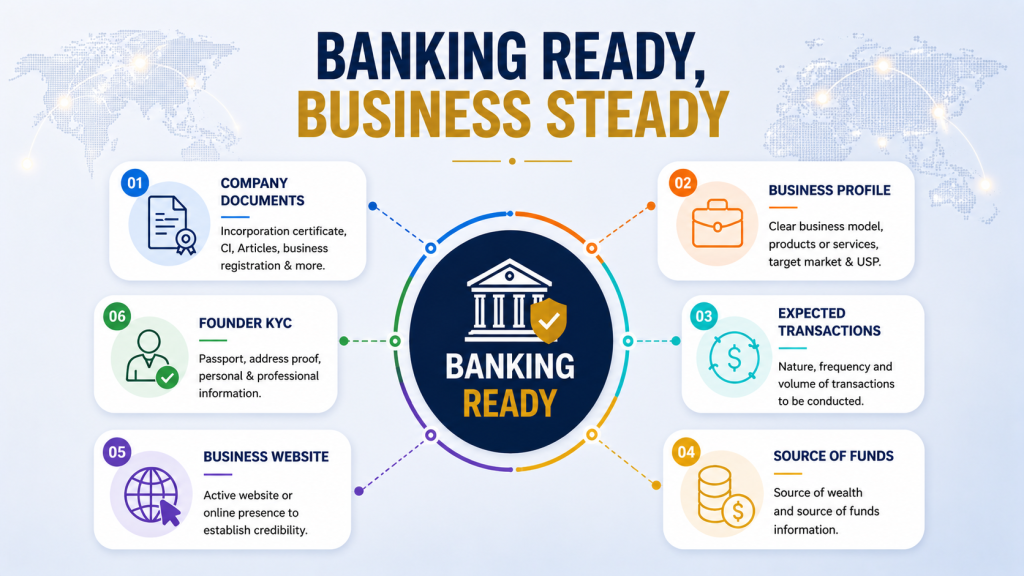
For many international founders, banking is more important than incorporation itself. A Hong Kong Corporate Bank Account for Foreigners is not automatically approved simply because a company has been registered. Banks and payment providers assess the underlying business, ownership, source of funds and expected transactions.
The Hong Kong Company Bank Account Opening Requirements can therefore be more detailed than the incorporation requirements. A provider bank may ask:
- Business model: What does the company sell and how does it generate revenue?
- Customer profile: Who are the customers and where are they located?
- Supplier information: Who does the company purchase from?
- Transaction expectations: What payments will be received and sent?
- Source of funds: Where does the company’s capital originate?
The company documents, website, contracts and banking application should all describe the same genuine business.
What Is a Banking Readiness File?
A Banking Readiness File is a practical way to prepare before approaching a bank or payment provider.
It can bring together the company documents, founder profile, website, business model, customer and supplier information, expected transaction profile and source-of-funds explanation.
Recommended Reading:
If you are planning to open a corporate account, understanding the banking process and requirements in advance can help you prepare more effectively. Read our guide on opening a business bank account in Hong Kong for a detailed overview.
What Is the Formation Process? Step-By-Step Guide
The Hong Kong Company Formation Process can be handled in a series of practical stages.
1. Business and Structure Assessment
The first step is understanding the business model, ownership, markets and expected transactions. This helps determine whether a Hong Kong private limited company is appropriate.
2. Company Name Selection
A suitable company name is selected and checked before the application is submitted. The name should meet Hong Kong’s registration requirements and should not create unnecessary regulatory or trademark concerns.
3. KYC and Document Preparation
The founder’s identification, address, ownership and business information are collected and reviewed. Getting this stage right can prevent avoidable clarification requests later.
4. Registered Office and Company Secretary
A Hong Kong company needs the appropriate local statutory arrangements. The registered office provides the official address, while the company secretary handles required corporate administration.
5. Incorporation Filing
The incorporation application is submitted to the Companies Registry with the required information and documentation.
For straightforward electronic applications, the Companies Registry states that incorporation of a private company limited by shares can normally be completed within one hour when the application meets the relevant conditions.
6. Corporate Documents
Once incorporation is completed, the company receives its relevant incorporation and business registration documentation. These documents become important for banking and future corporate administration.
7. Banking Preparation
Banking should be treated as a separate stage. The company may need to provide a detailed explanation of its business model, transaction flow and source of funds.
8. Ongoing Compliance
After incorporation, the company needs to maintain its statutory filings, accounting, tax and corporate records. Remote ownership does not remove these obligations.
How Long Does the Process Take?
The Hong Kong Company Formation Process can be completed quickly once the documents are ready, but the overall timeline depends on more than the Companies Registry. For a standard private company, the electronic incorporation itself can normally be completed within 1 hour if the application passes validation and the company name does not require further review. For an entrepreneur, a more practical timeline is:
Stage | Average Practical Timeline | What Happens |
Document & KYC preparation | 1–3 working days | Passport, address proof, ownership and business details are prepared |
Company setup | 1–2 working days | Registered office and company secretary arrangements are completed |
Incorporation filing | Within 1 hour* | Application is submitted electronically and reviewed |
Company documents | Same day* | Certificate of Incorporation and Business Registration Certificate are issued |
Banking preparation | 2–5 working days | Business profile and supporting documents are prepared |
Bank/payment review | 1–4+ weeks | Depends on the provider, business activity and KYC |
Overall setup | Around 1–4 weeks | Mainly depends on banking and document readiness |
What Are the Compliance Requirements After Incorporation?
A Hong Kong company is not a “set and forget” structure. It has continuing statutory, accounting and tax obligations.This is where many remote founders underestimate their responsibilities.
Annual Return
The company must meet its applicable annual filing obligations with the Companies Registry.
Accounting and Audit
Proper accounting records need to be maintained, with audit requirements applying according to the company’s circumstances.
Business Registration
The company’s business registration must remain valid and be renewed as applicable.
Significant Controllers Register
Hong Kong companies generally need to identify and maintain information about their significant controllers in accordance with the applicable requirements.
Tax & Foreign-Sourced Income
Hong Kong follows a territorial basis for profits tax, but overseas income should not automatically be treated as tax-free. Under the Foreign-Sourced Income Exemption (FSIE) regime, certain foreign-sourced income received in Hong Kong by in-scope entities may be subject to specific exemption conditions. For internationally operated businesses, the tax position should therefore be reviewed based on the actual income source, business activities and structure, particularly when planning for 2026 and beyond.
Can Indians Own a Hong Kong Company?
Yes. Indian nationals can generally own shares in a Hong Kong company, subject to applicable corporate and KYC requirements. The more important consideration is what happens on the Indian side.
For an Indian resident, ownership, funding, management, transactions and movement of profits may have Indian tax and foreign exchange implications. These depend on the actual structure and should be assessed before funds are transferred or the business arrangement is implemented.
A Hong Kong company should therefore be viewed as part of a wider cross-border business structure, rather than as an isolated overseas registration.
How Can You Register From India?
Registering a Hong Kong Company From India is mainly a remote documentation and coordination process. You can remain in India while the incorporation is handled electronically and the required Hong Kong registered office and company secretary arrangements are put in place. A practical process usually involves:
- Prepare KYC and business details: Keep your passport, address proof, ownership details and business activity information ready.
- Arrange the Hong Kong requirements: Set up the registered office and company secretary before filing.
- Submit the incorporation application: A standard private company can be incorporated electronically through the Companies Registry.
- Receive the certificates: Once approved, the Certificate of Incorporation and Business Registration Certificate are issued electronically.
Timeline: For a straightforward electronic application, the Companies Registry states that incorporation can normally be completed within 1 hour. In practical terms, however, allow around 2–5 working days for the overall incorporation setup, depending on KYC preparation, document checks and arranging the required local services. Banking is a separate stage and can take longer depending on the provider and business profile.
Can You Manage the Company From India?
Yes. Many commercial functions can be managed from India, including business strategy, customer communication, marketing, technology and day-to-day operations. The Hong Kong-side statutory functions remain different.
An entrepreneur can manage a Hong Kong company from India, while the company continues to maintain its registered office, company secretary, statutory records and required filings in Hong Kong. Indian residents should also consider the relevant Indian tax, FEMA/overseas investment and cross-border remittance implications before establishing and funding the company.
What Mistakes Should You Avoid?
Most problems in remote company formation come from poor preparation rather than the incorporation process itself. Planning the structure, documentation and banking requirements in advance can help avoid unnecessary delays and compliance issues. Here are the list of mistakes which should be avoided while incorporating a hongkong company:
- Incorporating before considering banking
- Providing inconsistent company or KYC information
- Assuming overseas income is automatically tax-free
- Choosing a structure without assessing the business model
- Ignoring ongoing compliance requirements
- Overlooking home-country tax and regulatory obligations
Taking care of these points early can make the incorporation and banking process smoother. It also helps ensure that the company remains properly structured and compliant after registration.
Why Choose Vorx for Hong Kong Company Formation?
Setting up a Hong Kong company remotely requires more than completing the incorporation process. Entrepreneurs also need to consider the business structure, documentation, registered office, company secretary, banking and ongoing compliance. Vorx takes a business-first approach to Hong Kong Company Formation Services, helping entrepreneurs understand the setup before they commit. Support can cover company incorporation, required local arrangements, banking preparation and post-incorporation compliance.
Whether you are an international or Indian entrepreneur, overseas business owner, investor or expanding company, the focus is on creating a structure that is practical to operate, properly documented and ready for long-term international business. With Vorx, the objective is not just to register a company it is to build a Hong Kong business structure that works beyond the incorporation stage.
Ready to set up your Hong Kong company remotely? Talk to Vorx Consultancy for practical guidance:
Book a Strategy Call: (Calendly Link)
Visit: www.vorxcon.com
Email: support@vorxcon.com
Final Thoughts
Opening a Hong Kong company remotely can be a practical option for entrepreneurs who want to establish an international business presence without relocating to Hong Kong. The incorporation process itself can be relatively quick, but the wider setup requires proper planning. From choosing the right structure and preparing documents to arranging banking and maintaining ongoing compliance, each stage should be considered before the company is established.
With the right approach, a Hong Kong company can provide a strong base for international operations, cross-border trade and expansion into Asian markets.
