

If you are launching a new business in Cyprus or have an existing business there, 2026 is going to be a good time to update your compliance plan, particularly concerning the local tax legislation.
2025 marked the end of a large-scale tax reform in Cyprus, which introduced changes not only to the main rate mentioned by most articles on the topic.
There are certain modifications to the criteria for establishing a tax resident for business owners outside the country namely, Indian entrepreneurs using Cyprus for company registration, trading companies, and accessing EU markets.
Here are the key points about the changes made, their implications and impact, etc.
What's New for Cyprus Corporate Tax in 2026
Summary in numbers: Cyprus increased the corporate income tax rate from 12.5% to 15%, effective as of January 1, 2026. Thus, Cyprus follows the OECD’s initiative on a minimum level of tax on profits (Pillar Two).
This is probably the first number that people want to know, but the tax increase is only one part of an extensive reform that updated residency rules, dividend taxation, tax loss carry-forwards, and filing deadlines.
Replacing “12.5%” with “15%” and stopping there would mean missing out on several important changes.
Although Cyprus remains one of the countries with low corporate taxes in comparison with most large EU economies, the aim of the reform was to maintain this advantage at the same time as international standards.
There are no signs in the 2026 reform that Cyprus is turning into a less convenient jurisdiction for foreign-controlled entities, but some outdated perceptions need to be corrected.
The 2026 Cyprus Tax Reform: What Actually Changed
Comparison table on the key differences can be found below. This is more convenient than a long list of points scattered throughout the paragraphs.
Area | Before 2026 | From 2026 |
Corporate Tax | 12.5% | 15% |
Tax Residency | Management & incorporation rules | Incorporation-based by default* |
Deemed Dividends | Applicable | Abolished for new profits* |
Dividend Tax (SDC) | 17% | 5% |
Loss Carry-Forward | 5 years | 7 years |
Tax Return Deadline | 15 months | 13 months |
Crypto Profits | Standard tax rate | 8% |
Tax residency is subject to treaty rules. Transitional deemed-dividend rules apply to earlier profits.
Planning Your Business in Cyprus?
Understand the 2026 tax changes before making your next move. Speak with Vorx Consultancy for professional guidance.
How Cyprus Corporate Tax Works for Foreign-Owned Companies
Cyprus taxes companies differently depending on their residency status. A Cyprus tax-resident company is taxed on its worldwide income profits earned in Cyprus and abroad. A non-resident company, by contrast, is only taxed on income sourced within Cyprus.
For most foreign owners setting up a company specifically to operate from Cyprus, residency is the goal, not something to avoid, since it’s what unlocks access to Cyprus’s double tax treaty network and its exemptions on dividends and share disposals.
As covered above, incorporation now generally establishes residency by default. But it’s worth being precise about what incorporation does and doesn’t achieve. Incorporating a company in Cyprus makes it a Cyprus legal entity and, under the new test, generally a Cyprus tax resident.
It does not, on its own, guarantee that a double tax treaty partner country will recognize that residency for treaty purposes, and it does not remove the need for genuine economic substance if you want the company to withstand scrutiny from tax authorities in your home country.
Those two things legal residency and defensible substances are related but not identical, and conflating them is one of the more common mistakes we see foreign owners make.
Vorx Consultancy Insight: We regularly see founders assume that once a Cyprus company is incorporated, the tax position is settled. In practice, tax authorities in the owner’s home country can look past the incorporation and ask where decisions are actually made.
A company with a registered address in Cyprus but no local director, no local meetings and all decisions made from abroad is a weaker position than one with genuine local management.
Read this guide: Cyprus Company Formation for Foreigners: A Complete 2026 Guide
What Taxes Apply to a Cyprus Company
Besides corporate income tax, there are several others, but their importance will depend on the type of your business activities.
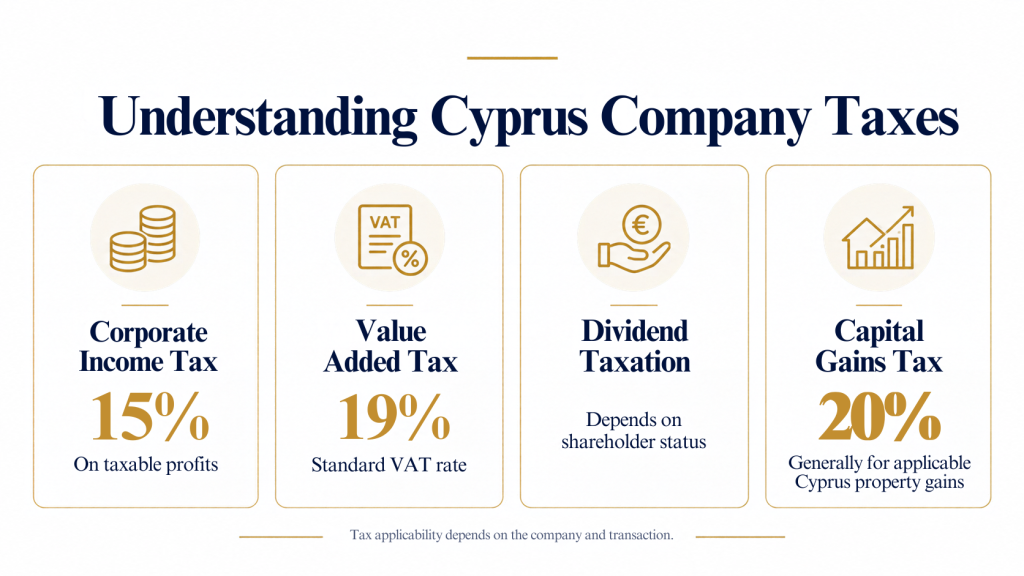
Corporate income tax is the primary tax at 15%, which applies to taxable profits and charges companies on their worldwide income and Cyprus source income of non-resident companies.
Value Added Tax (VAT) is levied on most goods and services with a threshold based on turnover. Businesses under that threshold may register voluntarily; nevertheless, many foreign-owned companies still do this even if they only deal with VAT registered customers, since they are allowed to recover VAT on business expenditures.
Special Defense Contribution (SDC) is a tax applied primarily to individuals, tax resident and domicile in Cyprus, and mostly impacts the dividends, interests, and rent.
If you are a non-domicile resident (the case of most foreign entrepreneurs relocating to Cyprus), you are generally exempt from SDC on that kind of income.
Capital gains tax in Cyprus is narrower than many foreign owners expect. It applies at 20%, but mainly to gains from Cyprus real estate, and to gains from disposing of shares in companies that mainly hold Cyprus real estate.
Dividends from profits on sale of shareholdings in an ordinary trading or holding company are normally exempted from taxation. This is one of the advantages of holding companies set up in Cyprus.
The payment of payroll taxes and social insurance contributions if you employ staff in Cyprus is a topic which warrants a separate guideline.
Tax Exemptions and Incentives Foreign Owners Should Know
Cyprus’s exemption regime is a big part of why the jurisdiction remains attractive even at a 15% headline rate.
Dividend income received by a Cyprus company is generally exempt from corporate tax, with one important exception:
If the company paying the dividend deducted that payment from its own taxable income in its home country, the exemption doesn’t apply and the dividend is taxed normally in Cyprus.
Profits from selling securities : shares, bonds, and similar instruments are broadly exempt, which is a major reason Cyprus is popular for holding structures.
The IP Box regime allows an 80% deduction on qualifying profits from intellectual property, bringing the effective tax rate on qualifying IP income down to roughly 2.5%. This is relevant if your business owns patents, software, or other IP assets.
Foreign exchange gains are generally exempt, though this exemption doesn’t extend to companies whose business is actually trading in currencies or currency derivatives.
Double tax treaties with more than 60 countries reduce or eliminate double taxation on cross-border income and can lower withholding tax rates on dividends, interest, and royalties.
Together, these exemptions mean the effective tax rate for many foreign-owned Cyprus companies ends up lower than the 15% headline figure, depending on the nature of the income involved.
Are You Making the Most of Cyprus Tax Benefits?
Explore applicable tax incentives and exemptions with guidance from Vorx Consultancy.
Registering and Paying Corporate Tax in Cyprus
The process is more straightforward than it sounds, though the deadlines matter.
Every company must register with the Cyprus Tax Department and obtain a Tax Identification Number within 60 days of incorporation, done through the Tax For All portal, after which you receive TaxisNet login credentials for filing.
Corporate tax itself is calculated on taxable profit income minus applicable exemptions and deductions at the 15% rate.
Companies pay this in stages rather than as one lump sum at year-end: two provisional tax instalments, on 31 July and 31 December, based on a self-estimated profit figure for the year.
That last point catches people out more than any other part of the provisional tax system, so it’s worth calendaring a mid-year review of your profit estimate rather than treating the initial number as fixed.
Ongoing Compliance Requirements for Cyprus Companies
Tax registration is the start, not the finish line. Every Cyprus company, regardless of profit, must file an annual tax return by the 13-month deadline.
Financial statements generally need to be audited, though small companies turnover under €200,000 and gross assets under €500,000 can opt for a review instead of a full statutory audit, provided they meet the qualifying conditions.
Companies engaging in related-party transactions need transfer pricing documentation to support that pricing is at arm’s length.
And beneficial ownership details must be reported to the relevant register, a requirement that’s been tightened across the EU generally, not just in Cyprus.
Economic substance is worth a section of its own because it’s more of a practical judgment call than a checklist.
Tax authorities generally look for signs that a company’s management genuinely happens in Cyprus: a local director involved in real decisions, board meetings actually held in Cyprus, and a registered office that’s more than a mailbox.
None of this needs to mean relocating your entire life to Cyprus, but a company run entirely by remote instruction with no local presence is more exposed if its tax position is ever questioned.
Keep Your Cyprus Company Compliant
From tax registration to ongoing accounting and filing requirements, Vorx Consultancy helps you manage your corporate obligations.
Cyprus Corporate Tax Considerations for Indian Business Owners
For Indian entrepreneurs, Cyprus corporate tax doesn’t exist in isolation it interacts with Indian tax rules through the India-Cyprus Double Taxation Avoidance Agreement.
A few points from that treaty matter more than the rest for anyone running a Cyprus company from India, or managing it while living between both countries.
Associated enterprises and control. If Indian-based managers directly or indirectly control the Cyprus company’s decisions, Indian tax authorities can, under certain conditions, attribute the company’s profits back to India for tax purposes, with Cyprus generally granting a credit for tax already paid there.
This is exactly why the substance point above matters so much for Indian founders specifically — a Cyprus company that exists on paper but is run entirely from Mumbai or Bangalore is a genuinely different tax position than one with real local management.
Capital gains and the 2017 cutoff. Shares in an Indian company acquired by a Cyprus resident before 1 April 2017 generally retain older, more favorable capital gains treatment. Shares acquired after that date are generally subject to Indian tax on disposal.
If you’re planning a holding structure that involves Indian shares, this date matters and is easy to get wrong.
Withholding tax caps. The treaty generally caps withholding tax on dividends, interest, and royalties at 10% when Cyprus is the paying jurisdiction, which is often lower than domestic rates would otherwise apply.
Place of Effective Management (POEM). Separately from the associated enterprises rule, Indian tax law can treat a foreign company as India tax resident if its effective management is found to be in India.
This is a related but distinct risk from the one above, and it’s another reason genuine Cyprus-based management isn’t just a nice-to-have for Indian owners.
None of this means a Cyprus structure is unsuitable for Indian entrepreneurs; it remains a well-used route for holding structures and EU market access.
It does mean the substance and documentation questions deserve real attention rather than being treated as boilerplate.
How the 2026 Rate Increase Affects Cyprus's Competitiveness
It’s reasonable to ask whether a jump from 12.5% to 15% changes the calculation on whether Cyprus is still worth it. In most cases, it doesn’t change much, for a few reasons.
Cyprus at 15% still compares favorably to headline corporate tax rates in Germany, France, and the UK, all of which sit meaningfully higher once local surcharges are included.
The exemptions covered earlier on dividends, securities gains, and IP income mean the effective rate for many foreign-owned companies stays below the headline figure regardless.
There’s also a less obvious upside worth mentioning. Many countries apply Controlled Foreign Company rules that flag a foreign subsidiary as suspiciously low-taxed if its rate falls below roughly half the parent country’s domestic rate.
A higher Cyprus rate can, in some cases, reduce that kind of scrutiny compared to the old 12.5% figure though this depends entirely on the specific CFC rules in the owner’s home jurisdiction, and shouldn’t be assumed without checking.
For large multinational groups with consolidated revenue above €750 million, the 15% rate now interacts directly with the OECD’s global minimum tax top-up mechanism.
This is a narrow point that mainly affects large corporate groups rather than the founder-led or SME-scale companies most foreign owners are setting up, but it’s worth knowing it exists if your group is part of a larger international structure.
Common Tax Mistakes Foreign Business Owners Should Avoid
A few patterns come up repeatedly with foreign-owned Cyprus companies:
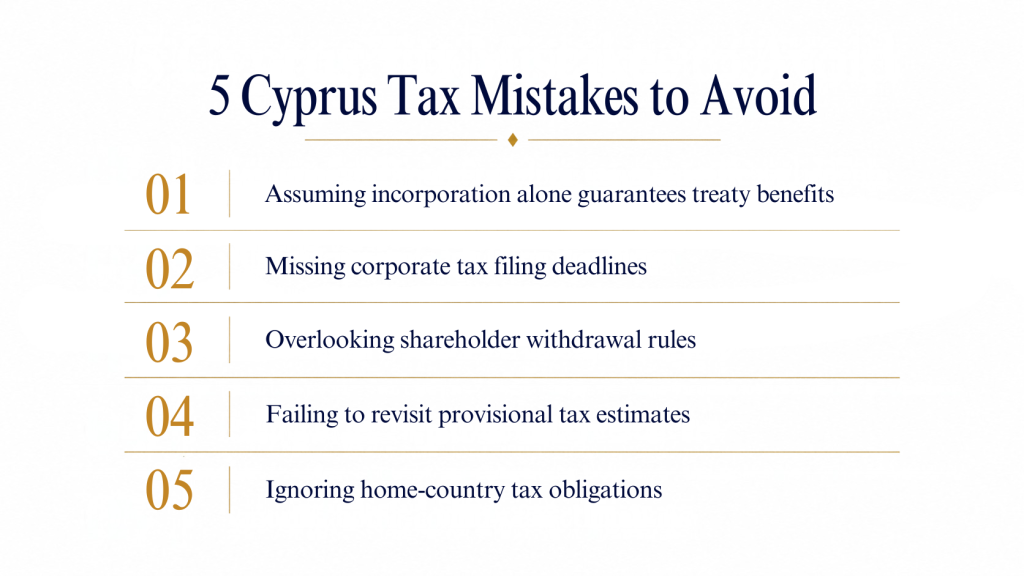
Assuming incorporation alone secures tax residency benefits, without maintaining any real local presence or substance.
Missing the new 13-month filing deadline out of habit from the old 15-month rule.
Treating informal shareholder withdrawals as harmless, without accounting for the new disguised dividend rule.
Locking in a provisional tax estimate in July and never revisiting it, risking the 10% underestimation penalty.
Assuming the old deemed dividend distribution rules still apply to 2026 profits.
Focusing entirely on Cyprus-side compliance while overlooking home-country exposure, such as CFC rules or POEM risk for Indian owners.
Most of these aren’t dramatic mistakes, they’re the kind of small oversights that compound into real problems only when a tax authority takes a closer look, which is exactly when you don’t want to be catching up on rule changes.
Read this guide: Cyprus Company Compliance Requirements: A 2026 Guide for Foreign Business Owners
How Vorx Consultancy Can Help
At Vorx Consultancy, we help foreign founders and investors work through exactly these questions: company registration, tax registration and the ongoing filing and audit obligations that follow.
For Indian entrepreneurs specifically, the key consideration is usually less about the Cyprus side of the rules and more about how the structure holds up from the Indian side, which is where cross-border experience matters most.
Whether you’re setting up a new company or reviewing an existing structure against the 2026 changes, it’s worth having someone look at the specifics of your situation rather than applying general rules to your particular business.
Start or Manage Your Cyprus Business with Confidence
Whether you’re registering a new company or reviewing your existing tax obligations, Vorx Consultancy can guide you through the process.
Final Thoughts
The headline from 2026 is a corporate tax rate of 15%, up from 12.5%. But the more useful takeaway is that the reform brought several offsetting changes: the end of deemed dividend distribution, a lower SDC rate on dividends, and a longer loss carry-forward period that make the overall picture more balanced than the rate increase alone suggests.
Cyprus remains a practical, well-established jurisdiction for foreign-owned companies, provided the substance and compliance timelines that come with it are taken seriously rather than assumed.
