France keeps showing up on the shortlist for Indian founders looking to enter Europe, a genuine EU market, a huge domestic economy, strong logistics access to the rest of the continent, and (contrary to its bureaucratic reputation) a registration process that’s now almost entirely online through the Guichet Unique portal.
But almost every founder asks the same question before they commit: what is this actually going to cost me?
The honest answer is that France charges very little to simply put a company on the register. What catches people off guard isn’t the government’s fee it’s everything that sits around it:
the legal notice you’re forced to publish, the bank that won’t open an account without a local visit, the accountant French law all but requires you to hire, and the virtual office you need because you don’t have a French address yet.
None of these are hidden in a sneaky way; they’re just spread across different providers, so nobody hands you one number.
This guide puts all of it in one place: the fixed government fees, the professional costs that scale with how much help you want, and the recurring expenses that show up every year after you’re incorporated.
By the end, you’ll understand exactly what goes into your budget and where the real variability comes from instead of guessing.
For a personalised, up-to-date cost estimate based on your exact structure and needs, it’s best to speak directly with a formation consultant.
How Much Does It Cost to Register a Company in France?
Strip away every optional extra, and France’s own formalities website confirms the core registration fee for a commercial company is quite low, with a modest additional charge for the mandatory declaration of beneficial owners (the déclaration des bénéficiaires effectifs, or RBE).
Add the legal notice you’re required to publish before you can even file, and the bare statutory minimum for 2026 remains genuinely affordable though the exact figure depends on your legal structure and where your registered office sits.
That’s the floor, not the ceiling. Realistically, most foreign founders end up spending a meaningfully larger amount once you factor in professional filing support, a business address, a French bank account, and translation of documents.
A founder who drafts their own statutes, uses a discount online formation platform, and is comfortable navigating French banking alone will land near the low end.
A founder who wants a lawyer to review everything, a premium Paris business address, and full hand-holding through the bank will land much closer to the top.
Also Read this guide: How to Register a Company in France: Complete 2026 Guide
Mandatory Government Fees
These three line items are non-negotiable every company pays them, regardless of which formation agency or accountant is involved, because the money goes to the state and the commercial registry, not to a service provider:
RCS registration (Registre du Commerce et des Sociétés): a modest, fixed fee for a commercial company like an SAS, SARL, SASU, or SA, filed through the Guichet Unique.
Declaration of beneficial owners: a small additional fee, mandatory for all companies to identify who ultimately controls the business.
Legal notice publication: the largest of the three, and the one people forget to budget for covered in detail below.
Legal Publication Costs
Before you can register your company, French law requires you to publish a legal notice (annonce légale) announcing the company’s creation, its name, structure, share capital, registered address, and business purpose.
This isn’t optional and it isn’t free, but since 2021 the pricing has been standardized into flat rates by legal structure rather than charged per line of text, which makes it much easier to budget for.
Rates differ slightly depending on whether you’re setting up an SASU, SARL, or SAS, with the SAS typically sitting a little higher than the other two structures.
One quirk worth knowing: the rate is set by where your registered office sits, not where the founder lives.
If your company’s siège social is in mainland France, you pay the mainland rate even if you, personally, are filing from Bangalore or Mumbai.
Overseas departments like Réunion and Mayotte have their own, higher flat rates relevant only if your registered address is actually located there.
Minimum Share Capital
This is where France genuinely surprises a lot of foreign founders. For an SAS, SASU, SARL, or EURL, the legal minimum share capital is symbolic.
France does not force you to lock up a meaningful sum of money to open the company, unlike some jurisdictions that demand substantial paid-up capital before you can register.
That said, “legal minimum” and “sensible amount” are two different things:
Banking credibility: French banks and payment processors are far more comfortable opening accounts for companies with real, even modest, capital than for a company capitalized at the bare legal minimum. A token capital amount can be read as a red flag during KYC.
Investor and partner perception: if you plan to raise funds, sign supplier contracts, or bid for B2B clients, a purely symbolic capital figure can quietly undermine trust it signals the founders didn’t put real skin in the game.
A practical range for most first-time foreign-owned SAS or SARL entities is a moderate, working-capital-appropriate amount, scaled to how much the business genuinely needs in its first year.
There’s no requirement to keep this capital untouched once deposited and the company is registered, it becomes available for business use.
Professional Service Costs
You can legally draft your own statutes (articles of association) for free using standard templates.
In practice, most foreign founders don’t, because a small drafting error, a missing clause, an inconsistent share structure, an incorrect governance provision can get your filing rejected and cost you weeks.
Here’s what professional support typically involves:
Drafting and filing the Articles of Association: available through a formation agency or online legal service at a range of price points, with higher costs if you go through a traditional law firm for a bespoke shareholders’ agreement.
Lawyer involvement (for anything beyond standard incorporation — investor terms, IP assignment, multi-founder equity splits): billed hourly, and can add up depending on complexity.
Certified translation of documents: if your supporting paperwork (passport, proof of address, board resolutions) isn’t in French, expect to pay a certified translator on a per-document basis for standard items.
Tax consultation for cross-border structuring: if you’re setting up a French subsidiary of an Indian parent company, a one-time consultation with a tax advisor familiar with the India–France treaty is worth every rupee and euro spent.
A useful sanity check: an all-in package from a formation agency filing, tax ID registration, legal notice, and bank account assistance for a standard SAS commonly starts at an accessible entry point, and once you add a virtual office subscription, one-time setup fees, and VAT, foreign founders often land at a noticeably higher total for the full bundle.
Business Address (Registered Office)
Every French company needs a registered address, and if you don’t have one, this becomes one of your first real recurring costs:
Virtual office / domiciliation service: entry-level plans are available at a low monthly cost for simple structures, with most SAS, SASU, SARL, and EURL entities landing in a moderate monthly range once mail scanning and forwarding are included.
Premium business address (a recognizable Paris or Lyon business district address, often bundled with meeting room access): commands a noticeably higher monthly fee depending on location and prestige.
Home address: if a co-founder or trusted contact already lives in France, using their residential address as the registered office is allowed and free though it comes with privacy trade-offs, since the address becomes public record.
Commercial office: if you’re renting real office space anyway, that address doubles as your registered office at no extra domiciliation cost but obviously the office lease itself isn’t free.
Most foreign founders without a physical presence in France go with a domiciliation service simply because it’s the most cost-effective way to satisfy the legal requirement while they figure out whether they need real office space at all.
Also Read this blog: Can Foreigners Register a Company in France? Requirements & Eligibility
Business Bank Account Costs
This is the step that trips up more Indian founders than anything else in the entire process, because French banks apply strict KYC checks to non-resident directors.
Traditional banks (BNP Paribas, Société Générale, Crédit Agricole): often require an in-person visit or, at minimum, a thorough document review, and can take several weeks to approve a non-resident account. Monthly business account fees add up on top of transaction fees.
Fintech/digital banks (Qonto and similar): faster onboarding, often fully remote, and popular specifically because they’re more foreigner-friendly, though plans still scale up with transaction volume and card features.
Capital deposit requirement: your share capital has to be deposited into a blocked account before registration banks will issue a deposit certificate once received.
This isn’t a bank fee, but foreign founders should be ready to have that capital available and transferable from an Indian account, which can itself involve international transfer costs.
Many banks apply a working capital deposit expectation for foreign-founded companies that’s noticeably higher than the bare legal minimum, which combined with the incorporation package above is why total “ready to operate” budgets for foreign founders commonly run higher than the statutory floor suggests.
Accounting & Annual Compliance Costs
France’s expert-compatible system means licensed accountants play a much bigger formal role than in some other countries for any company with meaningful turnover or employees, professional accounting support isn’t just recommended, it’s practically required to stay compliant.
Expect these ongoing costs once your company is running:
Annual bookkeeping and financial statements: a recurring yearly cost for a small SAS or SARL, scaling up as revenue and transaction volume grow.
Corporate tax filing: usually bundled into the annual accounting package, but complex cross-border structures (parent company in India, subsidiary in France) can push this higher.
VAT filing: monthly or quarterly depending on your turnover bracket, typically included in accounting retainers but sometimes billed separately.
Payroll, if you hire: a per-payslip cost, plus the accountant’s payroll management fee, and remember French employer social charges a substantial percentage on top of gross salary are a completely separate, much larger cost than payroll admin itself.
Minimum social charges for the manager/director: even a one-person SAS with no revenue yet still owes minimum social contributions each year, simply for holding the position.
Hidden Costs Most Entrepreneurs Forget
These are the line items that don’t show up in a formation agency’s headline pricing, but arrive as invoices a few weeks into the process:
Apostille/legalisation of Indian documents: getting your Indian incorporation certificates or personal documents recognized in France often requires apostille or consular legalisation before French authorities will accept them.
Certified translations: covered above, but easy to underestimate if you have multiple supporting documents.
Trademark registration: filing a French trademark involves a base fee per class of goods/services, with professional filing assistance adding to that.
Website and domain setup: not a France-specific cost, but often forgotten in the “incorporation budget” even though it’s needed to look credible to French clients and banks from day one.
Business insurance: professional liability (RC Pro) is mandatory for certain regulated activities and strongly recommended for most others costs vary by sector and coverage level.
Employer registration: a separate administrative step (and sometimes a separate cost) the moment you make your first hire.
Cross-border tax advisory: an annual, not one-time, cost if your structure spans India and France factor it into your yearly budget, not just your setup budget.
France Company Formation Costs: What Shapes Your Budget
Rather than a single number, think of your total cost as sitting somewhere on a spectrum between a lean, DIY-leaning scenario and a fuller, professionally-supported one:
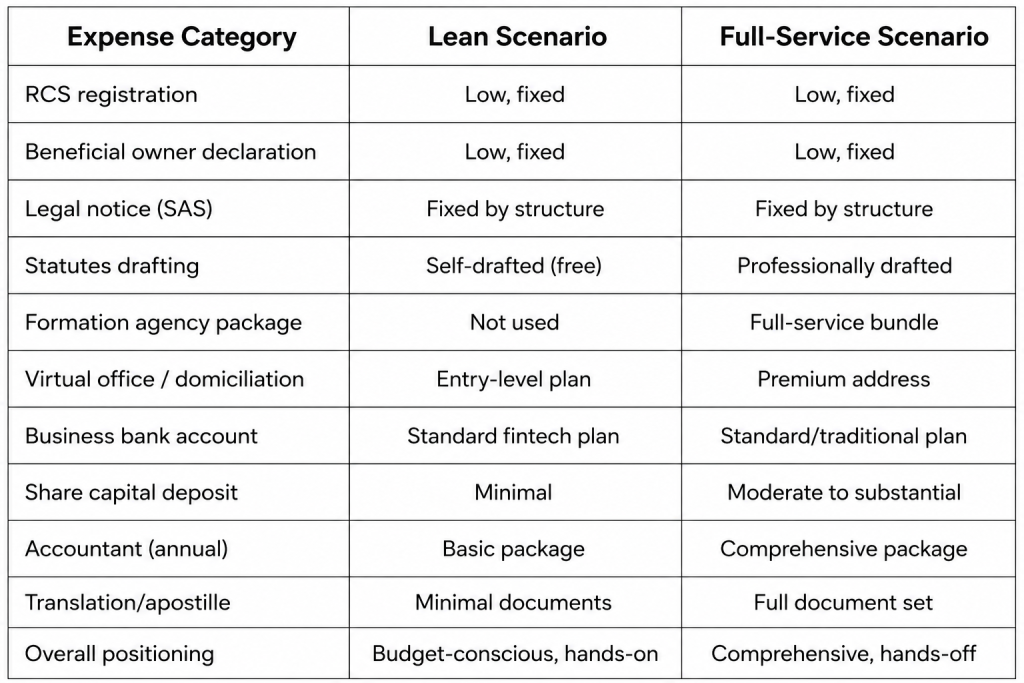
The gap between the two isn’t about one being “correct” , it’s about how much of the process you’re comfortable handling yourself versus how much you want offloaded to professionals who can catch mistakes before they become expensive delays.
For an exact number tailored to your structure, it’s worth requesting a personalised quote rather than relying on general ranges.
Also Read this blog: Can You Register a French Company Remotely? Step-by-Step Guide
Ways to Reduce France Formation Costs
Choose the right structure from the start. An SASU or SARL can be simpler and slightly cheaper to publish than an SAS, and switching structures later costs more than getting it right the first time.
Register remotely through the Guichet Unique yourself, if you’re confident with the paperwork, rather than paying an agency purely for the filing step.
Avoid unnecessary legal customization early on. Standard statutes work fine for most single-founder or small-team companies; bespoke shareholder agreements are worth paying for only once you have real investors or complex equity arrangements.
Prepare documents correctly the first time. Rejected filings mean paying the legal notice fee twice and losing weeks a professional review before filing can save far more than it costs.
Bundle incorporation services. Domiciliation providers frequently waive formation fees entirely if you sign up for their address subscription worth comparing before paying for filing and address separately.
Why Work with a Company Formation Consultant
Given everything above, a lot of founders reasonably ask whether it’s worth paying for help instead of doing it all solo.
For most first-time foreign founders, the answer comes down to five things a good consultant actually saves you:
Time: weeks saved by not learning the Guichet Unique system, French banking norms, and document requirements from scratch.
Compliance: someone catching a structural or filing error before it costs you a rejected application and a second legal notice fee.
Banking assistance: a consultant who already has relationships with foreigner-friendly banks can cut weeks off account approval.
Tax planning: getting your France–India structure right from day one, rather than restructuring later once the cost of the mistake is already locked in.
Ongoing support: someone to call when your first VAT filing or first payroll run doesn’t go the way you expected.
If you’d rather have someone who’s done this repeatedly walk you through the entire process — from choosing between SAS and SARL to opening your bank account Vorx Consultancy works specifically with Indian entrepreneurs and foreign founders setting up in France, and can help you build a budget that matches your actual business, not a generic template.