
Can You Really Register a Dutch Company Without Visiting the Netherlands?
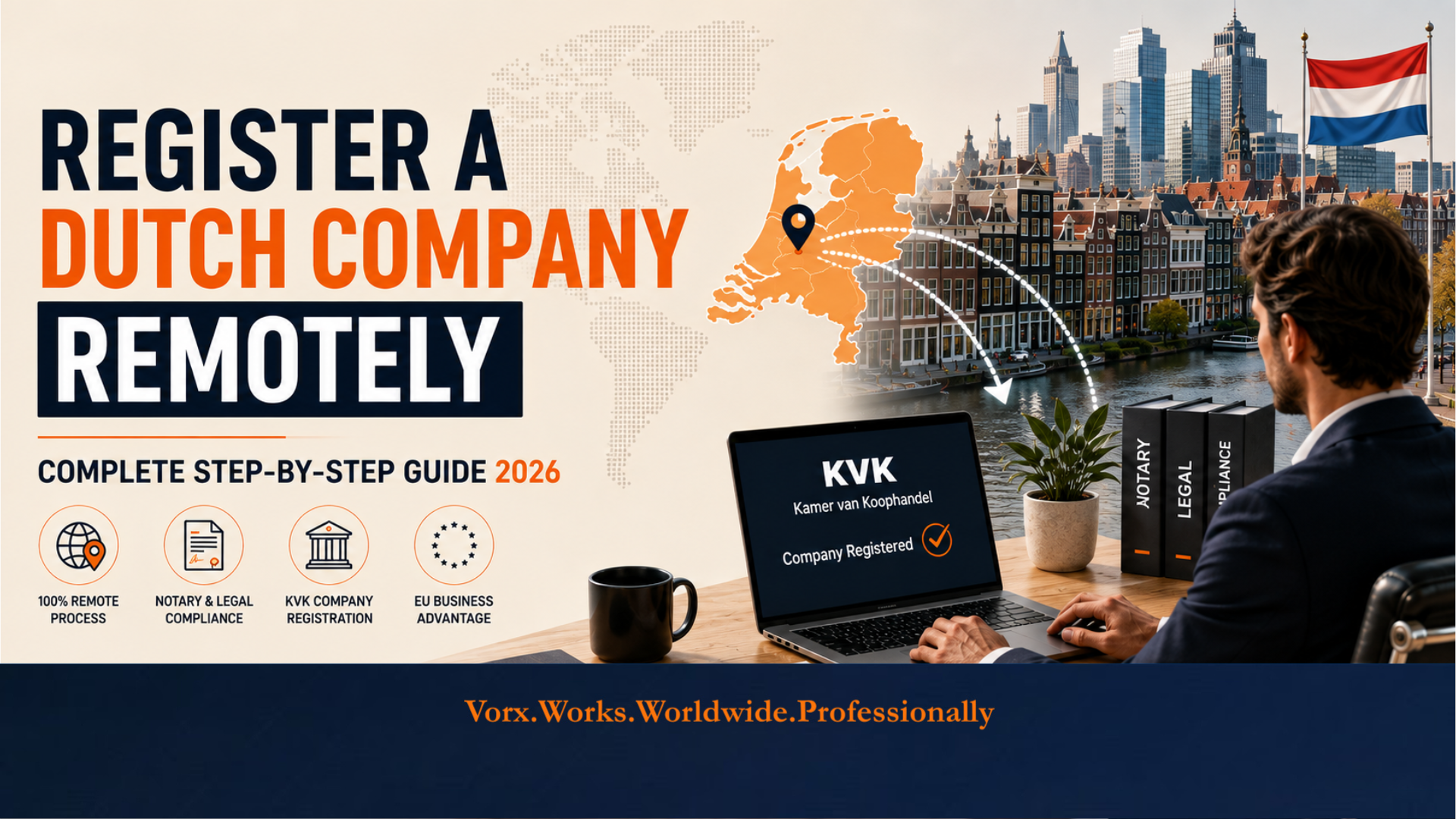
Yes — you can register a company in the Netherlands remotely without ever setting foot in the country.
The signing happens through a Power of Attorney or a video call with a notary, and the registration itself is filed electronically with the Dutch Chamber of Commerce (KVK).
But here’s what most guides won’t tell you upfront: incorporation and “ready to invoice clients” are two different milestones.
Your company can legally exist in 5-8 working days. Getting a working Dutch bank account often takes another 3-4 weeks on top of that. If you plan your launch around the shorter number, you’ll be frustrated in week two wondering why you still can’t send an invoice.
This guide walks through the real process, the parts that go smoothly and the parts that trip people up so you know exactly what to expect at each stage.
Who this is for:
- Foreign entrepreneurs starting a business in the Netherlands without relocating
- International founders setting up a Dutch BV from the US, UK, India, UAE, or elsewhere
- Digital businesses and remote teams who want an EU legal entity without the travel
- Startups and SMEs using the Netherlands as their EU entry point
- Investors who want a Dutch holding or operating company from abroad
If any of those describe you, keep reading we’ll cover the two ways to sign your deed remotely, a realistic day-by-day timeline, the costs nobody itemizes properly, and the specific things that cause delays or rejections.
Not sure which route fits your situation? Talk to Vorx Consultancy for a no-obligation assessment of your remote incorporation options.
Two Ways to Sign the Deed Without Being There
A Dutch BV legally comes into existence the moment a civil-law notary executes the deed of incorporation.
Since you’re not flying in for that appointment, you need one of two remote signing methods.
Route 1: Apostilled Power of Attorney
You sign a Power of Attorney (PoA) in front of a local notary in your own country, authorizing someone in the Netherlands (usually a lawyer or your formation agent) to sign the deed on your behalf.
That PoA then needs an apostille, an internationally recognized stamp confirming the document is genuine before it’s couriered or scanned to the Dutch notary.
This route works cleanly if your country is part of the Hague Apostille Convention. Most of Europe, the US, Canada, Australia, and the UK are covered.
If your country isn’t part of the Apostille Convention this includes countries like the UAE for certain document types, and requires a different process for India, China, and several others you’ll need consular legalization instead.
That means getting the document authenticated by your Ministry of Foreign Affairs and then by the Dutch embassy or consulate in your country.
It’s slower (often 2-3 weeks longer) and almost none of the guides floating around online mention this distinction.
If you’re in a non-Apostille country, build the extra time into your plan now, not after you’ve already told your notary you’ll be ready in a week.
Route 2: Video Identification
Some Dutch notaries now offer video-based identity verification instead of a PoA. You hop on a call, show your passport to the camera, and the notary verifies your identity directly, no apostille chain required.
This is faster when it’s available, but not every notary offers it, and some only accept it for founders from specific countries due to their own compliance policies.
Ask your notary or formation agent which route they actually support before you commit to a timeline. Don’t assume video ID is available just because you read it’s an option.
Which one should you use? If your notary offers a video ID and your home country’s documents are accepted, take it and shave days off the process.
If you’re in a country outside the Apostille Convention, the PoA route with consular legalization is often your only option, so plan for the longer timeline from day one.
Read This Guide: Can Foreigners Register a Company in the Netherlands? Requirements & Eligibility
Do You Need a Dutch Resident Director?
Short answer: no, not legally. A BV can be incorporated with a 100% foreign director and 100% foreign shareholder. Nothing in Dutch corporate law forces you to have a local person on the board.
Here’s the nuance almost nobody explains clearly: legal requirement and tax substance requirement are two different things.
If your Dutch BV is a standalone operating company selling products or services, you’re generally fine without local substance.
But if you’re setting up a holding company to benefit from tax treaties or the participation exemption, the Dutch tax authorities (and the tax authorities in your home country) look for “substance” signs that the company is genuinely managed in the Netherlands, not just a mailbox. That typically means:
- A Dutch resident director (or at least a majority of board decisions made in the Netherlands)
- A real Dutch bank account actively used
- A registered office that’s more than a mail-forwarding address
- Board meetings actually held in the Netherlands (even virtually, with proper documentation)
Real example: A US-based SaaS founder incorporating a single operating BV to sell software to EU customers usually doesn’t need a resident director; there’s no treaty benefit being claimed, so substance isn’t scrutinized the same way.
But an investor setting up a Dutch holding company to hold shares in an EU subsidiary and rely on the parent-subsidiary exemption will often need a local director specifically to avoid being classified as a “letterbox company” and losing those tax benefits.
If you’re not sure which category you fall into, this is worth a 30-minute call with a Dutch tax advisor before you incorporate, not after.
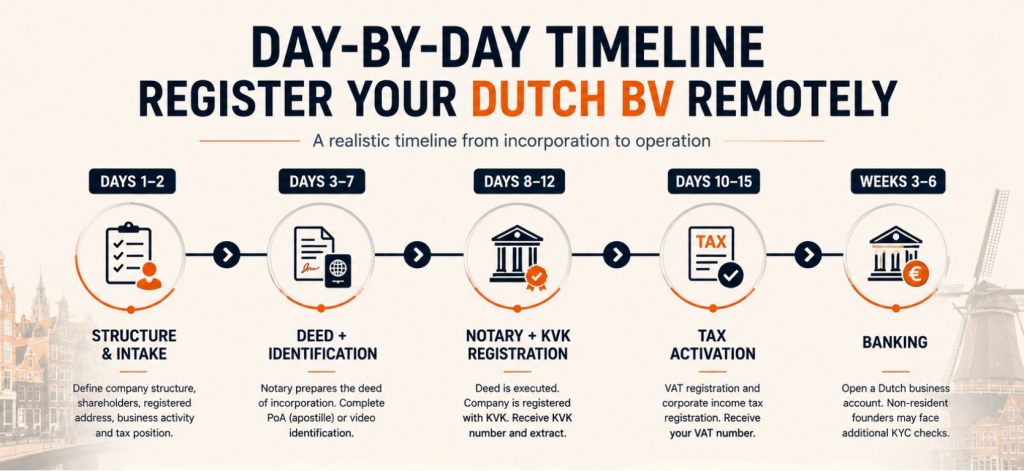
Timeline to Register a Company in the Netherlands Remotely, Day by Day
Here’s what the process actually looks like once you’ve decided on your structure and picked your signing route.
Days 1-2 — Structure and Intake
This is where you and your notary or formation agent lock in the basics: single BV or a holding-plus-operating structure, how shares are split between founders, your registered address in the Netherlands, who’s managing the company, and your initial tax position.
Get this right early restructuring after incorporation costs more time and money than getting it right upfront.
Days 3-7 — Deed Preparation and Identification
The notary drafts the deed of incorporation (in Dutch certified translations are available if you need to understand every clause).
While that’s happening, compliance checks run in the background, and you complete either your PoA signing/apostille or your video identification session.
Days 8-12 — Execution and Registration
The notary executes the deed. Your company is registered with the KVK Trade Register, and the UBO (Ultimate Beneficial Owner) register is updated with your ownership details.
You receive your KVK number and an official extract is your proof the company legally exists.
Days 10-15 — Tax Activation
VAT registration and corporate income tax registration happen, usually overlapping with the final registration steps. You’ll receive your VAT number (BTW-nummer) during this window.
Weeks 3-6 — Banking (the part everyone skips over)
This is the honest addition most competitor guides leave out entirely. Having a KVK number doesn’t mean you have a working bank account.
Non-resident founders routinely hit friction here; banks run their own KYC process independent of the notary’s, and it can add several weeks. We break down exactly why in the banking section below.
Bottom line on timing: budget 15 working days to be legally incorporated, and 4-6 weeks to be genuinely operational invoicing clients, receiving payments, filing your first VAT return.
Read This Guide: Dutch BV vs Sole Proprietorship: Which Business Structure Is Best for Foreign Entrepreneurs?
What You Need to Provide
The document list is shorter than most people expect. Your notary or formation agent handles the legal drafting, translations, and filings you’re mainly responsible for:
- A copy of your passport
- Your completed PoA signing (with apostille/legalization) or video identification session
- A Dutch registered address (your formation agent or a virtual office provider usually arranges this)
- Your chosen company name (check it against the KVK register first — see the rejection section below)
- A description of your intended business activity
Everything else drafting the articles of association, running KYC checks, filing with KVK, coordinating tax registration is on your notary or service provider.
If a provider is asking you for significantly more than this list, ask why; it usually means they’re bundling in extra services you may not need.
Where "Fully Remote" Breaks Down in Practice
This is the section most incorporation guides skip, and it’s the one thing that will actually determine how smooth your experience is.
Banking is the real bottleneck. Notaries and the KVK are used to processing non-resident founders; it’s routine for them.
Banks are a different story. Dutch banks run their own independent KYC and AML checks, and non-resident applicants without a Dutch address or local track record get extra scrutiny.
It’s common for founders to get their KVK extract in hand within a week and then wait a month for a functioning bank account.
Here’s how your two main options compare:
Fintech/EMI options (Wise Business, Revolut Business, Mollie)
- Remote-friendly: onboarding is fully online, built for exactly this situation
- Faster: often days rather than weeks
- Trade-off: not all of these hold a full EU banking license, and some Dutch clients or suppliers still prefer to see a traditional Dutch IBAN
Traditional banks (ABN AMRO, ING, Rabobank)
- More credibility with Dutch suppliers, landlords, and larger clients
- Slower and stricter: many require an in-person visit or, at minimum, a much heavier document trail for non-residents
- Some branches are more accommodating to remote founders than others — this varies a lot by branch and relationship manager, not just by bank policy
A practical approach many founders take: open a fintech business account first to get operational fast (invoicing, receiving payments, paying VAT), then apply for a traditional Dutch bank account in parallel once you have a few months of trading history which makes the traditional bank’s KYC process noticeably easier.
UBO verification can also add friction if your ownership structure has multiple layers, say, a holding company with shares split across two other entities.
Straightforward personal ownership rarely causes delays; multi-entity structures sometimes need extra documentation, so flag this to your notary early if it applies to you.
What Can Go Wrong (Rejection and Delay Scenarios)
Nobody likes to talk about failure points, but knowing them in advance saves you weeks.
Notary KYC rejection. Notaries are legally required to run anti-money-laundering checks.
Founders from sanctioned countries, individuals flagged as Politically Exposed Persons (PEPs), or incomplete apostille chains (a missing stamp, an expired document) are the most common causes of delay or rejection.
If you’re a PEP, disclose it upfront trying to work around it later costs far more time than addressing it from the start.
KVK name rejection. Your company name needs to be distinctive and can’t conflict with an existing trademark or be misleading about your business activity.
Check the KVK Handelsregister (or use a formation agent’s free name-checking tool) before you fall in love with a name. Rejections here are avoidable and entirely self-inflicted if you skip this step.
Bank refusal. Certain business activities draw heavier scrutiny from crypto, online gambling, high-risk payment processing, and businesses with founders from countries the bank considers higher-risk for compliance reasons.
If your business falls into one of these categories, talk to a fintech provider or a bank with specific experience in your sector before you incorporate, not after you’ve already paid notary fees and are stuck waiting on a bank decision.
How to pre-empt most of this: be upfront with your notary and bank about your business activity, your nationality, and your ownership structure from day one.
Founders who try to smooth over complications early tend to hit them later in a much more expensive way usually after the company is already incorporated and money is committed.
DAFT vs Standard BV Registration — Which Route for US Founders?
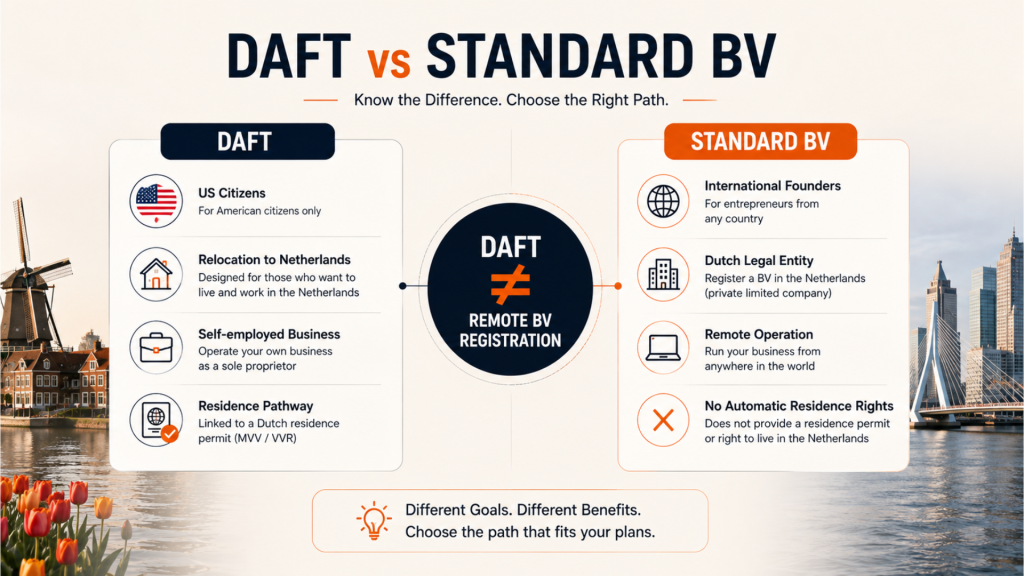
If you’re a US citizen, you’ve probably come across DAFT (the Dutch-American Friendship Treaty) alongside standard BV incorporation guides, often lumped together as if they’re the same thing. They’re not.
DAFT is a treaty-based residency pathway for US citizens who want to live and work in the Netherlands as a self-employed entrepreneur or sole proprietor.
It’s tied to a Dutch residence permit and requires a minimum capital investment into your own business. It’s designed for founders who plan to actually relocate.
Standard BV incorporation — the process this guide covers is a corporate structure.
It doesn’t require you to live in the Netherlands, doesn’t come with residency rights, and is suited to founders who want an EU legal entity while staying based wherever they already are.
Quick decision guide:
- Want to live in the Netherlands and run a self-employed business there → DAFT
- Want a Dutch/EU legal entity while remaining based abroad → Standard remote BV incorporation
- Want to eventually relocate but start with a remote entity now → Standard BV first, DAFT or a separate residence permit later if you decide to move
Conflating the two leads founders down the wrong path entirely — DAFT applicants who actually wanted a remote BV end up applying for a visa they don’t need, and remote BV founders sometimes assume DAFT gives them residency benefits it doesn’t. Get clear on which outcome you actually want before you start.
Read This Guide: How to Register a Company in the Netherlands
After Incorporation — Your First 12 Months of Compliance
Getting your KVK extract feels like the finish line, but it’s really the starting line for a set of recurring obligations.
Most guides end the article here worth knowing what’s actually coming next.
- VAT returns: filed monthly or quarterly depending on your turnover and how the Belastingdienst classifies your business
- UBO register updates: any change in ownership or beneficial ownership structure needs to be reflected within a set timeframe
- Annual accounts: due within a set period after your financial year-end, filed with the KVK
- Corporate income tax return: filed annually, typically due five months after your financial year-end (extensions are commonly available)
None of this needs to be intimidating; most founders hire a local bookkeeper or accountant for a few hundred euros a month to handle it.
The point is knowing it exists before you’re three months in and missing a filing deadline you didn’t know you had.
How Vorx Consultancy Helps
Coordinating a notary, apostille, KVK filing, VAT registration, and a bank account from another country is where most founders lose time.
Vorx Consultancy handles this end-to-end from choosing your structure and signing route to full registration and realistic bank introductions with transparent, itemized pricing so nothing hidden shows up later.
The goal is simple: get you actually operational, not just incorporated on paper.
Ready to register your company in the Netherlands remotely? Book a 20-minute consultation with Vorx Consultancy and get clear guidance on your structure, timeline, and costs before you commit.
Conclusion
Registering a company in the Netherlands remotely is genuinely possible; the notarization process, KVK registration, and tax setup can all be done without boarding an airplane.
Simply take into account the time required: 5-15 days to get incorporated, and 4-6 weeks to become completely functional once the banking part is considered.
