
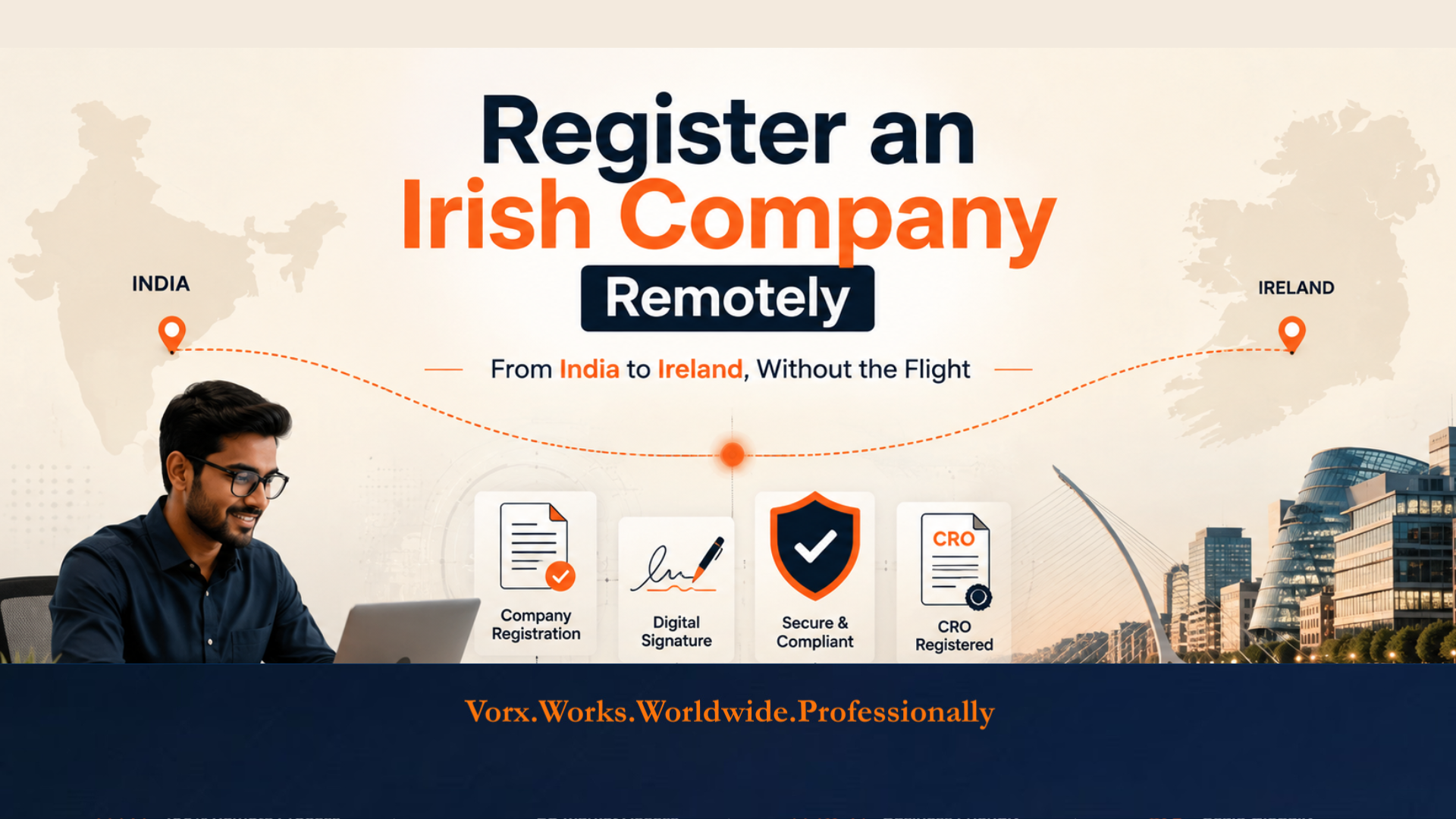
If you’re reading this from Mumbai, Bengaluru, or Delhi and wondering whether you actually need to fly to Dublin to set up a company there the short answer is no.
You can register an Irish company remotely, from start to finish, without ever boarding a flight. The Companies Registration Office (CRO) has run a fully digital filing system for years now, and thousands of non-resident founders use it every year.
But “remotely” doesn’t mean “without any requirements.” There’s one rule in particular the EEA-resident director requirement that trips up a lot of Indian founders because nobody explains it clearly upfront.
So let’s go through this properly: what you can do from your laptop in India, what actually needs planning, and where the real friction points are.
Why Indian Entrepreneurs Are Choosing Ireland Over Other Jurisdictions
Ireland keeps showing up on the shortlist for Indian founders expanding into Europe, and it’s not just because English is the working language (though that helps enormously with no translated contracts, no interpreter for calls with your accountant).
The bigger draw is market access. An Irish company gives you a legal foothold inside the EU single market, which matters if you’re running an e-commerce brand, a SaaS product, or a services business that wants to invoice European clients without the friction of cross-border compliance from India.
Ireland is also home to European headquarters for a huge chunk of global tech and pharma companies, so the ecosystem around banking, legal, accounting is genuinely built for international business, not just domestic Irish companies.
There’s also the India-Ireland Double Taxation Avoidance Agreement (DTAA), which exists specifically to stop the same income from being taxed twice in both countries.
It doesn’t eliminate your tax planning work, but it’s a meaningful safety net that founders expanding into other jurisdictions don’t always get.
If you’re comparing Ireland against, say, the UK or Estonia’s e-Residency programme: the UK has similar remote-friendliness but sits outside the EU post-Brexit, which matters if EU market access is your actual goal.
Estonia’s e-Residency is arguably simpler for a single-founder digital business, but it doesn’t carry the same weight if you’re planning to raise funding or work with EU enterprise clients who recognise Ireland as an established base.
Who Can Register an Irish Company from India?
Here’s the good news: you don’t need Irish or EU citizenship, you don’t need to be a resident, and you don’t need to set foot in the country.
This applies whether you’re:
- A solo founder building a product company
- An Indian startup opening an EU subsidiary
- An NRI looking to formalise a business presence in Europe
- An e-commerce or services business that wants an EU entity to sell into the region
One thing Indian founders often miss: setting up a foreign company isn’t purely an Ireland-side matter.
As an Indian resident investing in or setting up a company abroad, you fall under RBI’s Overseas Direct Investment (ODI) framework governed by FEMA.
This is a separate compliance track from anything the CRO asks for, and it’s worth looping in a chartered accountant familiar with outbound investment rules before you file anything in Ireland.
It’s not complicated, but it’s easy to overlook when you’re focused entirely on the Irish side of the process.
Read this guide: Can Foreigners Register a Company in Ireland? Requirements & Eligibility (2026)
Legal Requirements to Register an Irish Company Remotely
Most foreign founders register a Private Company Limited by Shares (LTD) — it’s the standard structure, and it’s what almost every non-resident ends up choosing.
Here’s what the structure actually requires:
A director. You can have a single-director company in most cases, but there’s a catch worth understanding properly.
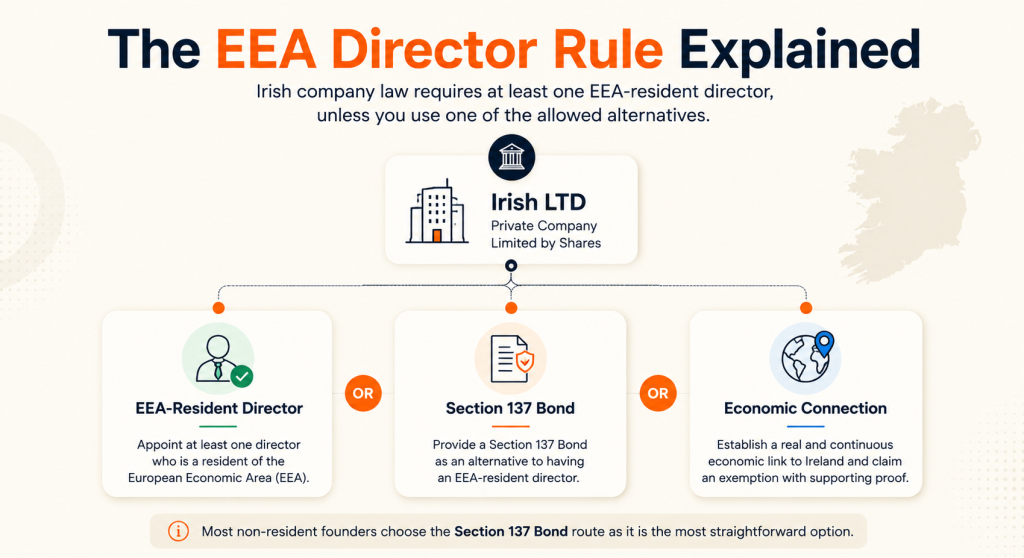
The EEA-resident director requirement. Irish company law requires at least one director to be a resident of the European Economic Area — unless you use one of two alternatives.
The first is a Section 137 Bond, which is essentially an insurance bond that covers the company against certain fines and penalties in place of having an EEA-resident director.
The second is claiming an exemption based on the company having a “real and continuous economic link” to Ireland this involves demonstrating things like ongoing trade or a physical office in the country, and it needs to be argued with supporting documentation rather than just claimed.
Most first-time non-resident founders go the bond route simply because it’s more straightforward to arrange.
A company secretary. Every Irish company needs one; this can be an individual or a corporate secretarial service.
A registered office address in Ireland. This has to be a physical address, not a P.O. box, and it’s where official correspondence gets sent.
Shareholder structure and disclosure. You’ll need to declare shareholders and their shareholdings clearly at incorporation.
A company constitution. This is the internal rulebook most companies use a standard constitution unless there’s a specific reason to customise it.
Step-by-Step Process to Register an Irish Company Remotely
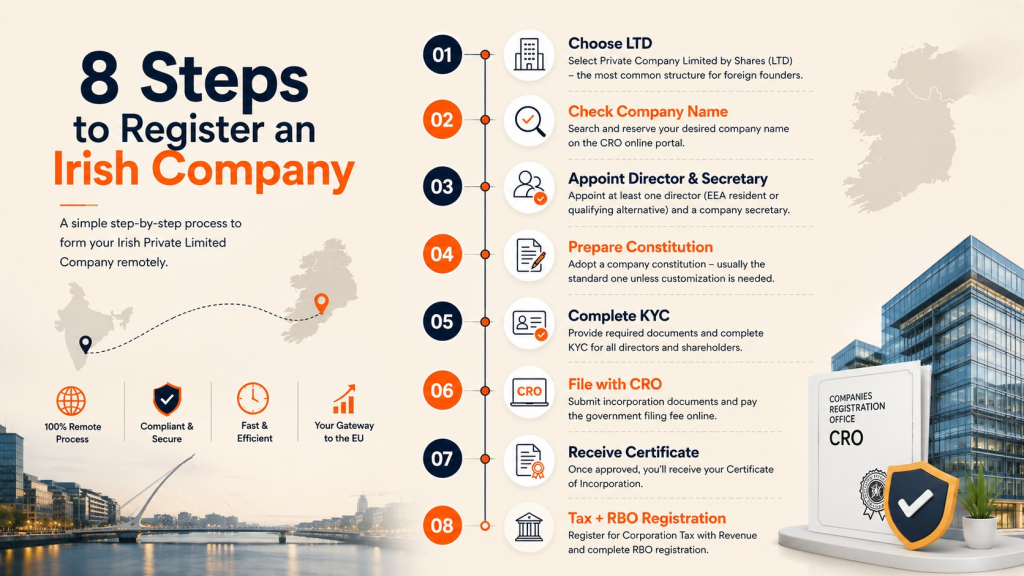
Here’s how the actual filing plays out, in order:
Step 1 — Choose your structure. For nearly all foreign founders, this is the LTD.
Step 2 — Reserve your company name. You’ll need to check name availability against the existing Irish business register before filing, since a clashing or misleading name is one of the most common rejection reasons.
Step 3 — Appoint your director(s) and secretary. Decide at this stage whether you’re going the EEA-director route, the bond route, or pursuing the economic-connection exemption — this affects what documentation you’ll need later.
Step 4 — Prepare and sign the constitution. This gets signed electronically; there’s no requirement for physical signatures or courier-shipped documents.
Step 5 — Complete identity verification and AML/KYC. This is done remotely through certified copies of documents, and sometimes video verification depending on the service provider you’re working with. Indian-issued documents typically need to go through notarisation and apostille (more on this below).
Step 6 — File with the CRO. Everything goes through CRO’s CORE online portal — this is the actual Republic of Ireland company register submission.
Step 7 — Receive your Certificate of Incorporation. Once approved, this confirms your company legally exists.
Step 8 — Register for tax and complete beneficial ownership filing. This means registering with Revenue for Corporation Tax (and VAT if it applies to your business), plus filing with the Register of Beneficial Ownership (RBO) — a separate, mandatory step many founders forget about until it’s overdue.
None of this requires a wet-ink signature, a courier, or a flight. Electronic signatures are accepted throughout.
Read this guide:How to Register a Company in Ireland: Complete 2026 Guide.
Planning to Register an Irish Company from India?
Let Vorx Consultancy handle the registration process while you focus on building your business in Ireland.
Documents Required from Indian Applicants
This is where Indian founders hit friction that founders from EU countries simply don’t experience and it’s a step almost no generic guide explains properly.
- Passport copy, certified and notarised
- Proof of address, such as a recent utility bill or bank statement, if it’s not in English, you’ll need a certified translation
- PAN card or other identity documents, often requested as part of KYC checks
- A description of your business activity
- Director and shareholder details for AML screening
The detail that catches people out: documents issued in India typically need to carry an apostille under the Hague Convention before Irish authorities or your registration agent will accept them.
India is a signatory to the Hague Apostille Convention, so this is achievable, but it adds a step: you’re getting the document notarised in India first, then apostilled through the relevant government authority, before it’s usable for your Irish filing.
Build this into your timeline early, because it’s the one part of the process that genuinely can’t be rushed from your laptop.
Read this guide: Ireland Company Formation Requirements: What Do You Need to Start a Company? (2026).
Do You Need to Visit Ireland at Any Point?
No, incorporation itself doesn’t require your physical presence, from name reservation right through to receiving your Certificate of Incorporation.
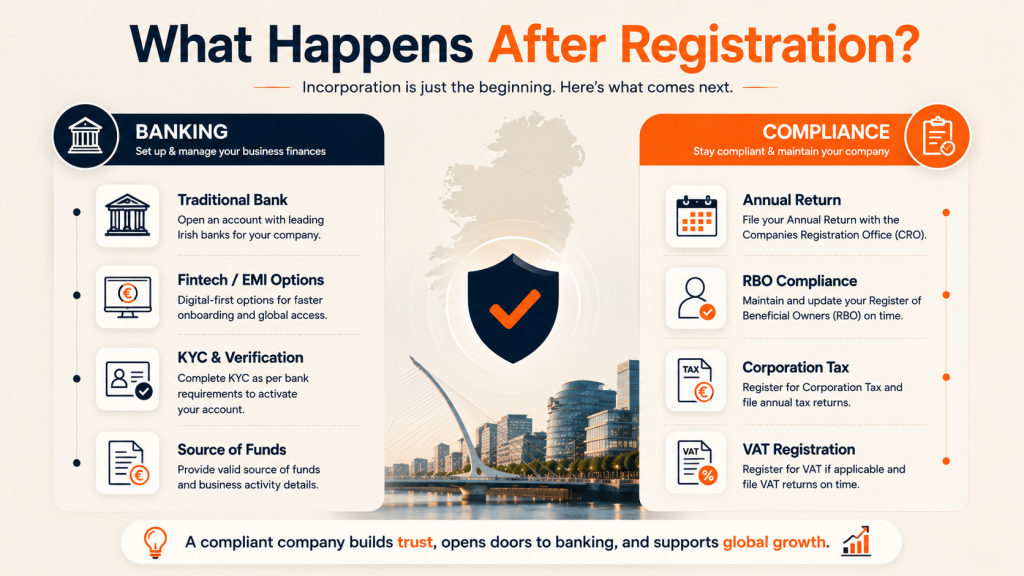
Where things can get slightly less “remote” is banking. Some traditional Irish banks still prefer or require an in-person meeting to open a business account, particularly for non-resident directors.
That’s not universal, but it’s common enough that you shouldn’t assume every bank will onboard you purely online.
Opening a Business Bank Account as a Non-Resident
You have two broad paths here. Traditional Irish banks offer the most “conventional” business banking relationship, but as mentioned, some still lean toward in-person verification for non-resident accounts.
On the other side, EMI (electronic money institution) and fintech providers like Wise Business and Revolut Business have built their onboarding specifically for remote, non-resident founders with no branch visit required, and account setup usually happens entirely through their app or web portal.
Whichever route you choose, have your source-of-funds documentation and business activity explanation ready in advance.
This is standard KYC territory and moves faster when you’re not scrambling to produce paperwork mid-application.
One more thing worth flagging for Indian founders specifically: moving funds from India to your new Irish company for setup or working capital may need to align with RBI’s Liberalised Remittance Scheme (LRS) or the ODI framework, depending on how your company is structured.
This isn’t something to guess your way through a quick conversation with your CA before you transfer money saves a lot of after-the-fact headaches.
Need Help Setting Up Your Irish Business?
From company registration to business banking and compliance, Vorx Consultancy can help you manage the process remotely from India.
Post-Incorporation Compliance :What Happens After You Register
Getting your Certificate of Incorporation is the milestone everyone focuses on, but it’s genuinely just the start of your obligations, not the end.
You’ll need to file an Annual Return (Form B1) with the CRO every year.
Your RBO filing needs updating any time beneficial ownership changes new shareholder, changed shareholding percentage, and so on.
You’ll also file a Corporation Tax return (CT1) with Revenue annually. If your business trades within the EU or sells to EU consumers, VAT registration may be triggered once you cross certain activity thresholds; the specifics depend on your business model, so this is worth reviewing with an accountant rather than assuming a blanket rule applies.
Here’s the part that genuinely surprises non-resident founders: if you miss your compliance deadlines, the CRO has the power to strike off your company.
That’s not a slap on the wrist. A struck-off company loses its legal status, and reinstating it is a far bigger headache than just filing on time would have been.
If you’re running this remotely, set calendar reminders or work with a registered agent who tracks these deadlines for you, because there’s nobody physically in Ireland reminding you.
Common Mistakes Indian Founders Make When Registering Remotely
A few patterns show up again and again:
Assuming the EEA-director requirement doesn’t apply to them. Some founders discover this rule only after their filing gets flagged, which delays everything.
Submitting documents without apostille. If your passport or proof of address hasn’t gone through notarisation and apostille, expect rejection or delay.
Picking a company name that clashes with the existing register. A quick search before you fall in love with a name saves a rejected filing.
Treating the Irish filing as the only compliance step. The India-side ODI/FEMA filing runs in parallel, not instead of, and skipping it creates problems back home even if your Irish company is perfectly compliant.
Registering for VAT too late. If you start EU sales before sorting out VAT registration, you’re playing catch-up on something that’s much easier to set up proactively.
How Vorx Consultancy Helps You Register an Irish Company Remotely
Reading through everything above, it’s fair to feel like there’s a lot of moving pieces: the EEA-director workaround, apostille requirements, India-side ODI compliance, post-incorporation filings.
This is exactly the kind of process where having someone who’s done it dozens of times makes a real difference, and that’s where Vorx Consultancy comes in.
Vorx Consultancy works specifically with founders registering Irish companies remotely, and the team handles the parts of this process that tend to slow Indian applicants down the most.
That means guiding you through the Section 137 Bond versus economic-connection exemption decision based on your actual business plans, rather than defaulting to whichever is easiest to sell.
It means flagging the apostille requirement for your Indian-issued documents before it becomes a delay, not after your filing gets stuck.
And it means making sure your company secretary, registered office, and constitution are all set up correctly the first time, so you’re not going back and forth with the CRO over avoidable errors.
Beyond incorporation itself, Vorx Consultancy also supports the post-registration side RBO filings, Corporation Tax registration, and building out a compliance calendar so annual returns and CT1 filings don’t slip through the cracks months down the line.
For founders who’d rather focus on actually running their business than becoming an expert in Irish company law, that ongoing support is often the more valuable part of the relationship.
Ready to Set Up Your Irish Company Remotely?
Avoid delays with EEA director requirements, document apostilles, CRO registration, and ongoing compliance.
Start your Irish company registration with Vorx Consultancy today.
Conclusion
Forming an Irish business online from India is not only possible but also something that has been done by hundreds of entrepreneurs who have formed an Irish business without even stepping into Ireland.
The truth of the matter is that the process of forming your company, including name registration, constitution, CRO registration, and certificate of incorporation is supposed to be completely carried out online.
The small details that many generic guides fail to mention will either make or break the entire process. They include ensuring that your director requirement for EEA is in order, your Indian documents are apostilled, as well as following your Irish compliance calendar and your FEMA/ODI compliance in India.
Getting all these things in place will ensure that there is nothing stopping you from running your completely compliant business in the EU from Dublin, without stepping out of India.