


Hungary taxes company profits at 9%. Cyprus now charges 15%. On paper, that looks like the easiest decision you’ll make this year.
It isn’t. If you plan to keep living in India, the worked example below shows the gap between the two countries shrinking to about one percentage point once Indian tax on your dividends applies.
If you relocate, the result flips: Cyprus can leave you roughly €12,000 more for every €100,000 of profit. And if your margins are thin, Hungary’s turnover-based local tax can quietly eat the advantage the 9% rate promised.
This Cyprus v. Hungary tax comparison will give you the complete picture of 2026: tax rates following Cyprus’ largest tax overhaul in 20 years; tax comparison based on the calculation of the tax liability for €100,000 profit; taxation of IP and SaaS revenue in each country; proper company formation in both jurisdictions; and the Indian laws (POEM, FEMA, and the tax treaties) which trump both jurisdictional benefits. The presentation concludes with a comparative table of founders.
Cyprus vs Hungary Taxes at a Glance (2026)
Key Factor | Cyprus | Hungary |
Corporate Tax | 15% | 9% |
Additional Business Tax | No general local business tax | Up to 2% local tax + 0.3% innovation levy, where applicable |
Dividend Tax (Residents) | Non-dom: 0% SDC + 2.65% healthcare levy; domiciled: generally 5% SDC + levy | 15% income tax + possible 13% social tax |
IP Tax Benefits | 80% deduction on qualifying IP profits | 50% deduction on eligible royalty income |
Standard VAT | 19% | 27% |
Minimum Share Capital | No statutory minimum | HUF 3 million (Kft.) |
Currency | Euro (€) | Hungarian Forint (HUF) |
Schengen Area | Not yet a member | Member |
India Tax Treaty | Generally 10% rates* | Generally 10% rates* |
Want to see how these stack up against Malta, the Netherlands or the UAE? You can compare more jurisdictions side by side with our free tool.
Tax rules here changed twice in the last year.
Bookmark this table and we’ll keep it current, so you’re not relying on a 2024 blog when you finally decide.
Cyprus Corporate Tax 2026: What Changed
Cyprus introduced significant changes to its tax law in December 2025, which came into effect from 1 January 2026 onwards. The tax rate quoted by many competitive articles is the older one of 12.5%.
The key changes for business owners:
The corporate tax rate increased from 12.5% to 15%, making Cyprus a member of the OECD minimum tax system.
The Special Defence Contribution (SDC) on dividends decreased from 17% to 5% for Cyprus domiciled individuals.
There is no deemed dividend distribution from profits made after 2026, meaning that you will not pay tax on profits you decide to retain in the business.
Losses can now be carried forward for seven years.
The non-dom regime survived. New residents who are not Cyprus-domiciled still pay 0% SDC on dividends and interest for 17 years, with a new option to extend by paying €250,000 per five-year block.
Cyprus also still exempts most qualifying dividends received from subsidiaries and gains on the sale of shares, which keeps it popular for holding companies.
Read this guide: Cyprus Corporate Tax 2026.
Hungary Corporate Tax 2026: 9% Is Not the Whole Bill
Hungary’s corporate income tax is the lowest in the EU at 9%. However, there are two more taxes imposed above it which are charged as a percentage of turnover.
Local business tax (HIPA): fixed by individual municipalities up to 2% of the net sales revenue after adjustments for expenses like cost of goods sold and subcontractor expenses. Since salaries are not deductible, it is felt most by people-intensive service industries.
Innovation contribution: For enterprises which exceed the limits of small businesses, 0.3%.
This is especially important in case of low-margin firms. A business that earns a profit of €60,000 against an adjusted income base of €2 million would end up paying a local firm tax of up to €40,000, which is four times higher than the company’s 9 percent corporate tax.
With profits reaching the Hungarian national residing shareholder, the next level is extremely high: it consists of 15% personal income tax and 13% social tax contribution, with a cap on the latter being EUR 2,600 for 2026.
Read this guide: Hungary Corporate Tax 2026
What You Actually Pay on €100,000 of Profit
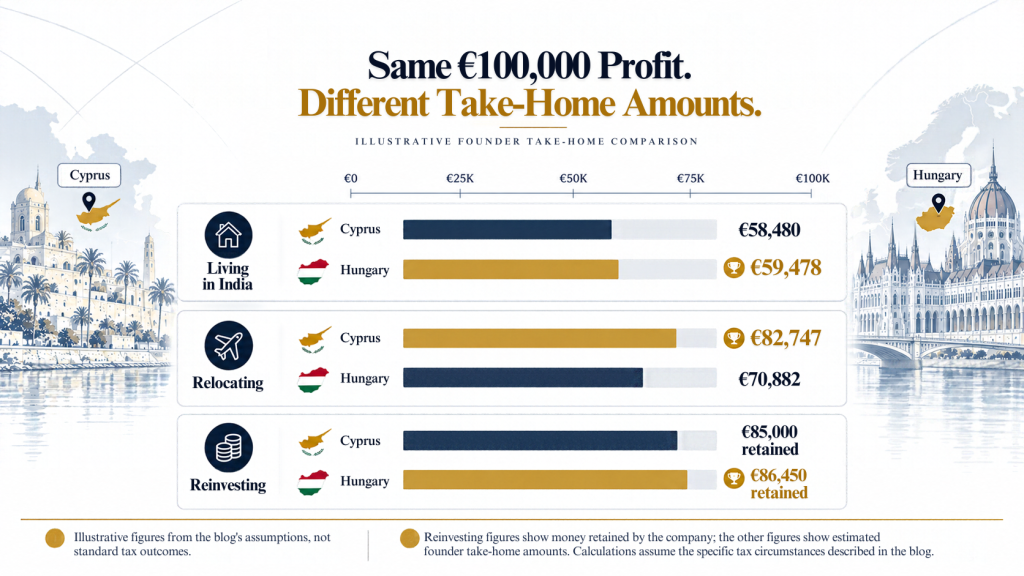
Please see below an illustration, which is a simplistic and hypothetical scenario. It involves a services business making €100,000 of profit and €250,000 of revenue adjusted for Hungary’s local tax (2% rate), dividend distribution of all profit, and the Indian founding member being in 30% slab plus 4% cess (31.2%, no surcharge).
Scenario A: You stay an Indian tax resident
However, since India imposes tax on income arising worldwide from its residents, this amount will be taxed again in India under slab rates.
The withholding tax levied by the other country for dividend is creditable in India but not the corporation tax paid by the company.
- Cyprus: €15,000 corporation tax. Cyprus does not impose tax withholding on the dividends that are paid to an Indian citizen. India taxes the €85,000 dividend: €26,520.
- Hungary: €5,000 local business tax and €8,550 corporate tax. The €86,450 dividend is taxed in India at €26,972, less a credit for any Hungarian withholding (capped at 10% under the treaty). The total stays the same either way.
Scenario B: You relocate and become tax resident there
- Cyprus (non-dom): €15,000 corporate tax plus the 2.65% healthcare levy on the dividend (€2,253). No SDC.
- Hungary: €13,550 company-level tax, then 15% income tax on the dividend (€12,968) and social contribution tax at the cap (about €2,600).
Scenario | Cyprus | Hungary |
Founder stays in India | 41.5% tax (€58,480 left) | 40.5% tax (€59,478 left) |
Founder relocates | 17.3% tax (€82,747 left) | 29.1% tax (€70,882 left) |
Profit reinvested | 15% tax (€85,000 retained) | 13.6% tax (€86,450 retained) |
Three takeaways stand out. If you stay in India, the jurisdiction choice barely changes your tax; Indian tax dominates.
If you relocate, Cyprus’s non-dom regime wins clearly. And if you reinvest profits rather than distribute them, Hungary’s lower company-level tax gives it a modest edge, as long as your margins are healthy.
Want this run with your real revenue, margins and residency plans? Our international tax structuring team can model it for you.
Know a founder who’s leaning towards Hungary just for the 9%?
This is probably the section to send them before they register anything.
IP and SaaS Income: Cyprus IP Box vs Hungary's Royalty Regime
The special regimes become more important than the headline rate for software/IP-based founders.
Cyprus IP box: 80% of the eligible profits generated through eligible IP (patents, copyrighted software) is exempt. With the new rate of 15%, the actual tax rate on such profits is around 3%.
Hungary: eligible royalty income from the use of self-developed IP can be deducted by 50% from taxable profits, which is subject to a maximum of 50% of the pre-tax profits.
At 9%, it means around 4.5% of the eligible income.
Both countries adopt the OECD “nexus” model – the deduction is based on the actual R&D done by the company.
An entity in Cyprus/Hungary that simply owns the code developed by your team in Bengaluru will find it hard to qualify.If your developers stay in India, the IP regime may deliver far less than the brochure suggests.
Cyprus vs Hungary Company Formation and Compliance
Cyprus: a private limited company needs one shareholder, one director and a company secretary, with no legal minimum capital.
Every Cyprus company must file audited financial statements, which adds an annual cost. Cyprus law is based on English company law, which many Indian founders find familiar.
Hungary:The Kft company form is used and requires a minimum capital of HUF 3,000,000 and registration in Hungary.
Registration can be carried out electronically and quickly, but documents should be in Hungarian, and for foreign founders, the documents require apostille and translation.Smaller companies are generally exempt from statutory audit below the thresholds.
Banking is the actual bottleneck in both: The EU banks check the background of non-residents very carefully, and an enterprise without its own office, employees, and management is doomed to wait. Plan your corporate bank account opening as part of the setup, not after it.
And two final practical notes: Hungary’s 27% VAT is the highest in the EU, which is relevant if you sell to customers from other EU countries, and Hungary belongs to Schengen, but Cyprus does not.
Read this guide: Hungary Company Compliance Requirements 2026.
The Indian Side: POEM, ODI and the Tax Treaties
This is where most Indian founders get caught out, and where no competitor article spends much time.
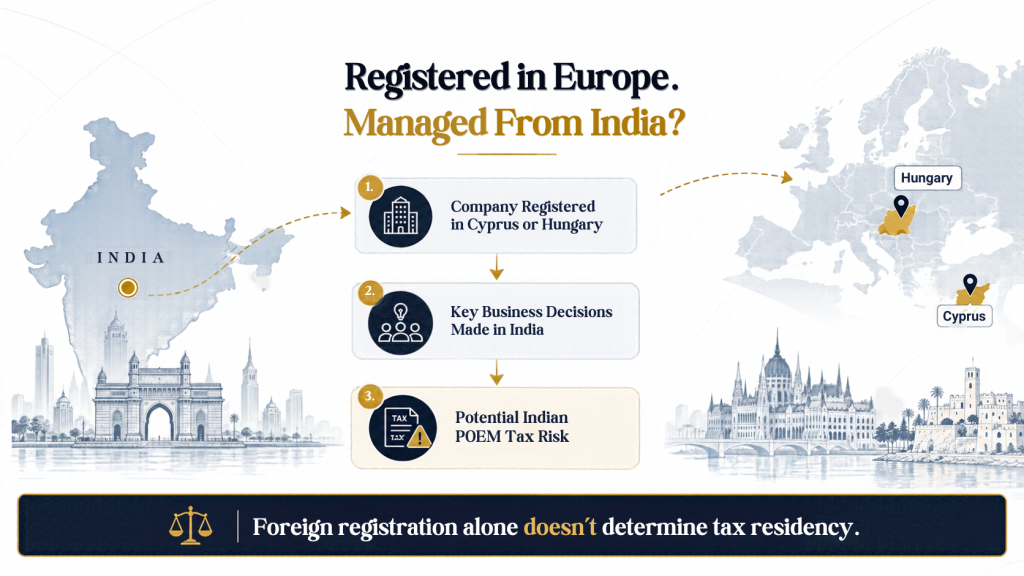
POEM (Place of Effective Management): if key management and commercial decisions for your Cyprus or Hungarian company are in substance taken in India, Indian tax authorities can treat it as an Indian tax resident.
Its global profits would then be taxed in India, wiping out the benefit of either country. Genuine local directors and decision-making abroad are essential.
FEMA overseas investment rules (2022): an Indian resident who sets up or controls a foreign company is making an Overseas Direct Investment.
It must be routed through an authorised dealer bank with Form FC filed, even when little cash is sent. Our FEMA and overseas investment compliance team handles these filings.
Tax Treaties: In its 2016 tax treaty with Cyprus and 2003 treaty with Hungary, India has set a maximum tax rate of 10% for withholding taxes on dividends, interests, and royalties.
The other change in India has been to remove Cyprus from its non-cooperative list in 2016.
Which Is Better for Your Business?
Business Situation | Better Choice | Main Reason |
Living in India | Both | Depends on Indian tax rules |
Relocating to Europe | Cyprus | Non-dom dividend tax benefits |
Reinvesting profits | Hungary | Lower corporate tax |
Low-profit trading business | Cyprus | No equivalent local business tax |
IT, SaaS & IP businesses | Cyprus | Attractive IP Box benefits |
Holding company | Cyprus | Potential dividend and capital gains exemptions |
Manufacturing business | Hungary | Investment incentives and EU market access |
Conclusion:
In a Cyprus vs Hungary tax comparison, the right answer depends on where you live and how you’ll use your profits.
Stay in India and take dividends, and the two countries cost roughly the same. Relocate, and Cyprus usually wins.Reinvest with healthy margins, and Hungary just about wins.
Before making your decision, plan for three things: where you’ll be tax resident, where the decision makers reside, and how profits will be taken out.
Vorx helps Indian founders with exactly this, from structuring and FEMA compliance to company formation, banking and residency. Book a free consultation and we’ll model both options with your real numbers.
