


For Indian entrepreneurs looking beyond the domestic market, the decision usually comes down to two names: Cyprus and the UAE.
Both offer routes to international company formation, access to global banking, and a base for scaling exports, digital services, or holding structures.
But they solve different problems. Cyprus opens the door to the European Union. The UAE puts you closer to Gulf, African, and Asian trade corridors, with a business environment built for speed.
If you’re an Indian founder, SME owner, exporter, or consultant weighing an overseas setup, the right choice depends less on which country is “better” and more on what your business actually needs: market access, banking relationships, personal residency plans, or all three.
This guide walks through the practical differences so you can make that call with a clearer picture.
Read this guide: Cyprus Company Formation for Foreigners: A Complete 2026 Guide
Cyprus vs UAE Company Formation: Quick Comparison Overview
Before getting into tax and banking detail, it helps to see how the two jurisdictions differ at a structural level.
Factor | Cyprus | UAE |
Legal system | Common law, EU member state | Civil law with free zone variations |
Currency | Euro | UAE Dirham (AED) |
Market access | European Union | Gulf, Africa, South Asia |
Foreign ownership | 100% permitted | 100% permitted (mainland and free zone) |
Business language | English widely used | English widely used |
Neither system is inherently superior. Cyprus suits businesses that need EU credibility and market entry.
The UAE suits businesses built around trade, logistics, or founders who want to relocate personally. Keep this distinction in mind as we go section by section, because it shapes almost every decision that follows.
Cyprus vs UAE Corporate Tax: Which Jurisdiction Taxes You Less
This is usually the first question founders ask, and it’s also the one most commonly misunderstood.
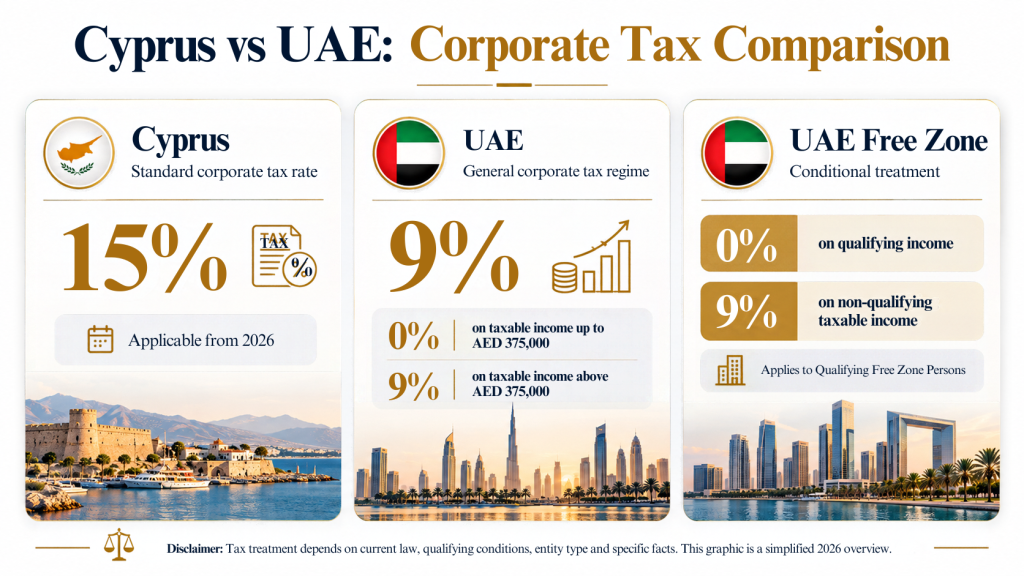
Cyprus applies a flat corporate tax rate of 12.5 percent on company profits, one of the lowest standard rates in the EU.
Certain income, particularly from qualifying intellectual property, can benefit from Cyprus’s IP box regime, which reduces the effective rate further on that specific income stream.
The UAE introduced federal corporate tax in 2023, and this is where many founders get caught out. UAE corporate tax stands at 9 percent on taxable income above AED 375,000, applying to most mainland businesses.
Free zone companies can still access a 0 percent rate, but only on qualifying income if they meet Qualifying Free Zone Person conditions; this isn’t automatic, and income outside those conditions is taxed at the standard 9 percent.
Vorx Consultancy Insight: We regularly meet founders who assume a UAE free zone company means zero tax across the board.
It doesn’t. The 0 percent rate is conditional, tied to specific activities and income categories, and getting it wrong can mean an unexpected tax bill at filing time.
Read this guide: Cyprus Corporate Tax 2026: Complete Guide for Foreign-Owned Companies.
Cyprus vs UAE Tax Benefits for Indian-Owned Businesses
Both India-Cyprus and India-UAE Double Taxation Avoidance Agreements exist to prevent the same income being taxed twice. What they don’t do is exempt an Indian promoter from Indian tax rules altogether.
If you’re repatriating profits to India as dividends, you’ll still need to account for Indian tax treatment on that income and any applicable withholding at source.
If your Cyprus or UAE company holds shares, earns royalties, or generates capital gains, the DTAA determines which country has taxing rights first; it doesn’t mean the income becomes tax-free everywhere.
This is a detail that’s easy to skip past in a hurry to incorporate, but it materially affects how much of your international profit actually reaches you as an individual.
Cyprus vs UAE Business Banking: Account Opening Reality for Indian Founders
This is where theory and practice diverge most sharply, and it’s worth being honest about it upfront.
Opening a business bank account in either jurisdiction as a non-resident, Indian-origin founder involves closer scrutiny than it did a few years ago.
UAE banks typically require a resident director or, at minimum, an in-person visit, along with clear documentation on the nature of business activity and source of funds.
Cyprus banks apply similar due diligence, though EU-regulated electronic money institutions have become a practical alternative for founders who need international payment capability quickly, while a traditional bank relationship is still being built.
Take a small example: an Indian SaaS founder incorporated in the UAE to serve Gulf clients found that opening a local bank account took considerably longer than expected, simply because the bank wanted evidence of an active office presence, not just a free zone license.
He ended up using an EMI for the first few months of invoicing while the traditional account was still in process.
This kind of gap is common, and planning for it in advance avoids unnecessary disruption to invoicing and payments.
Planning an overseas company but concerned about banking?
Vorx Consultancy can help you navigate company formation and banking requirements.
Cyprus vs UAE Compliance Requirements: Substance, Audit and Reporting
Compliance is where ongoing discipline matters more than the initial paperwork.
Cyprus companies are generally required to prepare audited financial statements and file annual returns, regardless of company size.
The UAE’s requirements vary by structure; some free zones mandate audited accounts, particularly for companies claiming the 0 percent Qualifying Free Zone Person rate, while requirements for mainland companies differ again.
Both jurisdictions also expect a degree of genuine economic substance meaning the company should demonstrate real decision-making, management presence, and operational activity in the jurisdiction, rather than existing only on paper.
This typically involves considerations like where board meetings are held, who the directors are, and where key business decisions are actually made.
Both Cyprus and the UAE participate in the Common Reporting Standard, which means financial account information tied to Indian beneficial owners can be shared with Indian tax authorities.
This isn’t a reason to avoid either jurisdiction, but it does mean structuring with the assumption of transparency, not the absence of it.
Read this guide: Cyprus Company Compliance Requirements: A 2026 Guide for Foreign Business Owners
Cyprus Company Registration for Indians: Process and Requirements
Registering a company in Cyprus as an Indian applicant follows a fairly structured path: name approval, submission of incorporation documents, appointment of a registered office and local agent, and registration with the Cyprus Registrar of Companies.
Supporting documents from India, such as identity and address proof, typically need to be apostilled or notarized to be accepted.
Where Indian applicants often face delays isn’t the registration itself, but document authentication timelines back home, along with source-of-funds verification once a bank account application follows.
Building extra time into your plan for this stage tends to prevent avoidable frustration later.
UAE Company Formation for Indian Entrepreneurs: Mainland vs Free Zone
The mainland versus free zone decision is one of the first real forks in the road for a UAE setup.
A mainland company allows direct trade within the UAE local market without restriction, which matters if your business model involves selling to UAE-based customers.
A free zone company offers 100 percent foreign ownership and is often the preferred route for founders focused on international trade, consulting, or digital services rather than local UAE sales.
For Indian entrepreneurs planning to relocate, company formation can connect to a residence visa application, though it’s worth being clear that setting up a company is a separate step from obtaining a residence permit; one doesn’t automatically guarantee the other, and each has its own eligibility criteria.
Personal Tax Residency: Where Should the Founder Live and Pay Tax?
This is the question most comparison articles skip, and it’s often more important than the corporate tax rate itself.
Where your company is incorporated and where you, as the founder, are personally tax resident are two different questions.
India’s tax residency rules are based on the number of days spent in India during a financial year, along with other conditions under the Income Tax Act.
Simply owning a Cyprus or UAE company doesn’t change your personal Indian tax residency status that depends on your own physical presence and circumstances.
There’s a related risk worth understanding: if a UAE or Cyprus company is effectively managed and controlled from India meaning key decisions are actually made by a director based in India Indian tax authorities can, under Place of Effective Management provisions, treat that foreign company as an Indian tax resident for corporate tax purposes.
This is precisely why genuine substance and clear decision-making location matter, not just as a compliance checkbox, but as a real safeguard for the structure you’ve built.
Which Jurisdiction Fits Your Business Model
Rather than asking which country is better in the abstract, it helps to ask which one fits your specific business:
SaaS and digital services: Cyprus offers EU market credibility and IP-friendly tax treatment; the UAE offers faster setup and zero personal income tax if you relocate.
Exporters and trading businesses: The UAE’s logistics infrastructure and free zone trade licenses are typically a stronger fit.
EU-facing service providers: Cyprus’s EU membership provides more straightforward market access and regulatory recognition.
Holding structures: Both jurisdictions can play a role, sometimes together, depending on where the underlying operating business sits.
Cyprus or UAE? Make your decision based on your business goals.
Connect with Vorx Consultancy to explore a suitable company formation strategy.
Best Country for International Business Setup: A Decision Framework
Instead of chasing a universal answer, ask four questions: Where are your customers based? Where do you personally plan to live? What are your banking and payment needs?
And what do your investors or partners expect to see in terms of jurisdiction credibility? The answers usually point toward one jurisdiction more clearly than any general “best country” ranking could.
Combining Cyprus and UAE: Holding Structures for Indian Groups
Some Indian-founded groups don’t choose one jurisdiction over the other they use both.
A UAE operating entity handling Gulf trade alongside a Cyprus holding or trading subsidiary for EU market entry is a structure we see fairly often at Vorx Consultancy, particularly among founders scaling beyond a single region.
This isn’t the right fit for every business, and it adds its own compliance layers, but it’s worth knowing the option exists before assuming it has to be either-or.
Common Mistakes Indian Entrepreneurs Make When Choosing a Jurisdiction
A few patterns come up repeatedly: assuming UAE company income is entirely tax-free without checking Qualifying Free Zone Person conditions; overlooking Place of Effective Management risk when the founder stays based in India; underestimating how thorough bank due diligence has become for Indian-origin beneficial owners; and treating the jurisdiction choice as permanent, when in practice structures can and do evolve as the business grows.
Final Verdict: Choosing Between Cyprus and UAE
There’s no single right answer here, and any article claiming otherwise is oversimplifying. Cyprus makes sense when EU market access and IP-related tax treatment matter to your business.
The UAE makes sense when Gulf trade access, speed of setup, and personal relocation are priorities.
At Vorx Consultancy, we generally recommend founders map out their target market, personal residency intentions, and banking needs before comparing tax rates in isolation because the jurisdiction that looks best on paper isn’t always the one that fits how your business actually operates.
Ready to Expand Your Business Internationally?
From choosing the right jurisdiction to company registration and ongoing compliance, Vorx Consultancy helps you plan your international expansion.
