


Ghana’s free zones scheme ensures that an exporting-oriented enterprise pays zero corporate income tax for its first decade.
This requires the issuance of Ghana Free Zone License by the Ghana Free Zones Authority (GFZA) with at least 70% of production being exported.
2026 has also changed the rules around it. Ghana has a new investment law, a new Customs Act, and the government’s policy to emphasize manufacturing in free zones.
This guide explains who qualifies, which documents you need, current GFZA fees, the step-by-step process and the tax you will actually pay after the holiday. It also covers what the 2026 reforms mean before you apply.
What Is a Ghana Free Zone License?
Ghana Free Zone License, It is the license issued by the GFZA to allow a firm to conduct business under the Ghana Free Zones Act of 1995 (Act 504).
The firm receives tax and custom privileges in exchange for the export undertaking.For customs purposes, a licensed free zone business is treated as operating outside Ghana’s national customs territory.
You do not have to be inside a fenced industrial park. Ghana allows two set-ups:
- Enclave free zones, such as the Tema Export Processing Zone near Tema Port.
- Single-factory status, which lets a licensed company operate from approved premises anywhere in Ghana, as long as it meets the 70% export rule.
Types of Ghana Free Zone Licenses
Each licence names the activity you are authorised to carry out.
Licence type | Who it is for | Example activity |
Developer | Companies that build and run free zone infrastructure | Industrial park or warehousing estate |
Manufacturing | Companies that process or make goods for export | Agro-processing, garments, packaging, pharma inputs |
Service | Companies serving foreign clients from Ghana | Logistics or support services for overseas clients |
Commercial | Trading, warehousing and distribution | A regional distribution hub for West Africa |
Check This First: The 2026 Free Zone Reforms
In its July 2026 mid-year budget review, Ghana’s government proposed to refocus the regime on export-oriented manufacturing. The proposals include:
- Issuing new free zone licences only to manufacturing enterprises.
- Requiring imported raw materials to be used within 12 months.
- Limiting duty exemptions to qualifying raw materials.
- Charging duties and taxes on goods that enter the domestic market.
Parliament then passed the Customs Bill, 2026, which tightens customs supervision of free zones and focuses them on manufacturing.
What this means for you: When making plans to apply for either a service or commercial licence, ensure that GFZA is accepting applications in your chosen area before spending money to get incorporated or acquire property. Manufacturers are the clear priority under the new direction.
Who Is Eligible for a Ghana Free Zone License?
The GFZA looks at the business model, not the investor’s nationality. To qualify, your business should:
Be a limited liability company registered in Ghana: A company incorporated abroad cannot hold the licence directly.
Be export-oriented: At least 70% of annual production of goods or services must be exported. Up to 30% may be sold in Ghana, with approval and with duties and taxes paid.
Add value to the goods or services it exports.
Be environmentally friendly: An EPA (Environmental Protection Agency) permit may be necessary for what you do.
Foreign and Ghanaian investors are both eligible, and 100% foreign ownership is allowed. The GFZA sets no minimum capital, but you must show evidence of funding and your ability to meet the export requirement.
Additionally, the new Ghana Investment Promotion Authority Act, 2026 (Act 1173) abolished the general minimum capital requirement for all foreign-owned firms. Trading enterprises are the main exception.
Our guide to Ghana investment registration under the new GIPA rules explains these changes in detail.
Example (hypothetical): A Pune-based plastic packaging manufacturing firm aims to sell its products to food processing companies in Nigeria, Côte d’Ivoire, and Europe.
It has a subsidiary in Ghana, a factory lease near Tema Port, and letters of intent signed with three foreign buyers. Because almost all of its output leaves Ghana, it fits the free zone model well. A software firm selling mainly to Ghanaian banks would not.
Not Sure If Your Business Qualifies?
Vorx Consultancy can help assess your export plans, business activity and eligibility before you begin the Ghana Free Zone licensing process.
Documents Required for Ghana Free Zone Licensing
New investors submit their company documents together with the GFZA application. Expect to provide:
- Certificate of Incorporation and company constitution
- Completed GFZA application form
- Business plan or feasibility study
- Evidence of a lease or rental of land or factory premises
- Evidence of export, such as an MoU or letter of intent with prospective foreign clients
- EPA permit, where applicable
- Evidence of funding or capital transfer
- Any other documents the GFZA requests
An existing Ghanaian company converting to free zone status also needs a three-year audit report, a SSNIT clearance certificate and a Ghana Revenue Authority (GRA) clearance certificate.
Suggestion: Evidence of your exports is the weakest element of your application. A letter of intent that mentions amounts, types of goods, and target markets is much more valuable than a mere assertion that “you plan to export”.
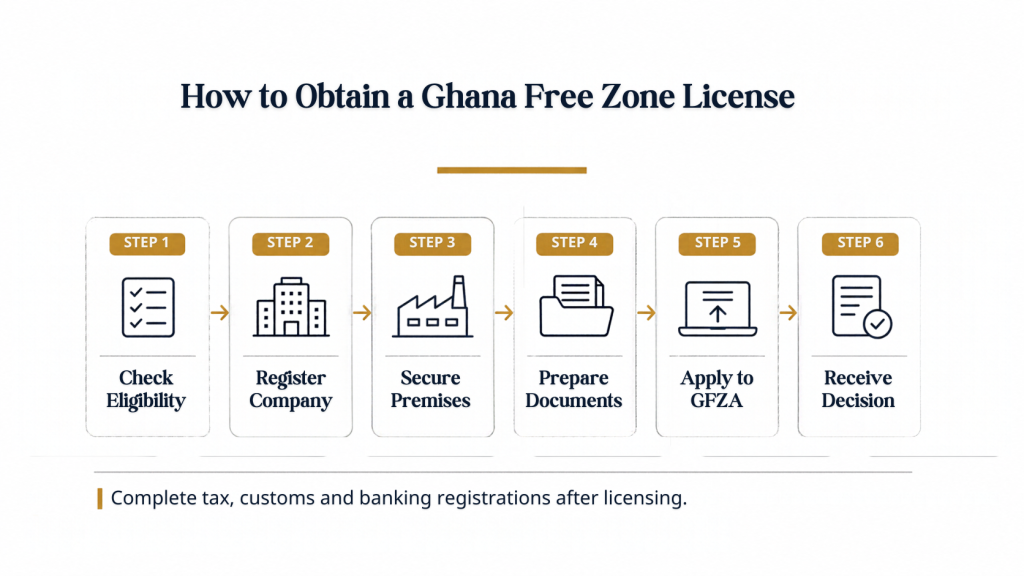
How to Obtain a Ghana Free Zone License: Step-by-Step Process
The entire process can be split into two stages: incorporation of the Ghana-based business and GFZA approval.
Ensure your activity is appropriate: Ensure that the 70% export requirement for output is realistic for you and that, based on the 2026 changes, your activity is licensed by the GFZA.
Set up a Ghanaian firm: Set up a limited liability firm with the Registrar of Companies. If you have foreign investors, register your investments with the Ghana Investment Promotion Authority (GIPA).
Secure premises and permits: Sign a lease for the land or factory. Obtain an EPA permit for your activity if it requires one.
Buy the form and make your file: GFZA form will cost you US$260, either through the internet or the GFZA offices. Put your business plan, evidence of exports and evidence of funding in there.
Step to submit the application: When your form and documents reach the GFZA, they issue an invoice for the statutory charges.
Wait for the Decision: As per the GFZA, they will inform you about the decision on your application within 28 working days from the date of receipt of the completed application. However, the missing documents start the clock all over again practically speaking.
Licence received, now get started: Your licence identifies your permitted activity (developer, manufacturer, service, or commercial). You have to begin operations within six months after receiving your licence.
Set up your post-licence operations: Register for tax with the GRA, set up customs procedures for duty-free imports, and open your business bank account.
Banks will run full corporate KYC on the company and its owners, so it helps to understand what corporate KYC involves before you apply.
Realistically, budget for a few months from incorporation to a working licence. The 28-working-day period covers only the GFZA review, not company registration, premises or permits.
Read this guide: Ghana Company Formation for Foreigners in 2026.
Tax Benefits of a Ghana Free Zone Company
The headline benefit is a 10-year corporate income tax holiday. The details matter just as much, especially what happens in year 11.
Corporate Income Tax Holiday
Licensed free zone developers and enterprises pay no income tax on profits for their first ten years of operation.
Tax After the 10-Year Holiday
After the holiday, the Income Tax Act, 2015 (Act 896) applies:
- 15% on income from exports outside Ghana’s customs territory
- 25% on income from sales in the domestic market
You may see an 8% figure quoted, including on the GFZA’s own FAQ page. Do not build your projections on it.
In January 2024, Ghana’s Court of Appeal (Blue Sky Products v Commissioner-General, GRA) upheld the 15% post-holiday rate for a free zone enterprise. Plan on 15% for exports from year 11.
Customs Duty and Other Incentives
- Exemption from import duties and levies on inputs used for production, and on exports
- No import licensing requirements and minimal customs formalities
- Total exemption from withholding tax on dividends from the free zone investment
- No restrictions on repatriating dividends, net profits, foreign loan payments or sale proceeds
- Foreign currency accounts with Ghanaian banks are permitted
- Guarantees against nationalisation and expropriation
Under the 2026 proposals, duty exemptions would be limited to qualifying raw materials, and imported raw materials would need to be used within 12 months.
What a Free Zone Company Still Pays
The licence is not a blanket exemption. Free zone companies still pay property tax and follow normal Ghanaian labour law. Goods sold into the local market attract customs duties and taxes, and domestic sales are not automatically VAT-free.
Read this guide: Ghana Company Tax Guide in 2026.
Ghana Free Zone Company vs Regular Ghana Company
If you will sell mostly inside Ghana, a regular company registered with the GIPA is usually the better fit. Here is how the two compare:
Factor | Free Zone (GFZA) | Regular (GIPA) |
Foreign ownership | 100% allowed | 100% in most sectors |
Minimum capital | No fixed minimum | None generally; $500K for trading |
Corporate tax | 0% for 10 years; then 15%–25% | Usually 25% |
Export requirement | Minimum 70% | None |
Local sales | Up to 30%, approval required | No free zone limit |
Dividend tax | Exempt | Generally applies |
Best for | Export businesses | Local businesses |
For groups with companies in several countries, the free zone decision should sit inside a wider international tax planning review. That way, the Ghana savings are not offset by tax at the parent level.
Free Zone or Regular Company? Choose the Right Structure.
The right company structure depends on your business activity, export plans and tax obligations. Speak with Vorx Consultancy to evaluate your options.
Ongoing Compliance Requirements for Free Zone Companies
Getting the licence is the start. To keep it and its benefits, you will need to:
Renew the licence every year and pay the renewal fee for your category.
Track exports against production: Your export records, customs declarations and tax returns must agree. This is how the 70% rule is checked.
Get approval before selling locally, and pay the duties and taxes on those sales.
Keep separate accounts for export and domestic income. After year 10, they are taxed at different rates.
Meet requirements of customs regulations regarding imports of input, especially the proposed 12-month period of usage of raw material.
Keep updated on your paperwork with the GRA, SSNIT and others. Tax holiday does not absolve you from your responsibilities.
If you already manage entities in several countries, a single global compliance plan keeps these deadlines from slipping.
Read this guide: Ghana Company Compliance Requirements in 2026.
How Vorx Consultancy Can Help with Ghana Free Zone Licensing
Vorx Consultancy supports international founders, including Indian businesses expanding into West Africa, through the whole set-up. That includes:
- Checking whether the free zone or a regular GIPA company suits your business model
- Ghana company incorporation and GIPA registration
- Preparing the GFZA application file, business plan and export evidence
- Tax structuring between Ghana and your home country
- Business bank account support and ongoing compliance
Approval decisions rest with the GFZA and other authorities. Our role is to make sure your application is complete, accurate and well presented.
Final Thoughts
One of the best tax-efficient methods of running an export-oriented business in West Africa is through a Ghana Free Zone License.
This will be very effective for manufacturers who can export at least 70% of their production. By the year 2026, it would be advisable to check your license category with the GFZA before applying and to expect 15% tax after year 11.
Planning to Obtain a Ghana Free Zone License?
Vorx Consultancy supports foreign investors with Ghana company incorporation, GFZA application preparation and ongoing compliance.
