

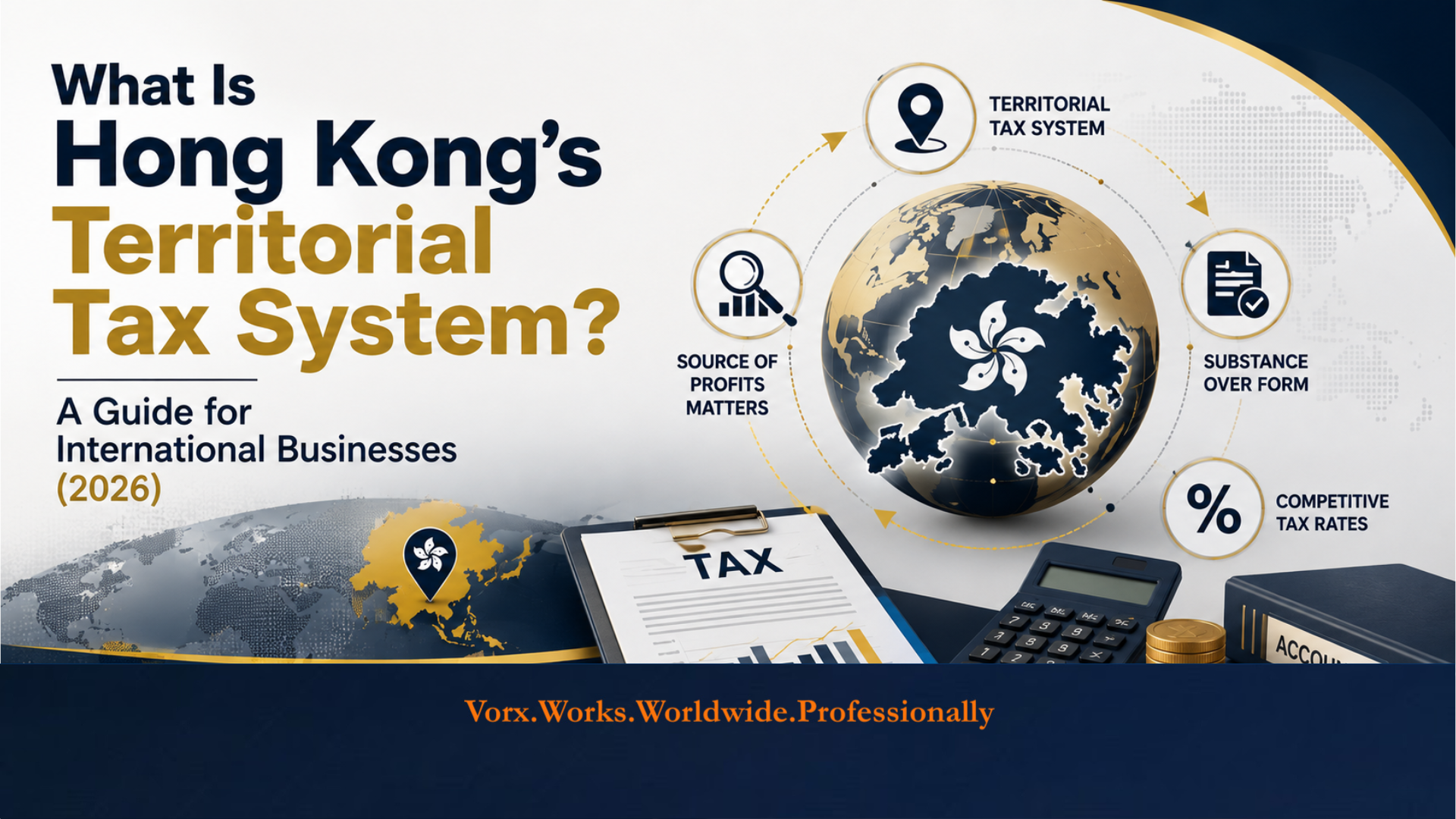
Understanding what the Hong Kong territorial tax system is important for entrepreneurs who want to operate a company in Hong Kong while serving customers across different countries. Unlike jurisdictions that generally tax residents on worldwide income, Hong Kong follows a territorial taxation approach, meaning the focus is primarily on whether income or profits arise in or are derived from Hong Kong.
For international businesses, this can make the Hong Kong tax system 2026 particularly interesting. However, simply having an overseas customer, foreign bank account, or company registered in Hong Kong does not automatically make business profits taxable or non-taxable. The source of profits and the activities that generated those profits matter.
This guide explains how Hong Kong territorial taxation works, current tax rates, offshore profits, the FSIE regime, and what the system means for Indian entrepreneurs.
What Is Hong Kong’s Territorial Tax System?
Hong Kong operates on a territorial source principle. In simple terms, Hong Kong generally taxes profits that arise in or are derived from Hong Kong, rather than taxing every profit earned by a Hong Kong company worldwide. This distinction is important because a Hong Kong-incorporated company can conduct international business and potentially earn profits that are not regarded as Hong Kong-sourced.
For example, imagine an Indian entrepreneur sets up a Hong Kong company and sells software to customers in the UK. If the key activities that generate those profits are carried out in Hong Kong, the profits may be treated as Hong Kong-sourced and subject to Hong Kong Profits Tax. But if the profit-generating activities are genuinely carried out outside Hong Kong, the position may be different.
So, having a Hong Kong company with overseas customers does not automatically mean the profits are offshore. The actual business activities, contracts, people and operations behind the income are important when determining the Hong Kong source of profits.
In simple terms, Hong Kong asks: “Where did this profit actually come from?” That source-based approach is what makes its tax system different from a system that broadly taxes worldwide income.
How Does the Territorial Tax System Work in Hong Kong?
The system is easier to understand if you separate where a company is incorporated from where it earns its profits. For example, imagine an entrepreneur establishes a Hong Kong company but performs the key profit-generating activities entirely outside Hong Kong. The resulting profits may require a source analysis rather than automatically being treated as Hong Kong taxable profits.
On the other hand, if the important operations, negotiations, sales activities or services that generate the profit are carried out in Hong Kong, the profits may be considered Hong Kong-sourced. In practice, businesses should look at:
- Where the core income-generating activities occur.
- Where contracts are negotiated and executed.
- Where employees or agents perform important functions.
- Where business operations are actually managed.
- The nature of the specific transaction.
The source test is therefore based on substance and facts, not simply the address printed on a certificate of incorporation.
Recommended Reading:
If you are planning to establish a business in Hong Kong, it is equally important to understand the steps involved in setting up a Hong Kong company before deciding on your structure.
What Are the Hong Kong Tax Rates in 2026?
For corporations, Hong Kong tax rates 2026 remain relatively competitive compared with many major international business centres.
The standard Hong Kong Profits Tax rate for corporations is 16.5%. A two-tiered regime can provide a lower rate of 8.25% on the first HK$2 million of assessable profits for qualifying taxpayers, subject to the applicable conditions.
Taxpayer / Profits | Applicable Profits Tax Rate |
Corporations — first HK$2 million of qualifying assessable profits | 8.25% |
Corporations — remaining assessable profits | 16.5% |
Standard corporate Profits Tax rate | 16.5% |
Unincorporated businesses — first HK$2 million of qualifying assessable profits | 7.5% |
Unincorporated businesses — remaining assessable profits | 15% |
The Hong Kong Profits Tax rate 2026 should always be considered alongside the nature and source of the income, available reliefs, and the business’s specific circumstances.
Which Business Profits Can Become Taxable in Hong Kong?
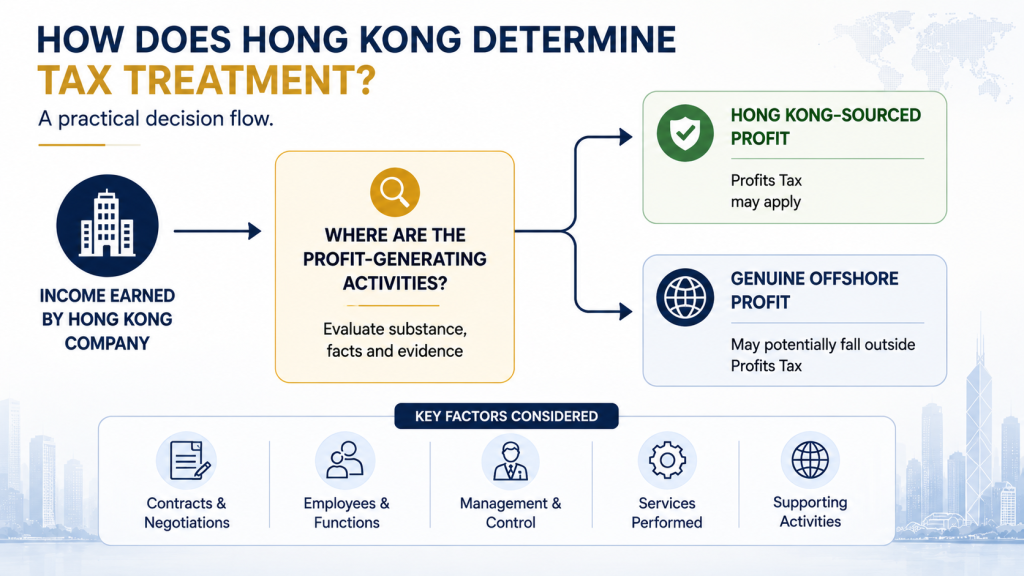
A Hong Kong business can generally be subject to Profits Tax when it carries on a trade, profession or business and earns profits that arise in or are derived from Hong Kong. The tax position is mainly determined by the nature of the business, the profit earned and its source.
- Business Activity:
The actual trade, profession or business being carried out is considered. Simply registering a company in Hong Kong does not, by itself, make all of its profits taxable. - Assessable Profits:
Profits Tax is generally calculated on assessable profits, rather than the company’s total sales or revenue. Allowable business expenses may therefore be relevant when determining the taxable amount. - Source of Profit:
The main question is where the activities that generated the profit actually took place. This is why the Hong Kong source of profits is a key concept for businesses with international operations.
In simple terms, Hong Kong looks at what the business does, what profit it earns, and where that profit comes from before determining whether Profits Tax applies.
How Does Hong Kong Tax Apply to Different Business Situations?
Real-world examples make the territorial system easier to understand.
Business Situation | General Tax Consideration |
Hong Kong company sells products through operations carried out in Hong Kong | Profits may be Hong Kong-sourced and subject to Profits Tax |
Hong Kong company provides services mainly through staff operating in Hong Kong | Hong Kong source considerations are likely to be significant |
Hong Kong company has overseas customers but key profit-generating activities occur in Hong Kong | Overseas customers alone do not make profits offshore |
Hong Kong company conducts relevant profit-generating activities entirely outside Hong Kong | Profits may potentially qualify as offshore, depending on the facts |
Company has a Hong Kong office but substantive activities generating a particular profit occur overseas | The specific facts and activities must be examined |
Company receives foreign-sourced passive income | FSIE rules may become relevant depending on the income type and circumstances |
The important takeaway is that customer location is only one part of the analysis.
How Does Hong Kong Decide Where a Business Profit Comes From?
The IRD generally looks at the operations that produced the profit. This is why the Hong Kong territorial source principle should not be confused with a simple “customer location” test.
For trading businesses, the place where purchase and sale operations are carried out can be particularly important. For service businesses, the activities performed to generate the service income can matter significantly. A company should therefore maintain clear evidence showing:
- Where negotiations took place.
- Where contracts were handled.
- Where services were performed.
- Where employees carried out relevant functions.
- Where key business. decisions were made.
- Where supporting commercial activities occurred.
A well-documented operating model can make the tax position easier to assess.
Does Having Overseas Customers Automatically Make Profits Offshore?
No, this is one of the most common misconceptions about Hong Kong taxation. A Hong Kong company might have customers in the United States, United Kingdom, India or Europe, but that alone does not establish that the profits are offshore.
For example, suppose a Hong Kong company sells consulting services to clients in the UK, but its consultants perform the core work from Hong Kong. The fact that the customer is in the UK does not automatically mean the resulting profit is foreign-sourced.
The source analysis focuses on the activities generating the profit. So, if you’re asking if Hong Kong taxes foreign income, the answer depends heavily on the nature and source of that income and, for certain foreign-sourced passive income, additional FSIE rules.
How Are Profits Earned Outside Hong Kong Generally Treated?
Genuine Hong Kong offshore profits may generally fall outside Hong Kong Profits Tax where they are not regarded as arising in or derived from Hong Kong. However, businesses should avoid treating “offshore” as a label that can simply be selected on a tax return.
The underlying facts need to support the position. This means businesses claiming offshore treatment should be prepared to explain how and where the relevant profit-generating activities occurred.
Also, foreign-sourced income can be affected by the Hong Kong FSIE regime, particularly where the income falls within the types covered by the regime and the relevant conditions are not satisfied.
What Is the FSIE Regime and Why Does It Matter?
The Hong Kong FSIE regime refers to Hong Kong’s foreign-sourced income rules covering certain types of income received in Hong Kong.
The regime is particularly relevant to multinational enterprise groups and certain foreign-sourced passive income. Depending on the circumstances, the rules can cover:
- Interest
- Income from intellectual property
- Dividends
- Disposal gains from equity interests
The treatment can depend on factors such as economic substance, participation requirements and nexus requirements, depending on the type of income involved. This means that the traditional idea that Hong Kong offshore income tax is always zero is too simplistic.
Businesses receiving foreign-sourced income should assess whether the FSIE rules apply before assuming that the income is outside the Hong Kong tax net.
What Other Taxes Should Businesses Know About in Hong Kong?
Profits Tax is not the only tax consideration for an international business. Depending on the business model, companies may also need to consider:
- Salaries Tax: Relevant to employment income arising in Hong Kong.
- Stamp Duty: May apply to certain transactions involving Hong Kong shares or immovable property.
- Property Tax: Relevant to certain rental income from Hong Kong properties.
- Withholding considerations: Hong Kong generally does not impose broad withholding taxes on dividends and interest, although specific payments and arrangements should be reviewed.
- VAT/GST: Hong Kong does not operate a conventional VAT or GST system.
The exact tax obligations depend on what the company actually does and the assets or transactions involved.
Recommended Reading:
Setting up a Hong Kong company is only the beginning; entrepreneurs should also understand the ongoing compliance requirements that keep the company in good standing.
What Does Hong Kong Tax Mean for Indian Entrepreneurs?
For Indian entrepreneurs, the biggest point is that setting up a company in Hong Kong does not automatically mean every international profit will be taxed there or automatically remain outside tax. An Indian founder should look at the complete structure. For example, before pursuing Hong Kong company formation from India, should consider:
Business substance:
Where will the actual business activities happen?
Management and control:
Who will make important business decisions and from where?
India-side tax exposure:
Indian tax rules, including foreign income and residency-related provisions, may still need to be considered.
FEMA and overseas investment rules:
An Indian resident investing in or establishing an overseas business may have India-side regulatory requirements.
Transfer pricing and related-party transactions:
Transactions between connected entities should be structured and documented carefully.
Banking and compliance:
A Hong Kong company still needs proper corporate records, accounting and statutory compliance.
For Indian entrepreneurs, the objective should not simply be “pay less tax.” A sustainable structure should have a genuine commercial purpose, appropriate substance and clear documentation.
Why Is Hong Kong’s Tax System Attractive for International Businesses?
Hong Kong remains attractive because its tax framework is relatively straightforward and commercially oriented. Some of its key advantages include:
- Territorial taxation: The focus is generally on profits arising in or derived from Hong Kong.
- Competitive rates: The standard corporate Profits Tax rate is 16.5%.
- No conventional VAT/GST: This can simplify certain business models.
- International financial centre: Hong Kong provides access to major financial and commercial networks.
- Strong legal framework: Its common-law-based commercial environment is familiar to many international businesses.
- Gateway to Asia: Businesses can use Hong Kong as part of a wider Asia-Pacific strategy.
However, the tax benefit should always be evaluated alongside substance, compliance, banking, reporting and the entrepreneur’s home-country tax position.
Recommended Reading:
Beyond its territorial tax approach, Hong Kong also offers several practical advantages for international businesses, from its strategic location to its established financial ecosystem. Explore the key benefits of doing business in Hong Kong in 2026.
How Can Vorx Help With Your Hong Kong Business Setup?
Setting up a Hong Kong company involves more than completing the registration process. Choosing the right structure, understanding the tax position, arranging banking and keeping up with ongoing compliance can all affect how smoothly the business operates.
Vorx Consultancy helps entrepreneurs manage these key areas under one setup strategy. From Hong Kong company formation and corporate structuring to banking assistance, tax planning and compliance support, we help you build a structure that fits your business goals and international operations.
For entrepreneurs, Vorx can also help connect the Hong Kong setup with the wider requirements of running an international business, so the focus is not only on incorporation but on building a practical and sustainable business structure.
Planning to do business in Hong Kong? Let Vorx help you build the right structure, stay compliant, and expand with confidence.
Book a Strategy Call: (Calendly Link)
Visit: www.vorxcon.com
Email: support@vorxcon.com
Final Thoughts
So, what is Hong Kong’s territorial tax system in practical terms? It is a source-based taxation framework where the key question is generally where the profits arise from, rather than simply where the company is incorporated or where its customers are located.
For international businesses, this can create an efficient and flexible tax environment. But offshore treatment is not automatic, and the Hong Kong source of profits needs to be assessed based on the actual business activities. The introduction of the Hong Kong FSIE regime also means businesses receiving certain foreign-sourced passive income need to look beyond the traditional territorial-tax explanation.
For Indian entrepreneurs considering Hong Kong company formation from India, the right approach is to evaluate the Hong Kong structure together with India-side tax, regulatory, substance and compliance requirements. A well-planned international structure should be commercially practical first and tax-efficient second.
