
If you are running a company in Hong Kong, being able to answer the question of what significant controllers register in Hong Kong is critical. This is because SCR Hong Kong, also known as the Significant Controllers Register, is a corporate register that officially determines who or what is the significant controller of a company.
The new significant controllers register Hong Kong, also known as the SCR, was introduced to Hong Kong on 1 March 2018. Its main purpose is to improve transparency and make Hong Kong’s Companies Ordinance relevant and comparable to international regulations. Therefore, when incorporated in Hong Kong, all companies are obliged to identify their significant controllers and maintain the controllers register Hong Kong up to date.
As an incorporated company owner, there is essential information about the significant controllers register Hong Kong that you should know. Firstly, an SCR is not something that is prepared when a company is being incorporated, and it requires maintenance on an ongoing basis.
This guide will discuss what a significant controller register Hong Kong is, who should maintain it, who falls under the significant controller in Hong Kong, and how to maintain the controllers register Hong Kong.
What Is a Significant Controllers Register?
A Significant Controllers Register is a register maintained by a Hong Kong company containing information about its significant controllers. The purpose is to provide a clearer picture of who ultimately owns or controls the company. Under Hong Kong’s SCR requirements, companies must take reasonable steps to identify significant controllers, obtain the required particulars, enter them into the SCR and keep the information current.
The SCR does not normally need to be filed with the Companies Registry as part of the company’s routine incorporation documents. Instead, it must be maintained by the company and made available for inspection by relevant law enforcement officers when required.
This makes the register an important part of Hong Kong corporate transparency and beneficial ownership compliance.
Which Hong Kong Companies Need an SCR?
The SCR requirement generally applies to companies formed and registered under the Companies Ordinance or a former Companies Ordinance, as well as re-domiciled companies. This includes companies limited by shares, companies limited by guarantee and unlimited companies. Companies listed on the Stock Exchange of Hong Kong are exempt.
A common misconception is that only large businesses need an SCR. In reality, the requirement can apply to ordinary private companies as well. Therefore, a newly incorporated Hong Kong private company should consider its SCR obligations as part of its wider Hong Kong company compliance requirements from the beginning.
Recommended Reading:
If you are comparing Hong Kong as a base for international operations, it is also useful to understand the wider business advantages of Hong Kong beyond company formation and compliance.
Who Is a Significant Controller?
A significant controller Hong Kong company must identify is not necessarily limited to the person whose name appears directly on the company’s shareholder register. A person can have significant control when one or more statutory conditions are met. These include:
- Holding, directly or indirectly, more than 25% of the issued shares.
- Holding, directly or indirectly, more than 25% of the voting rights.
- Having the right to appoint or remove a majority of the board of directors.
- Having the right to exercise, or actually exercising, significant influence or control over the company.
- Having significant influence or control over a trust or non-legal-person firm whose trustees or members satisfy relevant control conditions.
This is why simply checking the immediate shareholder list may not always be enough.
How Do You Identify a Significant Controller?
Identifying a controller can be straightforward for a company owned directly by one or two individuals. It can become more complicated where ownership passes through several companies, trusts, nominee arrangements or different classes of shares. The Companies Registry expects companies to take reasonable steps to identify their significant controllers. This can involve reviewing the register of members, articles of association, statement of capital, shareholder agreements and other relevant documents.
For example, suppose Company A is a Hong Kong company owned by Company B. If Company B is ultimately owned or controlled by an individual, Company A should trace the ownership through Company B to find the person who actually controls the company. If that individual meets the required control conditions, they may need to be recorded as a significant controller of Company A.
The key principle behind significant controller identification Hong Kong rules is to look beyond the immediate structure and understand who actually holds significant ownership or control.
What Is a Designated Representative for SCR?
A SCR designated representative Hong Kong company must be responsible for assisting a law enforcement officer in relation to the company’s SCR. The designated representative must generally be one of the following:
- A Hong Kong-resident natural person who is a member, director or employee of the company; or
- An accounting professional, legal professional or licensed trust or company service provider.
The designated representative is therefore not simply an administrative contact. The role forms part of the company’s statutory SCR framework.
How to Stay SCR Compliant in Hong Kong?
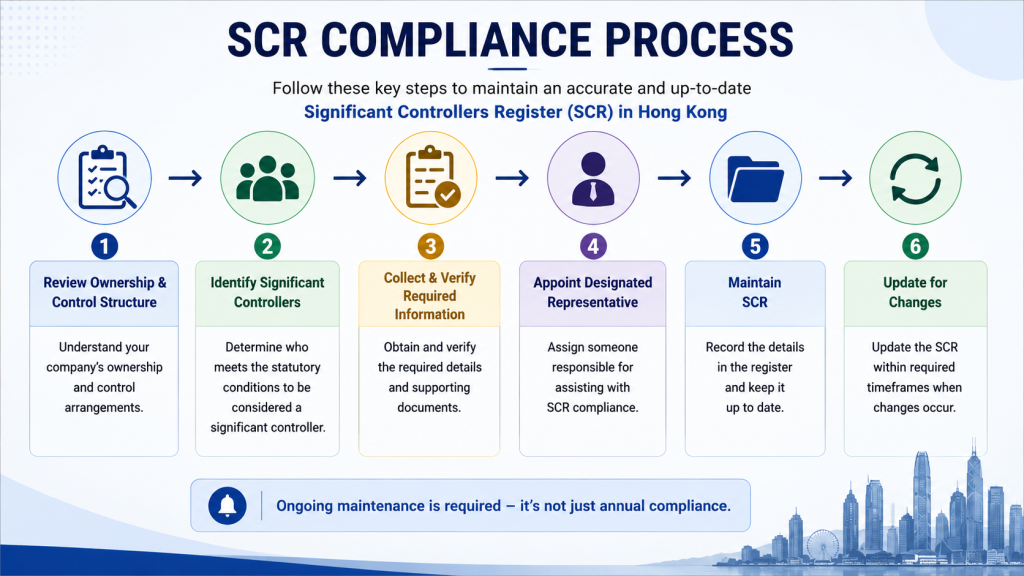
Good SCR compliance starts with identifying the correct controller and continues with keeping the information accurate. A practical compliance process can include:
- Review the company’s ownership and control structure.
- Identify direct and indirect significant controllers.
- Obtain and verify the required particulars.
- Appoint an appropriate designated representative.
- Prepare and maintain the SCR.
- Monitor ownership and control changes.
- Update the register within the applicable statutory timeframe.
- Keep relevant supporting corporate records.
- Review the SCR alongside other corporate compliance obligations.
This approach makes maintaining SCR in Hong Kong much easier to manage, especially when the company has overseas owners or a layered group structure.
What Information and Documents Must Be Included in the SCR?
The SCR must contain the required particulars of significant controllers and information relating to relevant changes. It must also include the name and contact details of the designated representative and other required matters.For a registrable natural person, the required particulars include:
- Name
- Correspondence address
- Identity card number or relevant passport details
- Date on which the person became a registrable person
- Nature of the person’s control
The company should also maintain supporting corporate records that allow it to substantiate the information recorded in the SCR. These can include shareholder records, constitutional documents, ownership structures and relevant agreements.
Importantly, an SCR should not simply be left blank. Even where the company has no registrable person or legal entity, the relevant position needs to be recorded.
Where Should the SCR Be Kept?
A company must keep its SCR at its registered office or at another place in Hong Kong. The register can be maintained in hard-copy or electronic form.
If the SCR is kept at a prescribed location other than the registered office, the company may need to notify the Registrar using Form NR2. The guideline states that notification is generally required within 15 days after the SCR is first kept at that place, subject to the applicable exceptions.
This is an important practical point for companies using a corporate secretary or professional service provider to maintain company records.
Is the Significant Controllers Register Public?
No, the SCR is not simply a public register available for anyone to inspect. The primary inspection rights concern law enforcement officers and the Companies Registry for relevant statutory purposes. A company must make its SCR available for inspection when demanded by an authorised law enforcement officer and permit copies to be made.
A significant controller whose name appears in the register also has specific rights to inspect the SCR. Therefore, the SCR should be treated as a statutory corporate record rather than a document that companies publicly publish online.
What Are the SCR Deadlines for 2026?
SCR compliance in Hong Kong does not work around one fixed annual filing date. Instead, the relevant deadline usually starts when the company identifies a significant controller, receives the required information, or becomes aware of a change that affects the register.
Situation | Practical Timeline | What to Do |
A potential significant controller is identified | Start the process promptly | Check the ownership and control structure and issue the required notice where necessary. |
Required details of a significant controller are confirmed | Within 7 days | Record the confirmed information in the SCR. |
Information already recorded in the SCR changes | Within the applicable 7-day period | Update the affected entry rather than waiting for the next annual compliance cycle. |
SCR is kept somewhere other than the registered office | Within 15 days where notification is required | Notify the Companies Registry using the appropriate form. |
No ownership or control change occurs | Ongoing | Continue maintaining the SCR and ensure existing information remains accurate. |
don’t treat the SCR as a document that needs attention only once a year. If ownership, voting rights, control arrangements or a controller’s recorded details change, the company should check whether its SCR needs to be updated.
How Often Should a Hong Kong Company Review Its SCR?
There is no simple rule saying that every company must perform a formal SCR review every month or quarter. Instead, the register must remain accurate and up to date. Companies should review their SCR whenever circumstances may affect significant control, including:
- Share transfers or changes in ownership.
- Changes in voting rights.
- Changes to board appointment rights.
- Changes in a controller’s personal particulars.
- Corporate restructuring or changes in an ownership chain.
- A person becoming or ceasing to be a significant controller.
The Companies Registry specifically requires the company to update the SCR when circumstances change and information previously entered becomes incorrect.
Recommended Reading:
If you are based outside Hong Kong and considering incorporation, you may also want to read our guide on opening a Hong Kong company remotely and understand what the process involves for non-resident founders.
What Happens If Your SCR Is Not Updated? Penalties and Consequences
Keeping the Significant Controllers Register accurate is an ongoing responsibility. If a company fails to identify a significant controller, record the required information, or update the SCR when circumstances change, it can lead to SCR non-compliance and statutory penalties.
What Are the Penalties for SCR Non-Compliance?
The Hong Kong Companies Ordinance provides penalties for failures relating to SCR obligations. The main financial consequences can be summarised as follows:
Non-Compliance | Potential Penalty |
Failure to comply with relevant SCR obligations | HK$25,000 fine |
Continuing offence after conviction | HK$700 per day while the offence continues |
Providing materially false, misleading or deceptive information knowingly or recklessly | More serious penalties may apply, depending on the offence |
The exact liability can depend on the specific SCR obligation that has been breached and the circumstances of the case.
What Are the Other Consequences?
Beyond the financial penalty, an outdated SCR can create practical compliance problems.
- Additional compliance work: The company may need to investigate and correct incomplete or outdated records.
- Regulatory attention: Failure to maintain the SCR can attract scrutiny from the relevant authorities.
- Ownership transparency issues: An inaccurate register may make it harder to establish who actually controls the company.
- Greater risk for complex structures: Foreign-owned companies and businesses with layered ownership can face additional difficulty when tracing control.
- Responsible persons may be affected: SCR duties can create obligations not only for the company but also for relevant responsible persons.
The practical lesson is simple: don’t wait for an annual compliance cycle to update the SCR. If ownership, control, or relevant particulars change, check the register and take the required action within the applicable timeframe.
Need help with Hong Kong SCR compliance? Let Vorx Consultancy help you.
Book a Strategy Call: (Calendly Link)
Visit: www.vorxcon.com
Email: support@vorxcon.com
SCR Compliance for Foreign-Owned Hong Kong Companies
Foreign ownership does not automatically remove a Hong Kong-incorporated company from SCR obligations.
For businesses with overseas shareholders, the main challenge is often tracing the ownership and control structure across jurisdictions. A Hong Kong company may need to investigate whether a person exercises significant control through an overseas legal entity. The Companies Registry FAQ confirms that where a registrable legal entity is an overseas company, the company must investigate further to identify whether an individual has significant control through that overseas company.
This makes SCR for foreign-owned Hong Kong companies particularly relevant for international entrepreneurs, holding companies and multinational group structures.
SCR vs Other Hong Kong Compliance Requirements
Compliance Requirement | Main Purpose | Typical Focus |
Significant Controllers Register | Identify significant ownership/control | Controllers and beneficial ownership |
Annual Return | Update statutory company information | Company particulars and annual filing |
Register of Members | Record company ownership | Shareholders and shareholdings |
Register of Directors | Record management | Directors |
Accounting Records | Maintain financial records | Transactions and financial information |
Tax Compliance | Meet tax obligations | Profits tax and relevant filings |
Understanding these differences helps businesses build a complete Hong Kong corporate compliance 2026 plan instead of focusing only on one statutory register.
Recommended Reading:
If you are also evaluating the tax side of operating a Hong Kong company, our guide to the Hong Kong territorial tax system explains how Hong Kong taxes business profits and what international entrepreneurs should understand about the system.
How Vorx Helps You Stay SCR Compliant in Hong Kong?
Managing SCR obligations can become complicated when ownership structures cross multiple countries or when directors and shareholders are based outside Hong Kong.
Vorx Consultancy can support businesses with SCR compliance services Hong Kong, helping founders understand their obligations, review ownership and control structures, organise required information and maintain their wider corporate compliance framework.
For foreign entrepreneurs, the benefit is not simply preparing a register. It is having a structured process for keeping the company’s corporate records aligned with its actual ownership and control position.
Need help with Hong Kong SCR compliance? Let Vorx Consultancy help you.
Book a Strategy Call: (Calendly Link)
Visit: www.vorxcon.com
Email: support@vorxcon.com
Final Thoughts
Understanding significant controllers register Hong Kong means understanding more than just a statutory register. The SCR is part of Hong Kong’s broader framework for corporate transparency and beneficial ownership. For most applicable Hong Kong companies, the responsibilities include identifying significant controllers, maintaining the required particulars, appointing a designated representative, keeping the register in Hong Kong and updating it when circumstances change.
For companies with straightforward ownership, SCR compliance can be relatively manageable. For foreign-owned businesses, multi-layered corporate groups and structures involving trusts or indirect ownership, the identification process can require much more careful analysis.
The safest approach is to treat the SCR as an ongoing compliance responsibility, not a document that is prepared once and forgotten. When ownership, control or relevant particulars change, the company should reassess its position and update its records within the applicable timeframe.
