

Should you decide to start up a business in Central Europe, then you have to keep Hungary and Poland in mind.
Both nations belong to the European Union, both accept foreign founders, and both are positioned in the center of Europe’s supply chain networks. But they are not interchangeable.
Hungary is known for its 9% corporate tax. Poland is known for its size, talent pool and large domestic market.
This will depend on what you have for sale, who you have for customers, and what degree of compliance you are prepared to handle. Here is a straightforward comparison of the two based on the 2026 regulations.
Hungary vs Poland Company Formation: Quick Comparison
Factor | Hungary | Poland |
Business Structure | Kft (private limited company) | Sp. z o.o. (limited liability company) |
Corporate Income Tax | Flat 9%, plus up to 2% local business tax | 19% standard, 9% for small taxpayers |
VAT | 27% standard | 23% standard |
Foreign Ownership | 100% allowed | 100% allowed |
Registration Process | Through a Hungarian lawyer, filed electronically | Online (S24) or via a notary |
Local Director Requirements | Not mandatory | Not mandatory |
Corporate Banking | Strict KYC, in-person visit often expected | Strict KYC, more banking options |
Annual Compliance | CIT return and annual report by 31 May | CIT-8 by 31 March, KSeF e-invoicing |
EU Market Access | Full single-market access | Full access, plus a domestic market of nearly 38 million |
Can Foreign Entrepreneurs Register a Company in Hungary or Poland?
Yes. Both countries let foreigners, including non-EU residents, set up and fully own a company.
Foreign Ownership Rules in Hungary
It all depends on whether it is more suitable for your product, your target group, and your willingness to control the level of compliance. This is the straightforward contrast between them by the 2026 standards.
Foreign Ownership Rules in Poland
A Polish sp. z o.o. may also be 100% foreign owned. The minimum capital requirement is only PLN 5,000 (approximately €1,200). Some operations, such as acquisition of certain real estate, require additional permits; however, regular business companies have no restriction on ownership.
Do You Need a Local Director or Physical Presence?
Neither country requires a resident director. In practice, though, banks want to meet the people behind the company, and running everything from abroad can create tax residency issues back home.
Company Registration Process: Hungary vs Poland
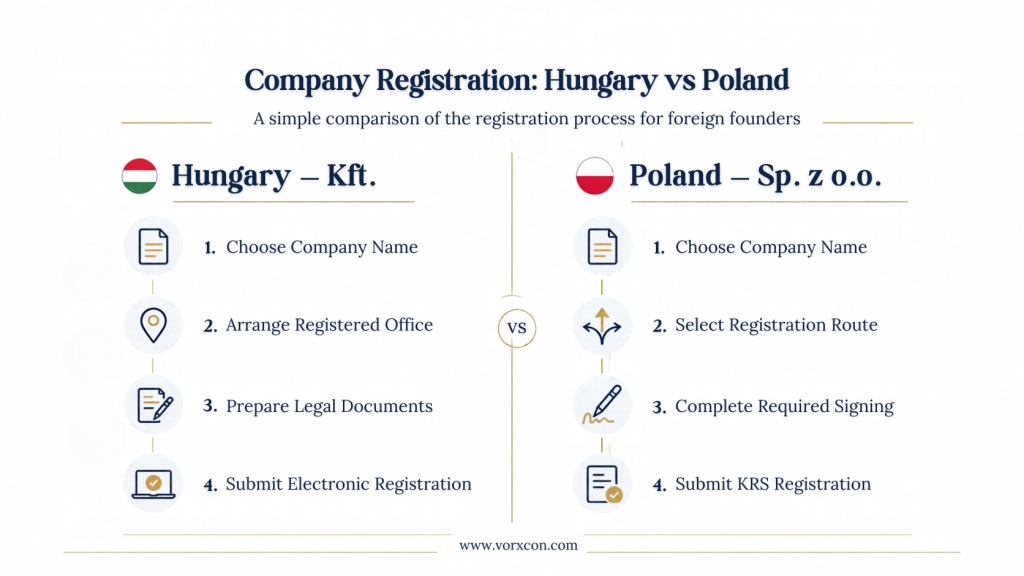
How Company Formation Works in Hungary
Name selection is done, you get the registered office sorted out, and your Hungarian lawyer then drafts and co-signs the foundation deed.
It is then submitted electronically to the Court of Registration. With the standard template deed, registration can happen in about one business day. A customised deed usually takes up to 15 business days.
Read this guide: Hungary Company Formation for Foreigners: A Complete 2026 Guide
How Company Formation Works in Poland
Poland offers two routes. S24 allows a fast and inexpensive process, but every founder must prove his or her Polish trusted profile or electronic signature, something which is rare for foreigners.
The only remaining option is to sign the documents in front of a Polish notary either in person or via a representative and then send the documents to KRS.
Read this guide: How to Register a Company in Poland: Complete 2026 Guide for Foreign Founders
Which Country Offers a Simpler Registration Process?
On paper, S24 is the quickest. For a non-resident founder without Polish e-signature tools, both countries end up being lawyer-led or notary-led processes.
Hungary’s single lawyer-driven process is often easier to manage remotely, while Poland’s lower capital requirement helps if cash flow is tight.
Hungary vs Poland Corporate Taxes: Which Is Better?
Corporate Income Tax Comparison
The corporate tax in Hungary is fixed at 9%, the lowest in the entire European Union. Besides, the local business tax rate by municipal authorities is 2%, which is based on revenues rather than profits.
Poland’s standard rate is 19%. Small taxpayers (prior-year sales up to about €2 million) and new companies can use 9%.
Poland also offers the Estonian CIT model, where tax is deferred until profits are distributed, at 10% for small taxpayers and 20% for others.
VAT and Other Business Taxes
Hungary has the highest standard VAT rate in the EU at 27%. Poland’s is 23%. For B2B companies reclaiming input VAT, this matters less. For B2C sellers, it directly affects pricing.
Dividend Tax and Cross-Border Tax Considerations
Hungary charges no withholding tax on dividends paid to foreign companies. Poland applies 19%, which can be reduced under a tax treaty or EU rules. Both countries have tax treaties with India.
Does Hungary’s 9% Corporate Tax Make It a Better Choice?
Not automatically. A small Polish company paying 9%, or reinvesting under Estonian CIT, can end up with a similar effective rate. Run the numbers for your own revenue, margins and profit plans before deciding.
Read this guide: Hungary Corporate Tax 2026 Guide
Not Sure Whether Hungary or Poland Fits Your Business?
Tax rates are only part of the decision. Vorx Consultancy helps foreign entrepreneurs evaluate company structures, tax considerations, and business requirements before expanding into Europe.
Business Banking and Remote Company Formation
Can Foreigners Register a Company Remotely?
This is definitely true in most situations, usually via an apostilled power of attorney and either a notarised or online signing with a lawyer.
Corporate Bank Account Opening Requirements
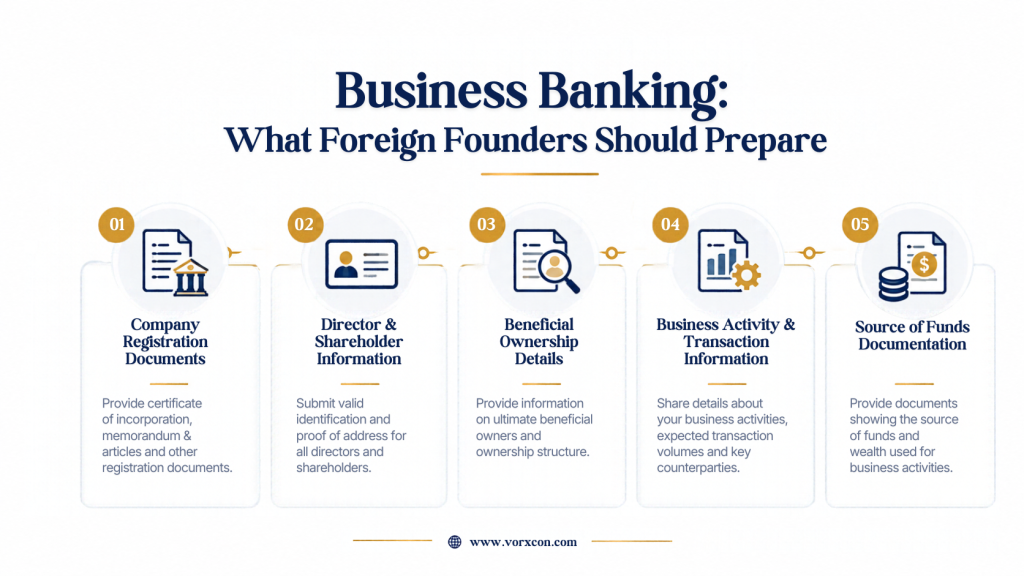
Banks typically ask for registration documents, passports and proof of address, beneficial owner details, a business plan with expected transaction flows, and source of funds documentation.
Banking Challenges for Non-Resident Entrepreneurs
This is the point where most foreign founders fail to proceed. Most banks require a physical meeting while companies without any clients or employees locally will have additional scrutiny.
Poland generally has more bank and fintech options. In Hungary, the choice is narrower.
Read this guide: How to Open a Business Bank Account in Hungary as a Foreign Entrepreneur
Annual Compliance and Reporting Requirements
Annual Accounting and Corporate Tax Filings
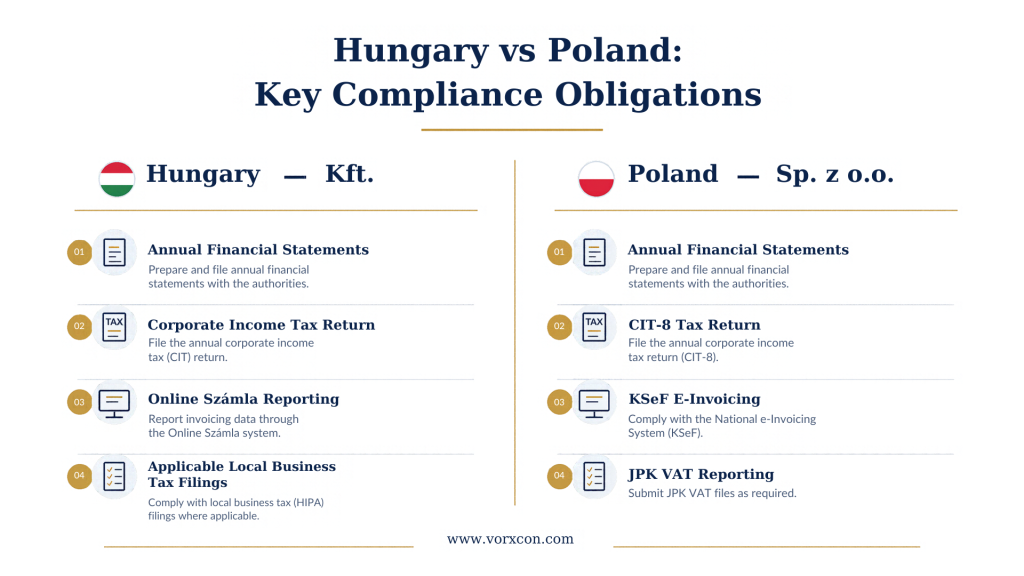
The corporate income tax return and annual financial report in Hungary are required by 31 May. In Poland, the CIT-8 is due by 31 March, while the financial statements have to be submitted within six months and filed at the KRS.
VAT Reporting and E-Invoicing Requirements
For Hungary, reporting of data related to the invoice on a real-time basis to the tax authority via Online Számla is required.
For Poland, e-invoicing was made mandatory starting from 1 February 2026 for large taxpayers and from 1 April 2026 for the majority of others and in 2027 for small businesses. In addition, there is the requirement of filing the JPK_V7 report by VAT payers on a monthly basis.
Regulatory Compliance Responsibilities for Foreign-Owned Companies
Foreign entities should ensure that the information regarding beneficial ownership is up-to-date, have documents for transfer pricing related to transactions with the parent entity, and use an authentic registered office.
Read this guide: Hungary Company Compliance Requirements 2026: Annual Filings, Tax Returns and Deadlines
Hungary vs Poland for Indian Entrepreneurs
FEMA and Overseas Direct Investment Rules
The FEMA Overseas Investment Regulations 2022 govern any investments made by an Indian resident into foreign firms.
The Indian corporates invest within their financial limits, whereas individual Indians have a liberal remittance limit of $250,000 annually through the Liberalised Remittance Scheme.
RBI Reporting and Funding Requirements
The funds will be routed through an authorized dealer bank, which is accountable to the RBI and has a Unique Identification Number for the foreign company.
After that, you have to submit the Annual Performance Report every year before 31 December.
Place of Effective Management and Indian Tax Considerations
If key decisions for your European company are effectively taken in India, it can be treated as an Indian tax resident under the POEM rules.
That brings its global income into the Indian tax net and wipes out the 9% advantage. Foreign shareholdings must also be disclosed in your Indian tax return.
Common Compliance Mistakes Indian Founders Should Avoid
- Remitting money before completing ODI paperwork with the bank
- Missing the Annual Performance Report deadline
- Running the company entirely from India with no local substance
- Not disclosing foreign assets in the Indian tax return
Planning European Expansion from India?
From company registration to FEMA, RBI, and cross-border compliance considerations, Vorx Consultancy helps Indian entrepreneurs navigate the requirements of establishing a business in Europe.
Which Country Is Better for Your Business Type?
IT and Consulting Businesses
Hungary suits profitable, low-headcount service firms that want low tax and tax-free dividends to a foreign parent.
Poland suits IT companies that need a deep developer pool, and its 5% IP Box regime can help software businesses.
E-commerce and Trading Companies
Poland usually wins here, thanks to its large consumer market, strong logistics and lower VAT. Hungary’s 27% VAT is a real drawback for local B2C sales.
Manufacturing and Logistics Businesses
Both are strong. Hungary offers generous manufacturing incentives and a large automotive base, while Poland has a bigger industrial base and major logistics corridors.
Businesses Planning to Hire Locally
Poland’s labour market is far larger, so recruitment is easier. Hungary has lower wages in many sectors, but a smaller talent pool.
Common Mistakes When Choosing Between Hungary and Poland
Choosing a country depending on corporate tax alone: Business tax, VAT, withholding tax, and home country tax influence your bottom line.
Neglecting corporate banking: Without a functioning corporate bank account, you will not be able to issue invoices or pay taxes. Plan banking ahead of incorporation.
Failing to consider that incorporation does not equal residence: Simply having a company will not provide you with a visa or residence permit. It is a different procedure altogether.
Forgetting about ongoing compliance: Bookkeeping, filings, and e-invoicing are expenses that must be considered regularly and handled by locals.
Neglecting the cross-border tax considerations: POEM, transfer pricing, and treaties may influence the ultimate tax result.
Conclusion: Hungary or Poland for Company Formation?
When Hungary May Be the Better Option
Choose Hungary if your business is profitable with a low headcount, you plan to pay dividends to a foreign parent company, and most of your sales are outside Hungary.
When Poland May Be the Better Option
If you are looking for a country where you have an opportunity to sell to a large domestic market, employ locals, be classified as a small taxpayer, or have less capital requirements, then choose Poland.
Factors to Consider Prior to Making a Decision
Consider your margins, customer location, employment plans, your exit strategy, and tax structure in your own country.
The proper decision is the one that will still make sense in year three, not just on day one.
Hungary or Poland? Make the Right Move for Your Business.
Every business has different expansion goals. Vorx Consultancy helps foreign entrepreneurs navigate company formation, registration requirements, and ongoing compliance in Europe.
Book a Company Formation Consultation
